OpenAI Lockdown Mode Review: What Gets Through
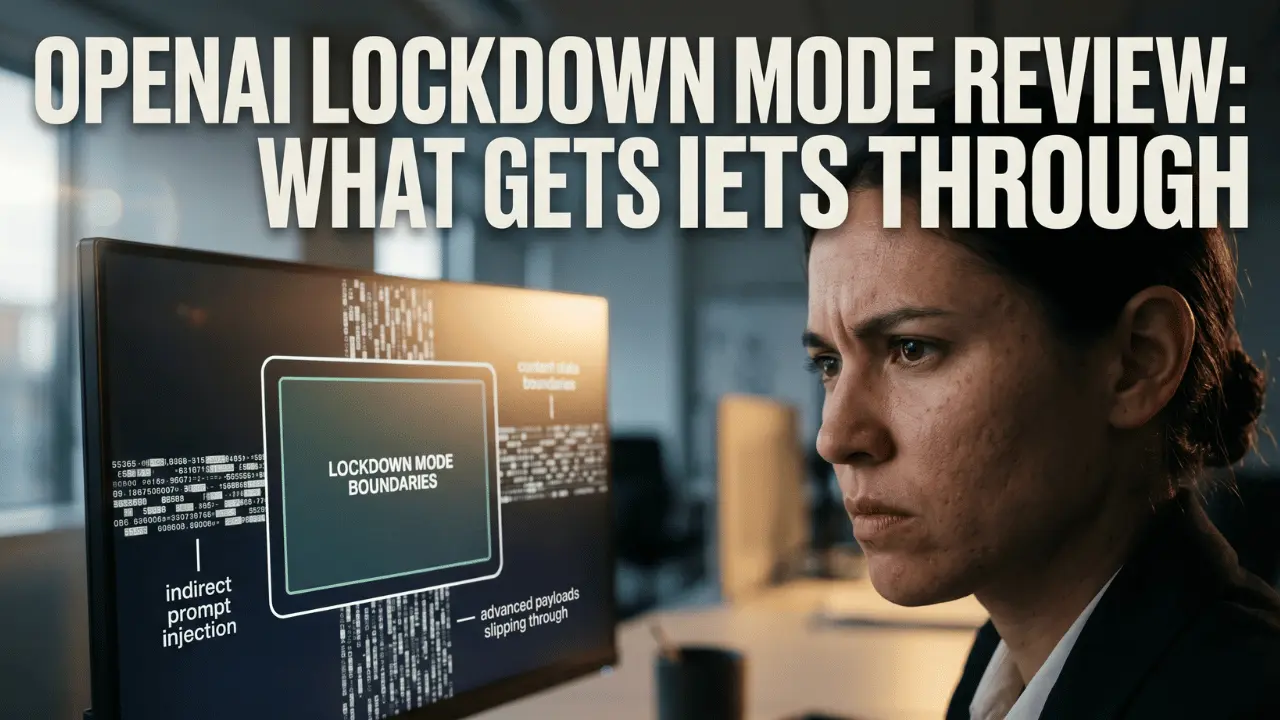
- Unpatchable Reality: OpenAI openly conceded that prompt injection vulnerabilities cannot be entirely engineered away at the model layer.
- Autonomy Trade-off: The mechanism functions by drastically narrowing agent capabilities and restricting automated tool connections.
- Evasion Is Live: Advanced indirect prompt injections and obfuscated payloads successfully bypassed the control within its first week of release.
- Compliance Value: While not an absolute shield, enabling this feature serves as a crucial defensive baseline for European regulatory frameworks.
On February 13, 2026, OpenAI shipped Lockdown Mode for ChatGPT and quietly admitted what every red team already knew: prompt injection in AI browsers may never be fully patched.
This aggressive new defense introduces strict boundaries to curb agent autonomy and reduce risk across enterprise workspaces. To see how this security capability updates the modern corporate threat landscape, read our comprehensive overview on ai agent security at the parent Pillar Page.
This technical review explores what Lockdown Mode successfully neutralizes, what sophisticated payloads still slide through, and how it impacts your actual deployment pipeline.
What Is OpenAI Lockdown Mode?
OpenAI launched Lockdown Mode on February 13, 2026, targeting ChatGPT browser interfaces and integrated agent workspaces. The release marked a turning point in how vendor platforms handle systemic security threats.
The feature was introduced as an emergency configuration to isolate execution environments when models interact with untrusted external text. Instead of attempting to magically clean incoming data tokens, it forces the AI system into a restricted operating state.
It primarily targets active browser rendering layers and automated web scanning pipelines. These are the precise surfaces where third-party information regularly mixes with core system instructions.
Does Lockdown Mode Actually Block Prompt Injection?
The short answer is no—it limits the damage rather than completely blocking the underlying exploit mechanics. The security framework functions as a containment protocol rather than a complete filter.
While Lockdown Mode reliably catches simplistic, direct command injections, it struggles against complex indirect variants. Obfuscated text hidden inside deep nested tables, style sheets, or variable structures can still manipulate the model's logic.
Once the model ingests the manipulated data, its internal reasoning layer can be redirected. If a payload uses multi-step logic shifts, the active safety classifiers often fail to flag the context swap.
The Architecture Behind 'Unpatchable' AI Vulnerabilities
LLM architectures process developer instructions and third-party data identically as numeric tokens. Because there is no hardware isolation separating code from data, any text can behave as a command.
OpenAI’s documentation acknowledges this fundamental reality. Consequently, their mitigation focuses entirely on tightening downstream runtime permissions rather than modifying the core model parsing engine.
ChatGPT Atlas Browser Integration and Enterprise Trade-offs
The security implementation directly modifies how advanced agent environments execute interactive user requests. When Lockdown Mode is enabled, the ChatGPT Atlas browser agent operates under strict constraints.
It restricts background API executions, disables multi-domain web scanning, and limits autonomous form submissions. This reduction in capabilities minimizes your exposure to cross-domain data leaks.
However, it also limits the productivity gains enterprise users expect from automated browser assistants. For enterprise PMO directors, the strategy must be risk-adjusted.
Enable the feature by default across standard administrative and business units processing external data assets. However, for developers working inside native development environments, you will need secondary controls. For a complete baseline on protecting software engineering pipelines, check out our forensic breakdown of the GitHub Copilot CVSS 9.6 vulnerability.
Comparative Safety: OpenAI vs. Anthropic and Compliance Maps
Evaluating platform capabilities requires looking at how different ecosystem providers design their integration security. OpenAI’s runtime confinement strategy yields fewer false-positive workflow interruptions than lexical filtering systems.
However, it places a higher reliance on post-execution tracking layers. By comparison, working within Anthropic's Model Context Protocol relies heavily on rigid client-side definitions to explicitly limit tool access paths from the start.
This client-side strategy offers an alternative layer of structural isolation outside the model's token parsing space.
Satisfying EU AI Act Robustness Mandates
Enabling this feature provides immediate documentation for compliance mapping. It explicitly addresses the adversarial input resilience rules defined under Article 15 of the EU AI Act.
While it does not completely eliminate risks, implementing these platform controls demonstrates systematic due diligence to regulatory auditors.
Conclusion & CTA
OpenAI’s Lockdown Mode represents a realistic shift in AI defense. By admitting that prompt injection cannot be fully patched, the industry must move away from lexical filters and lean into architectural isolation.
Enforce Lockdown Mode across your user tiers today, but continue to build independent, multi-layered defensive guardrails to secure your automated systems.

Frequently Asked Questions (FAQ)
OpenAI launched Lockdown Mode on February 13, 2026, as an advanced security feature for ChatGPT. It was designed to isolate execution layers and limit agent autonomy when processing untrusted third-party data inputs.
No, it does not completely block prompt injections. Instead, it reduces the blast radius of an attack by stripping the agent of its autonomous capabilities and blocking downstream tool execution channels.
LLMs process developer system instructions and external data data as identical semantic tokens. Because there is no architectural boundary separating instructions from data, a complete code-level patch is fundamentally impossible.
Yes, enterprise security teams should enforce it by default for general business users. The reduction in tool autonomy is an acceptable trade-off to protect corporate data from document-borne threats.
Yes, it limits agent capabilities significantly. The Atlas browser agent is blocked from executing autonomous data transfers, interacting with multiple domains, or submitting multi-step background web forms.
Within its first week, complex indirect prompt injections hidden inside obfuscated markdown tables and CSS parameters bypassed the system. These multi-step semantic payloads easily evaded the real-time input classifiers.
OpenAI focuses on runtime containment and limiting downstream tool execution. Anthropic relies heavily on strict integration specifications via protocols that isolate tool access parameters directly at the client application boundary.
Yes, users experience minor false-positive interruptions when processing complex, highly technical documents. The system's safety classifiers occasionally flag safe formatting structures as adversarial prompt injection attempts.
It helps fulfill the adversarial resilience mandates under Article 15. While it isn't an absolute shield, deploying it provides mandatory documentation verifying that your organization actively mitigates AI input risks.
OpenAI has focused the initial rollout on front-end ChatGPT browser environments. Enterprise developers building custom solutions must implement independent semantic firewalls to replicate these exact restrictions at the API layer.