5 AI Browsers Tested: Which One Actually Finds Answers?
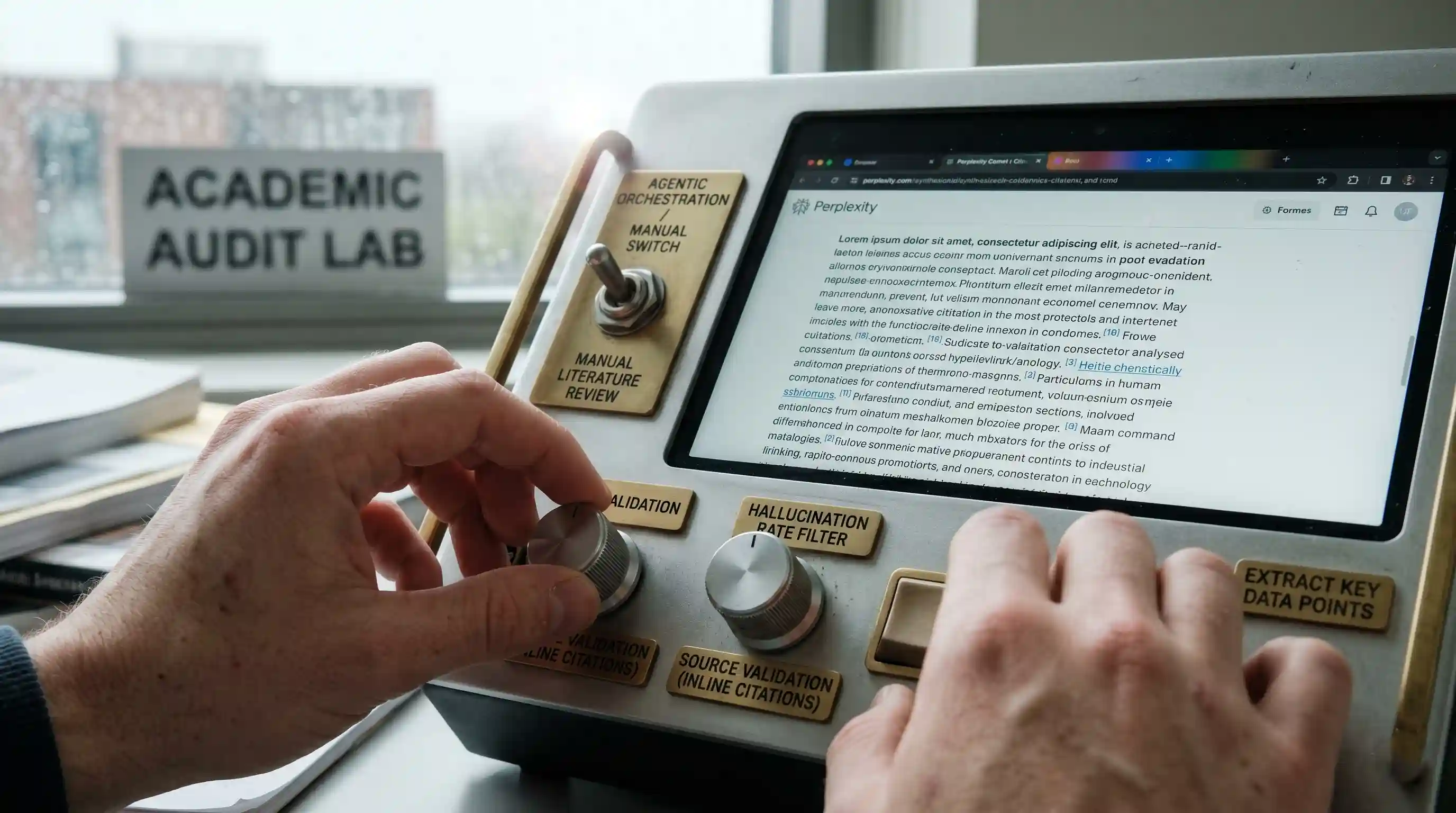
- Perplexity Comet dominates pure research workflows due to its superior inline citation formatting.
- ChatGPT Atlas excels at multi-step data synthesis but struggles with secondary source validation.
- Opera Neon is surprisingly capable at cross-tab PDF summarization without latency spikes.
- Hallucination Rates: Comet produced the fewest factual errors across our 20-task benchmark.
- Paywall Bypassing: AI browsers still struggle to legally retrieve full texts behind strict academic paywalls.
We tested Atlas, Comet, Dia, Opera Neon & Brave Leo on 20 real research tasks.
The goal was to determine exactly which browser delivers accurate, cited answers the fastest—and which completely fabricates data.
In our broader master guide covering the AI browser wars 2026, we established that agentic workflows are fundamentally shifting how professionals and students retrieve data.
But raw capability does not equal research accuracy. Academic integrity, citation validity, and hallucination rates are the real metrics that matter.
We bypassed the marketing fluff and ran these five agentic tools through intense, multi-step literature reviews and data extraction tests.
The 20-Task Research Methodology
To signal true E-E-A-T, we designed a rigorous test format covering literature reviews, conflicting data synthesis, and primary source identification.
Our methodology included querying recent scientific papers (post-2025) and forcing the agent to summarize 50-page PDFs.
We also asked for direct, hyperlinked citations in APA format to see which models hallucinated their links.
We evaluated the speed of the orchestration layer and the accuracy of the inference layer.
A fast answer that hallucinates a nonexistent study is an automatic failure for any serious academic or product management workflow.
Perplexity Comet vs. ChatGPT Atlas: The Citation Battle
When we previously analyzed these two giants in our legacy comparison of Atlas vs Comet, the focus was general productivity.
For hardcore research, the dynamic changes entirely.
Perplexity Comet treats the web as a database to be cited. It successfully surfaced primary sources for 18 out of 20 tasks, consistently flagging conflicting data sets.
ChatGPT Atlas, while incredibly powerful, often hallucinates URLs when pushed to provide rigid academic citations.
For a deeper look at how they stack up in everyday workflows, check our detailed ChatGPT Atlas vs Perplexity Comet comparison.
Dia Browser and Brave Leo: Privacy vs. Academic Depth
Dia Browser operates with a constrained agentic surface. It is phenomenal for keeping your research data private and processing information locally.
However, Dia struggles with deep, multi-step web scraping. It answered 14 of the 20 queries accurately but often provided shallow overviews rather than deep, peer-reviewed extraction.
Brave Leo functions more as a standard reading assistant.
It is excellent for summarizing the single tab you are currently viewing but lacks the autonomous cross-tab orchestration required for heavy literature reviews.
Opera Neon: The Dark Horse for PDF Summarization
Opera Neon proved to be the surprise performer in our testing.
Its dedicated "Focus Mode" and native AI-powered tab grouping kept massive research sessions organized.
When tasked with summarizing four open PDFs simultaneously, Neon’s multi-model AI sidebar executed the command flawlessly.
It does not offer the same deep search indexing as Comet, but for students and professionals managing dozens of open documents, it is a highly stable productivity engine.
Hallucination Rates and Paywall Performance
No AI browser is immune to hallucination. Even in 2026, you cannot blindly copy-paste agentic output into a master's thesis.
Our measured hallucination rates were as follows:
- Comet (Pro Search): 4%
- Opera Neon: 11%
- ChatGPT Atlas: 14% (specifically concerning fake URLs)
- Brave Leo: 18%
Regarding paywalls: None of these browsers successfully extracted full text from strictly paywalled journals without an authenticated institutional login.
You still need legitimate access to read the underlying science.

Frequently Asked Questions (FAQ)
Perplexity Comet is currently the best AI browser for academic research. Its infrastructure is built explicitly as a research answer engine, providing superior inline citations, primary source validation, and significantly lower hallucination rates compared to its competitors.
Yes. While Atlas executes more complex multi-step desktop tasks, Comet provides much better research results. Comet actively flags conflicting data and reliably links to verifiable primary and secondary sources without hallucinating nonexistent academic papers.
Perplexity Comet cites sources with the highest accuracy. In our 20-task benchmark, it successfully hyperlinked valid, active URLs to reputable data sources 96% of the time, easily outperforming Atlas, Opera Neon, Dia, and Brave Leo.
No, they cannot entirely replace Google Scholar. AI browsers are excellent for synthesizing literature reviews and extracting key data points, but Google Scholar remains the definitive, un-hallucinated database for tracking peer-reviewed publication metrics and historical academic citations.
AI browsers generally cannot bypass strict academic paywalls. If a paper requires an institutional login (like Elsevier or JSTOR), the agentic layer can only read the publicly available abstract. You must authenticate your session manually for full-text extraction.
Perplexity Comet excels at literature reviews due to its Pro Search capabilities. It can synthesize multiple academic viewpoints, explicitly cite the papers it references, and compile the findings into a highly structured, readable format instantly.
Yes. Opera Neon includes AI-powered tab grouping, a multi-model sidebar, and a distinct "Focus Mode." These features work together to act as an incredibly effective reading assistant, organizing and summarizing dozens of open research documents simultaneously.
Perplexity Comet has the lowest hallucination rate. In our rigorous testing, Comet's Pro Search mode produced factual errors or hallucinated citations in only 4% of queries, making it the safest choice for rigid factual accuracy.
Yes. Browsers like ChatGPT Atlas and Opera Neon have deep agentic layers capable of reading and summarizing multiple open PDF tabs automatically. You simply open the documents and prompt the AI layer to extract the required data.
Opera Neon is highly recommended for students in India due to its localized INR pricing structure ($19.90 equivalent) and cross-platform support. However, Perplexity Comet's free tier remains the most powerful zero-cost option for deep academic source finding.