LangChain vs. LlamaIndex: Choosing the Right Python Framework for RAG and GenAI Orchestration in India
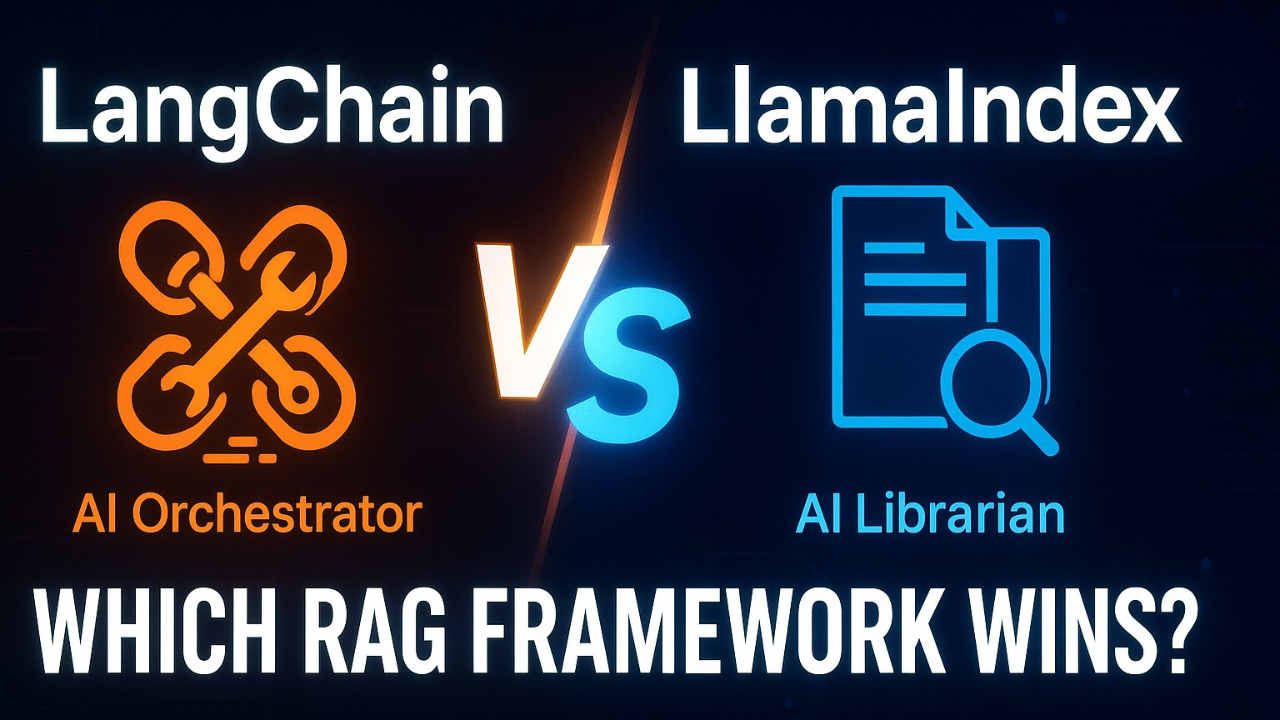
Choosing between LangChain and LlamaIndex isn't a technical preference; it's a strategic decision that defines your AI's capabilities and your project's budget. While digital transformation spending in fintech alone is projected to reach $1,009.8 billion by 2025, the wrong framework can inflate costs and derail project success. This guide moves beyond the hype in the LangChain vs LlamaIndex debate to analyze the production data and developer sentiment that should drive your choice. The core thesis is clear: this is not about a single "winner" but about selecting the right tool for a specific job, complex orchestration versus specialized data retrieval in your RAG framework.
This article is a deep dive within our central resource: The Complete AI Developer Toolkit Guide for India
1. What is a Retrieval-Augmented Generation (RAG) Framework?
At its core, a Retrieval-Augmented Generation (RAG) framework solves a fundamental LLM weakness: models are great at talking, but less great at knowing. RAG is a pattern that "fixes the gap by bringing a model the right facts at the right moment." If LLMs like GPT are the "engines," then frameworks like LangChain and LlamaIndex are the "toolkits, connectors, and glue" that allow developers to build complex applications on top of those engines. They provide the essential structure for creating context-aware chatbots, search engines, and automation workflows that can reason over proprietary, up-to-date information.
2. LangChain: The "Orchestrator" for Complex Agentic AI
LangChain is best understood as the "colorful orchestrator" or "conductor of the orchestra", a versatile framework, playfully nicknamed the "Parrot," that excels at stringing together prompts, memory, and tools into complex sequences. Its primary strength lies in building applications that require multi-step reasoning and interaction with external systems.
2.1. Philosophy: The Symphony of Chains
LangChain's purpose is to "simplify the development of applications that rely on large language models by providing abstractions and tools to build complex chains of operations." Its philosophy centers on creating flexible, reusable components that enable developers to construct intricate, multi-step workflows without coding every interaction from scratch.
2.2. Key Strengths: The Swiss Army Knife
Extensive Agent Capabilities
LangChain empowers LLMs to use external tools like search engines and APIs to make autonomous decisions. This is the "Orchestrator" in action, not just playing a single instrument (the LLM) but conducting an entire ensemble of external tools. Its agent framework is proven to handle complex financial decision trees effectively. Furthermore, its chain-of-thought reasoning provides the transparent audit trails crucial for regulatory compliance.
Sophisticated Memory Management
LangChain enables applications to maintain context across user interactions. It offers various memory types, from simple conversation buffers like ConversationBufferMemory to more advanced summary-based systems, which are critical for building coherent conversational experiences.
Massive Ecosystem
As the "Swiss Army knife" of GenAI, LangChain plugs into a vast ecosystem of tools and services. It features connectors for vector databases like Pinecone and Weaviate, LLMs from OpenAI and HuggingFace, and countless other APIs.
2.3. The Tradeoff: The Cost of Infinite Flexibility
LangChain’s immense flexibility is both a "blessing and a curse." While its power is undeniable, this flexibility introduces a well-documented friction point. The developer consensus, particularly on forums like Reddit, is that the framework has "over-abstracted steps that are relatively simple," which can "frustrate experienced devs." This can lead to increased development time and debugging complexity when building highly custom logic that fights against the framework's built-in abstractions.
3. LlamaIndex: The "Librarian" for Advanced Data Retrieval
In contrast to LangChain’s orchestration, LlamaIndex is the "calm librarian", a focused framework, or "Llama," designed to meticulously catalog, index, and retrieve information. It doesn’t try to conduct the whole symphony; instead, it ensures the right knowledge is available at the right time.
3.1. Philosophy: The Science of Retrieval
LlamaIndex is "designed specifically for efficient data indexing, retrieval, and querying." Its core mission is to connect LLMs with unstructured data, making it exceptionally easy for applications to retrieve relevant information from massive datasets. The framework is built to solve the challenge of getting an LLM to use your private data correctly and efficiently.
3.2. Key Strengths: The RAG Specialist
Superior Document Processing
LlamaIndex excels in document-heavy scenarios. In one analysis of financial services, it was found to "process regulatory filings more efficiently than LangChain" by using optimized chunking strategies that better understand financial document structures.
Advanced Indexing & Retrieval
The framework provides sophisticated indexing structures and retrieval mechanisms that go beyond simple vector search. Its famously developer-friendly API makes it simple to connect a knowledge base to an LLM with just a few lines of code using tools like SimpleDirectoryReader and VectorStoreIndex. This is the "Librarian's" core function: not just finding a book, but knowing the precise paragraph on the correct page.
Rich Data Connectors (LlamaHub)
LlamaHub acts as a "centralized repository" of prebuilt connectors for a vast array of data sources, including APIs, PDFs, documents, and databases. This significantly simplifies the process of integrating diverse data into a RAG pipeline.
3.3. The Tradeoff: The Limits of Specialization
LlamaIndex is more "opinionated" than LangChain, meaning it is less versatile outside its "sweet spot" of RAG and knowledge retrieval. While it excels at feeding an LLM the right data, its narrower scope means it isn't designed to manage the complex, multi-tool agentic workflows that are LangChain's specialty. For those capabilities, a developer might need to pull in another framework (like LangChain), adding architectural complexity to the project.
4. Performance & Cost: A Head-to-Head RAG Framework Benchmark
While developer experience is key, production performance and API costs are critical. A benchmark of five major RAG frameworks, isolating for identical models, embeddings, and tools, revealed key differences in efficiency.
| Framework | Average Tokens (Lower is Better) | Framework Overhead (ms) |
|---|---|---|
| Haystack | ~1.57k | ~5.9 ms |
| LlamaIndex | ~1.60k | ~6 ms |
| DSPy | ~2.03k | ~3.53 ms |
| LangGraph | ~2.03k | ~14 ms |
| LangChain | ~2.40k | ~10 ms |
This data confirms a critical point for enterprise deployment. In this specific test, Haystack and LlamaIndex were the most token-efficient frameworks. This technical result directly explains the cost analysis from production fintech deployments reported by SmartDev: LlamaIndex’s superior token efficiency is the reason its "caching mechanisms decrease repeated query costs significantly" in document-heavy scenarios. Conversely, LangChain's higher token usage and overhead might be a worthwhile cost for the complex, high-value agentic workflows where its advanced "token optimization can reduce LLM API costs" through intelligent context management.
5. The Hybrid Approach: Using LangChain and LlamaIndex Together
Developers do not have to make an exclusive choice. As one expert notes, "Most real-world teams use both together." The hybrid model resolves the central debate by delegating tasks to the specialist. LlamaIndex, the librarian, expertly prepares and serves the exact data needed. LangChain, the orchestrator, then takes that data and directs the complex workflow. This architectural pattern maximizes both data precision and agentic capability by leveraging the best of each framework: "Use LlamaIndex for data management... Use LangChain for orchestration."
6. Conclusion: Which LLM Development Framework Should You Choose?
The decision between LangChain and LlamaIndex comes down to your application's primary function. The right choice aligns the framework's core strengths with your project's specific needs.
| Use Case | Recommended Framework | Rationale |
|---|---|---|
| Process Orchestration & Agent Behavior | LangChain | Excels at complex multi-step financial workflows and custom tool integration. It builds the "brain". |
| Data Retrieval & Cost-Optimized RAG | LlamaIndex | Prioritizes data organization, advanced retrieval, and document-heavy compliance monitoring. It builds the "library". |
| Maximizing Precision & Capability | Hybrid Approach (Both) | Use LlamaIndex for data preparation and LangChain for overall workflow orchestration. |
Ultimately, the division is clear: LangChain builds the "brain," while LlamaIndex builds the "library." As agentic systems become more complex, the hybrid approach will likely become the industry standard, making proficiency in both frameworks a key differentiator for elite AI engineering teams.

Frequently Asked Questions (FAQs)
1. Can you use LangChain and LlamaIndex together?
Yes. A common and powerful approach is to use LlamaIndex for its superior data indexing and retrieval, and then use LangChain as an orchestration layer to manage complex agentic workflows.
2. Which RAG framework is generally easier for beginners?
LlamaIndex is generally considered to have a gentler learning curve. Its "high-level API and focus on data connection and querying make it easier to get started," especially for developers new to LLMs.
3. How do the frameworks impact production costs?
The cost impact depends on the workload. LlamaIndex can reduce costs in document-heavy scenarios through efficient caching. LangChain can reduce costs in high-throughput workflows through token optimization and intelligent prompt management.
Sources and references:
- How does LlamaIndex compare to other vector databases like Pinecone?
- LangChain vs LlamaIndex - Reddit
- LangChain vs LlamaIndex: A Guide for LLM Development - Nanonets
- LangChain vs LlamaIndex: Fintech AI Performance Guide - SmartDev
- LlamaIndex vs LangChain: RAG framework differences - Statsig
- LlamaIndex vs LangChain: Which RAG tool is right for you?
- RAG Frameworks: LangChain vs LangGraph vs LlamaIndex vs Haystack vs DSPy
- LangChain vs. LlamaIndex: The Right Framework for the Job, Not the Hype.
Hungry for More Insights?
Don't stop here. Dive into our full library of articles on AI, Agile, and the future of tech.
Read More Blogs