MLOps Explained: Why 85% of AI Models Fail in Production and the AI Developer's Guide to Production-Ready AI
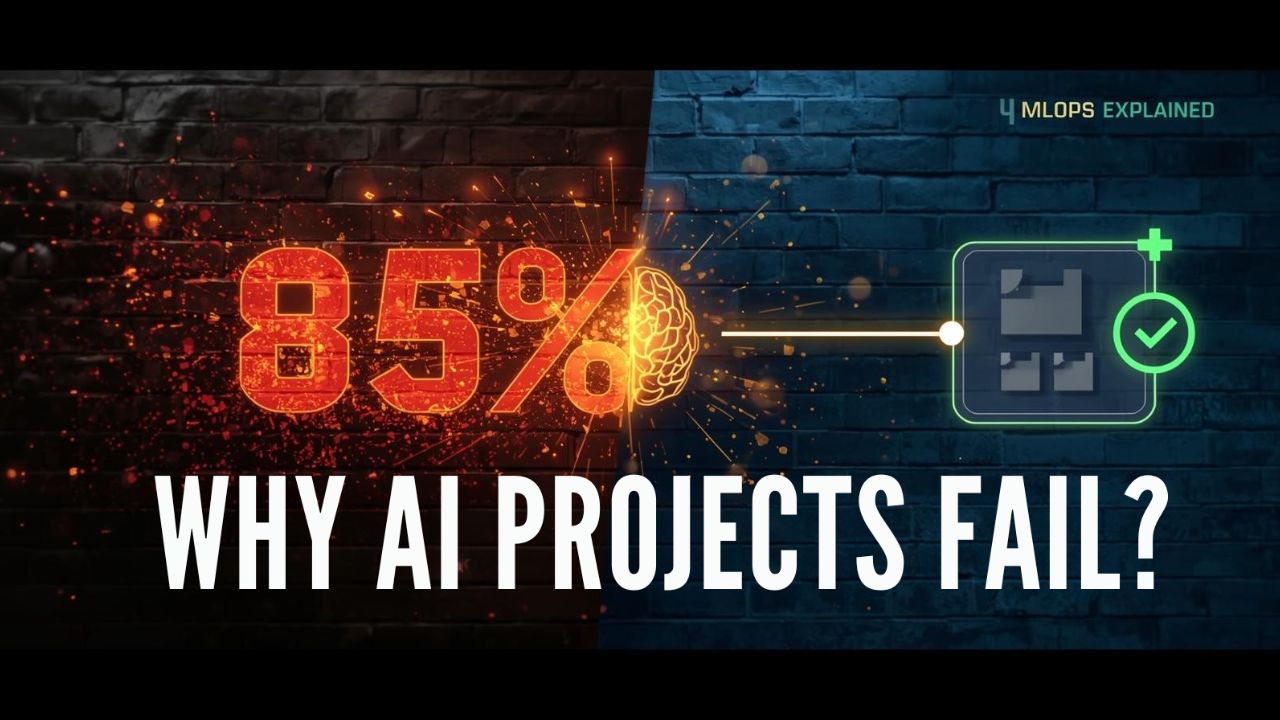
Industry statistics reveal a startling gap in artificial intelligence, showing that between 50% and 90% of machine learning models never make it to production. According to one study, a staggering 85% of AI projects will ultimately deliver erroneous outcomes. This high failure rate stems from the immense difficulty of transitioning models from experimental notebooks to reliable, scalable production systems.
The industry's answer to this challenge is MLOps. MLOps (Machine Learning Operations) is a set of practices that combines Machine Learning, DevOps, and Data Engineering to standardize and streamline the entire machine learning lifecycle. It provides a disciplined framework for managing projects from initial data preparation and model training to final deployment and ongoing monitoring, a discipline essential for large-scale initiatives like AI for India. Ultimately, an MLOps pipeline transforms machine learning from a research-oriented, artisanal craft into a scalable, predictable, and value-generating business function.
To succeed with AI, organizations must move beyond manual experimentation and adopt a disciplined MLOps pipeline. This structure is essential for addressing key challenges, from initial data management to post-model deployment issues like data drift, all of which must be underpinned by robust model monitoring and continuous use of the latest AI tools. Adopting these practices is a critical step in any company's digital transformation.
This article is a deep dive within our central resource: The Complete AI Developer Toolkit Guide for India
What is MLOps? The Principles for Production-Ready AI
MLOps is more than a collection of AI tools; it is a cultural and practical shift guided by a set of core principles designed to make machine learning repeatable, reliable, and scalable on the AI Cloud.
Beyond DevOps: What Makes MLOps Unique?
While MLOps borrows heavily from DevOps, it addresses unique challenges inherent to machine learning:
- Code and Data Duality: Unlike traditional software, ML systems are built from both code and data. MLOps must therefore manage the versioning and lineage of both, a task DevOps tools are not equipped for.
- Experimental Nature: Data science is inherently experimental. An MLOps framework must be able to track and evaluate a multitude of successful and unsuccessful experiments to ensure reproducibility.
- Silent Model Failure: A deployed ML model can fail silently in production not because of a code bug, but because the incoming data has changed. This phenomenon, known as data and concept drift, requires specialized monitoring systems that are not part of a standard DevOps toolkit, making the use of specific AI tools necessary.
The 5 Core Principles of a Successful MLOps Strategy
A mature MLOps strategy is built on five foundational principles that ensure a robust and scalable ML lifecycle.
- Reproducibility: This involves meticulously tracking and versioning data, code, and models to ensure that any experiment or deployment can be precisely replicated and audited.
- Continuous Integration/Continuous Deployment (CI/CD): CI ensures that code changes are regularly integrated and tested, while CD automates the process of deploying validated models to production environments, enabling faster iteration.
- Collaboration: MLOps mandates effective communication and clearly defined processes for cross-functional teams, including data scientists, ML engineers, data engineers, and business stakeholders.
- Versioning: A comprehensive versioning system is critical, tracking not only changes to the codebase but also to datasets and the models themselves to ensure complete traceability.
- Monitoring and Logging: This principle requires systematic metadata logging and continuous performance monitoring to understand a model's behaviour in production and to proactively detect and resolve issues.
These principles provide the "why" behind MLOps. The next section details the "how" by breaking down the end-to-end MLOps pipeline, showing how these principles are put into practice at each stage of a model's lifecycle.
The End-to-End MLOps Pipeline: A Stage-by-Stage Breakdown
A mature MLOps practice is structured around a multi-stage pipeline, which imposes discipline on the ML lifecycle, turning a potentially chaotic series of experiments into a governable, automated, and auditable production line for AI.
Stage 1: Data Management
This is the foundational stage where the quality and integrity of data are established. Key activities include automating data collection and processing through data pipelines, implementing data versioning with tools like Data Version Control (DVC) to track changes, and establishing rigorous data quality checks to ensure consistent and reliable inputs for model training.
Stage 2: Model Development & Experiment Tracking
In this phase, data scientists perform feature engineering, train models, and conduct hyperparameter tuning. A critical component of this stage is the use of experiment tracking AI tools like MLflow, which systematically log all training runs, parameters, metrics, and model artifacts. This ensures that every experiment is reproducible and comparable.
Stage 3: Model Deployment & Serving
Once a model is trained and validated, it must be packaged and deployed into a scalable AI Cloud production environment. This typically involves containerizing the model and serving it as a scalable microservice using platforms like Seldon Core or KServe. These frameworks are built for Kubernetes and support standard communication protocols like REST and gRPC, making it easier to integrate the model into existing applications.
Stage 4: Model Monitoring, Maintenance & Governance
After deployment, a model is not static. It must be continuously monitored for performance, accuracy, and degradation due to data drift. This stage involves setting up systems to track key metrics and trigger alerts when performance drops. This is also where AI Governance comes into play, ensuring that models operate in a fair, transparent, and compliant manner, adhering to both internal policies and external regulations, a vital component for projects like AI for India.

Navigating the Crowded MLOps Tooling Landscape
The MLOps market is filled with a wide array of specialized AI tools, each designed to solve specific problems within the ML lifecycle. Understanding their roles can help organizations build a cohesive and effective MLOps stack.
The Foundation: Experiment Trackers
Experiment trackers are the lab notebooks of MLOps, recording every detail of the model development process.
- MLflow: A widely supported, free, and open-source option that serves as a model registry and experiment tracker.
- Weights & Biases (W&B): A commercial alternative that offers a more polished user interface, advanced visualizations, and features like collaborative reports, making it a popular choice for teams seeking a premium experience with their AI tools.
The Engine: Pipeline Orchestrators
Orchestration AI tools automate the execution of multi-step MLOps pipelines, managing dependencies and scheduling tasks.
- Kubeflow: A powerful, Kubernetes-native toolkit for running ML workloads at scale, but its complexity makes it better suited for teams with deep Kubernetes expertise.
- ZenML: Offers a developer-first, Pythonic approach, allowing teams to transform standard Python code into reproducible pipelines with minimal annotations, focusing on ease of use and infrastructure abstraction.
The Gateway: Specialized Model Serving
These AI tools are purpose-built for deploying and serving models in production environments reliably and at scale.
- KServe and Seldon Core: Both are advanced, Kubernetes-native solutions for model deployment, with Seldon Core currently offering better out-of-the-box support for batch inference use cases.
- BentoML: A framework that simplifies the process of packaging trained models, code, and dependencies into a standardized format (a "Bento") that can be easily deployed as a containerized API endpoint.
The All-in-Ones: End-to-End Platforms
Some platforms aim to provide a unified solution covering the entire MLOps lifecycle, providing integrated AI tools.
- ClearML: Described as a "one in all tool" that handles experiment tracking, pipeline orchestration, and data versioning within a single, tightly integrated open-source system.
- Major AI Cloud Providers: Like AWS (SageMaker), Azure Machine Learning, and Google Cloud AI Platform offer comprehensive, managed MLOps platforms that integrate deeply with their respective cloud ecosystems.
Tackling the Silent Killer: A Deep Dive on Data Drift
Data drift is one of the most critical and unique challenges in MLOps, where a model's performance degrades silently over time simply because the real-world data it receives in production no longer matches the data it was trained on.
What is Data Drift and Why Does It Invalidate Models?
Data drift is defined as a change in the statistical properties of data over time. When the input data distribution in production "drifts" away from the training data distribution, the model's learned patterns become less relevant, leading to degraded performance and inaccurate predictions, even for the most well-designed AI tools.
There are three primary types of drift:
- Covariate Drift: The distribution of the input variables changes (e.g., an e-commerce recommendation model sees a shift in the geographic distribution of its users).
- Prior Probability Drift: The distribution of the target variable changes (e.g., a fraud detection system sees a sudden spike in fraudulent transactions during a holiday season).
- Concept Drift: The fundamental relationship between the input features and the target variable changes (e.g., a sentiment analysis model becomes outdated as new slang and cultural references emerge on social media).
Strategies for Detection and Mitigation
A robust MLOps strategy must include proactive measures for managing data drift.
- Detection: Statistical methods are commonly used to detect drift in real-time. Techniques like the Population Stability Index (PSI) can quantify the change in a variable's distribution between two time periods, with a value over 0.25 indicating a significant shift. Other methods include the Kolmogorov-Smirnov (KS) test and the Chi-Square test.
- Mitigation: Once drift is detected, the primary mitigation technique is periodic model retraining with fresh data that reflects the new distribution. Other strategies include developing drift-aware models, such as online learning algorithms that can adapt incrementally, and using ensemble techniques that combine multiple models to be more robust to change.
Understanding the statistical tests behind drift detection is key.
The Future of MLOps: From Automation to Responsibility
The MLOps field is rapidly evolving beyond simple automation to address the growing complexity and societal impact of AI systems.
Beyond Models: The Shift to Data-Centric AI
A significant trend is the shift from a "model-centric" to a "data-centric" approach. Instead of focusing primarily on tweaking model architecture and code, this philosophy emphasizes that improving the quality, consistency, and representativeness of the data is often the most effective way to enhance model performance. This shift moves Responsible AI considerations, such as mitigating bias and ensuring equitable outcomes for missions like AI for India, to the very beginning of the MLOps pipeline.
MLOps as the Engine for Responsible AI
Responsible AI is the practice of building systems that are ethical, explainable, and endurant (safe and reliable). MLOps provides the operational framework to execute on these principles at scale. For example, an MLOps pipeline can:
- Support Ethical AI by ensuring data is complete and up-to-date to mitigate against bias and by tracking model history to allow for more robust ethical auditing.
- Support Explainable AI by explaining the relationships between features and the target variable, understanding the relative importance of training data, and explaining individual predictions for debugging, auditing, and compliance.
- Support Endurant AI by ensuring high data quality to improve model reliability and implementing controls for auditing, such as access controls and logs of prior changes and versions.
The Next Frontier: LLMOps and AI Agents
The rise of Large Language Models (LLMs) has given birth to LLMOps, a specialized extension of MLOps. This new discipline addresses the unique challenges of developing and deploying LLMs and AI Agents, including prompt engineering, context management, hallucination prevention, and tracking conversation histories. As organizations increasingly build applications with generative AI, LLMOps represents the next major evolution in operationalizing AI, utilizing specialized AI tools within the AI Cloud.
The principles of LLMOps are critical for building next-generation applications.
Frequently Asked Questions (FAQs)
1. My model works perfectly in testing. Why do I still need MLOps?
A model that performs well in a static testing environment can still fail silently in production due to issues like data drift, where real-world data changes over time. MLOps is necessary to implement continuous model monitoring, which tracks performance and data consistency, allowing you to detect and address degradation before it has a negative business impact, and is crucial for public AI for India applications.
2. Is automatically retraining my model on new data always the best strategy?
No, automatic retraining carries risks. It can be costly, amplify the risk of failure if the new data is flawed, and may not be effective if the training data has long delays (e.g., loan default prediction). Furthermore, a performance drop might be caused by other issues like data leakage or downstream process changes, so it is crucial to investigate the root cause before deciding to retrain.
3. What is the difference between an MLOps "pipeline orchestrator" and a "model serving" tool?
A pipeline orchestrator (like Kubeflow or ZenML) automates and manages the execution of multi-step workflows, such as data preparation, model training, and validation. A model serving tool (like Seldon Core or KServe) specializes in the final deployment step, providing the infrastructure to run a trained model as a scalable and reliable API endpoint for real-time predictions.
Sources and references:
- Difference between ClearML, MLFlow, Wandb, Comet?
- Data drift detection and mitigation: A comprehensive MLOps approach for real-time systems
- What is MLOps? Lifecycle, Tools & Best Practices
- Five Levels of MLOps Maturity
- ClearML Agent enables seamless remote execution
- The MLOps guide: IBM
Hungry for More Insights?
Don't stop here. Dive into our full library of articles on AI, Agile, and the future of tech.
Read More Blogs