The AI Chip War Intensifies: Meta’s Interest in Google TPUs Challenges Nvidia’s Dominance
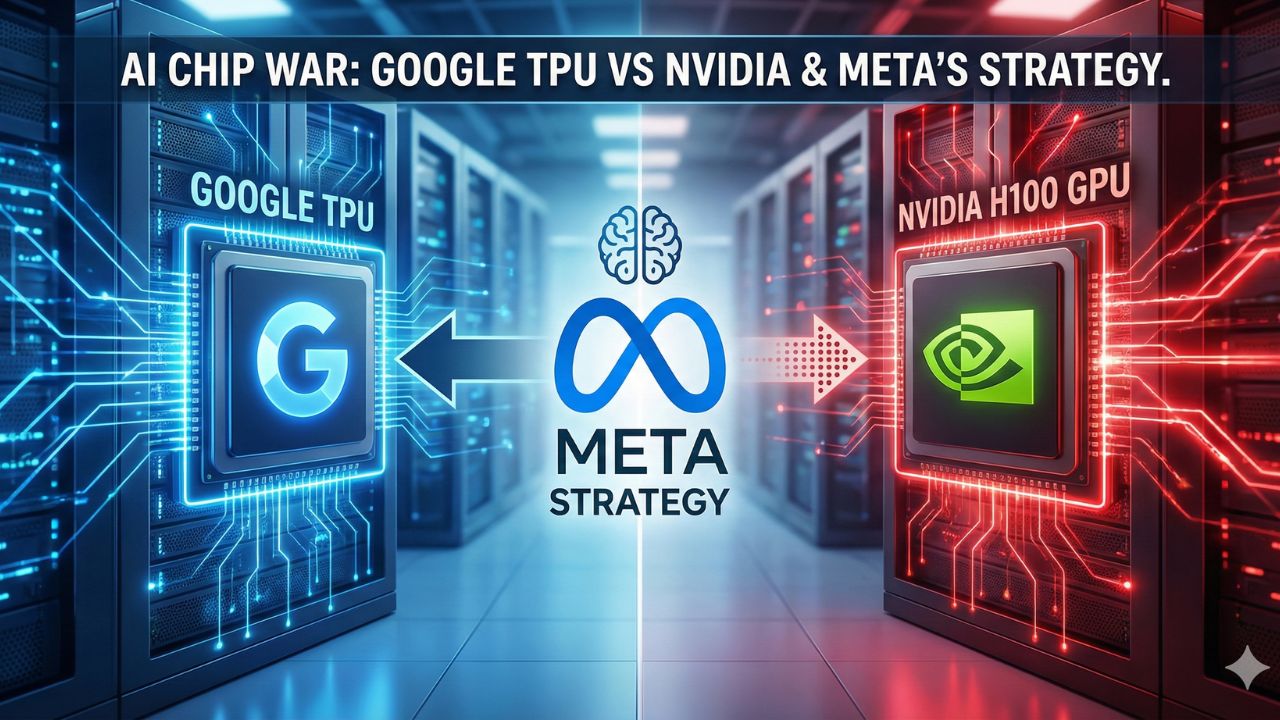
The multi-billion dollar race to power the world's most advanced AI models just entered a volatile new phase.
Recent reports indicate that Meta Platforms (formerly Facebook) is in advanced talks to procure Google's custom Tensor Processing Units (TPUs) for its massive data centers, a move that threatens to disrupt Nvidia's near-monopoly on AI hardware.
The news triggered a massive reaction in the stock market, wiping billions from Nvidia's valuation and sending a clear signal: the era of single-vendor AI infrastructure is coming to an end.
Related Guide: This article is part of our comprehensive content hub. Read the main guide on AI for Business Strategy.
1. The Core News: Meta's Pivot to Diversification
For years, Nvidia’s GPUs (Graphics Processing Units), primarily the H100 and A100 series, have been the undisputed gold standard for training and running large language models (LLMs) like those developed by Meta.
The recent reports suggest a significant pivot:
- Near-Term Plan (2026): Meta is reportedly considering renting TPU capacity from Google Cloud for certain AI workloads.
- Long-Term Plan (2027): Meta is in discussions for a multi-billion dollar deal to deploy Google’s custom TPUs (likely the latest Ironwood generation) directly within its own data centers.
This strategic move by Meta is driven by two critical factors:
- Supply Chain Diversification: Reducing reliance on a single vendor (Nvidia) to mitigate rising costs and supply constraints.
- Cost and Efficiency: Google’s application-specific TPUs are optimized for neural network tasks, potentially offering a better performance-per-watt and cost-per-TFLOPS ratio for Meta's specific large-scale training and inference needs.
2. Market and Industry Shockwaves
The market reaction was swift and dramatic:
- Nvidia Stock Impact: Shares of Nvidia dropped significantly (up to 7% before recovering slightly), erasing hundreds of billions in market value, as investors perceived the loss of a major customer like Meta as a material threat.
- Alphabet (Google) Stock Surge: Shares of Google’s parent company, Alphabet, rose sharply, validating the years of massive, internal investment the company has poured into its custom silicon program.
- Nvidia’s Response: Nvidia responded publicly, asserting that it remains "a generation ahead of the industry" and the only platform that runs every AI model across every computing environment, emphasizing the superior versatility of its GPUs.
This battle is no longer just about raw processing power; it’s about ecosystem, cost, and control over the entire vertical stack.
3. TPU vs. GPU: The Technical Difference
The contest between Google and Nvidia highlights the fundamental difference between general-purpose and specialized computing.
| Feature | NVIDIA GPU (e.g., H100) | Google TPU (e.g., Ironwood) |
|---|---|---|
| Design Philosophy | General Purpose Accelerator | Application-Specific Integrated Circuit (ASIC) |
| Primary Strength | Versatility and flexibility. Excellent for a wide range of tasks: graphics, HPC, and all types of AI workloads. | Efficiency and speed for neural network math. Specialized for the tensor algebra used in deep learning. |
| Software Ecosystem | CUDA (Compute Unified Device Architecture). A vast, mature ecosystem supporting PyTorch, TensorFlow, etc. | JAX/TensorFlow/PyTorch-XLA. Highly optimized within the Google Cloud ecosystem, but less flexible outside it. |
| Scalability | Uses technologies like NVLink for clustering multiple GPUs. | Uses custom Inter-Chip Interconnect (ICI) technology to link thousands of chips into highly efficient, massive "Pods" (up to 9,216 chips). |
| Cost Efficiency | High initial cost, but can be reused for many tasks. | Generally offers better performance-per-watt and lower running cost for repetitive AI workloads. |
4. Implications for AI Developers and Businesses
This competition benefits the entire AI ecosystem, offering developers and businesses new choices:
- For the AI Engineer/Developer: You can no longer rely on a single hardware ecosystem. Proficiency in frameworks like PyTorch/XLA (to run on TPUs) and CUDA/PyTorch (for GPUs) will become essential. The choice of hardware will increasingly be dictated by model size, budget, and deployment environment.
- For Large Enterprises: The option of on-premise TPU deployment (which Google is now pitching) provides a path to high-performance AI infrastructure while meeting strict data security and regulatory requirements that prohibit data movement to public clouds.
- For the Market: The entry of a credible, large-scale alternative will put downward pressure on AI compute costs. As Google competes more aggressively with its hardware, it pushes Nvidia to accelerate its innovation and potentially offer more competitive pricing.
This is a clear signal that vertical integration (controlling hardware, software, and cloud infrastructure) will be the defining competitive edge in the next phase of the AI race.

Frequently Asked Questions (FAQs)
No. The reports indicate Meta is diversifying its chip supply to reduce dependency on Nvidia. Meta is one of the largest spenders on AI infrastructure globally, and it is highly unlikely they would switch vendors entirely due to the massive technical and software challenges involved.
Tensor Processing Unit. A tensor is a multi-dimensional array of data, and TPUs are custom-built by Google to accelerate the mathematical operations (tensor algebra) that are the foundation of deep learning and neural networks.
Historically, Google kept TPUs for internal use and rental via Google Cloud. The strategic shift to selling/renting externally is driven by two goals: to challenge Nvidia's market dominance and to amplify the reach of Google Cloud's AI services, validating their technology with a major, outside customer.
It depends on your workload. If you are developing and deploying large-scale LLMs and generative AI models, particularly those running on TensorFlow or JAX, TPUs offer great cost-efficiency at scale. If your workload is varied, requires flexibility, or uses a wide variety of software and tools, the versatility and mature ecosystem of Nvidia GPUs (CUDA) still make them the default choice.
Sources and References
- The Information (Original Report on Meta/Google TPU Talks)
- The Economic Times: "Google touts its TPUs as alternative to Nvidia AI chips; Meta expresses interest"
- Times of India: "Nvidia publicly responds to 'losing' $250 billion to 'Google deal,' declares: We are"
- Google Cloud Official Documentation (for TPU specifications and offerings)
- Morningstar UK (for analyst commentary on stock impact)