Why HSBC's AI Layoffs May Spare India's GCCs
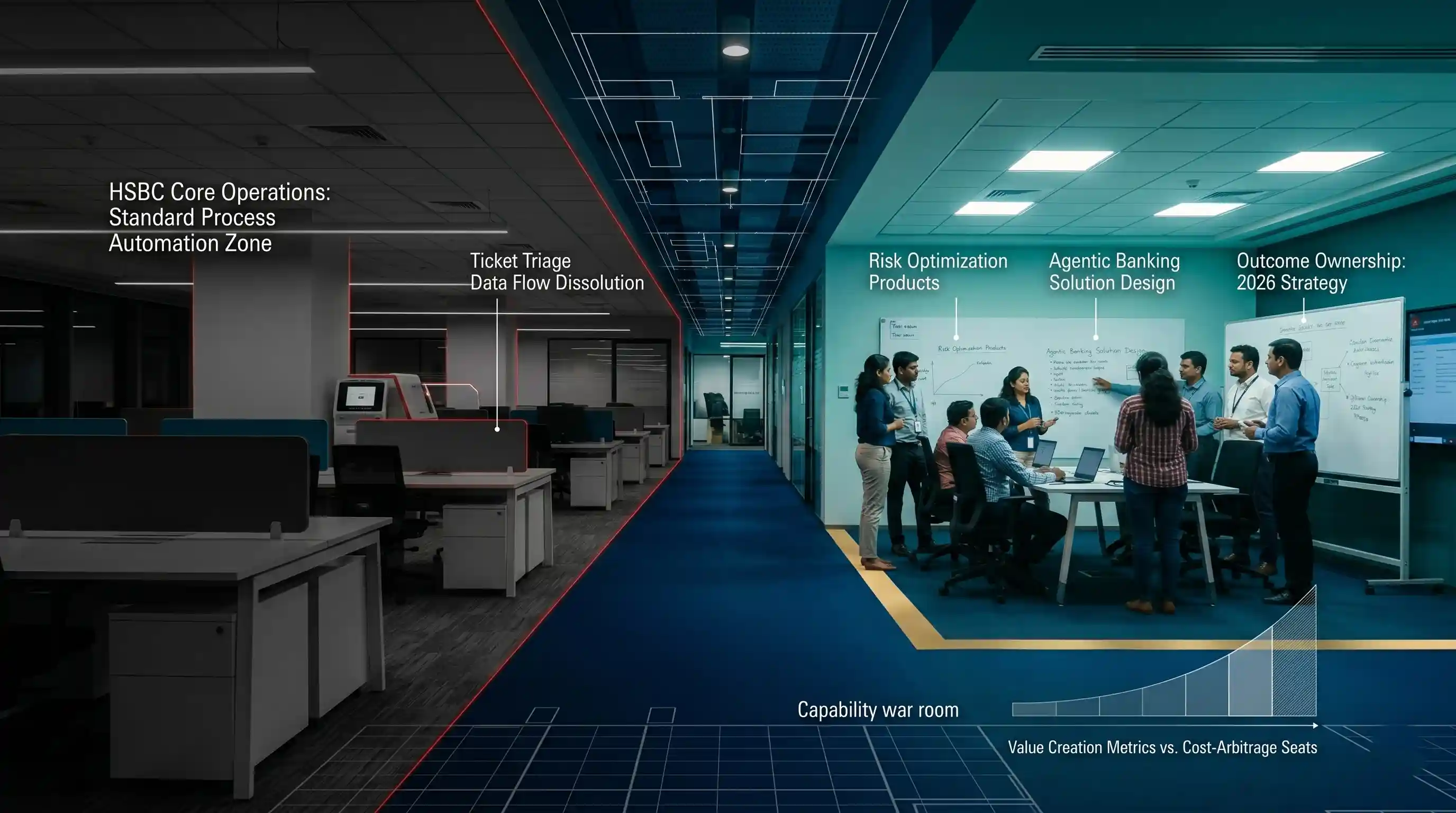
- Targeted Reductions: The reported ~20,000 cuts primarily target redundant, back-office processing roles globally, not complex analytical tech functions.
- The Capability Pivot: India's Global Capability Centres (GCCs) are rapidly transitioning from simple cost-arbitrage units into high-value product hubs.
- Net-Positive Reallocation: Saved capital from routine process automation is actively being funneled back into engineering, architecture, and agentic AI deployments.
- Immediate Reskilling Action: Survival for banking professionals depends entirely on shifting from task execution to AI-agent orchestration.
Everyone read the 20K cut as bad news for India—but the hsbc ai layoffs india data tells a different story for GCCs.
When global announcements point to massive workforce reductions, panic usually hits offshore delivery teams first. However, looking closely at the data from the comprehensive AI Layoffs 2026 Tracker reveals a profound structural shift rather than a blunt headcount slash.
The nature of the work automated versus the work retained completely flips the doom narrative.
The Reality Behind HSBC's 20,000 AI Layoffs
The massive headline numbers can easily paralyze workforce planners and banking professionals alike.
To build an effective defense strategy, you must separate standard macroeconomic cost-cutting from genuine AI disruption.
When Did HSBC Announce Its AI-Driven Layoffs and Why Now?
The initial announcements began surfacing as part of HSBC’s late-stage efficiency reviews for the fiscal cycle.
Driven by the mature deployment of enterprise-grade LLMs and automated process intelligence, the bank hit an inflection point.
The timeline reflects a calculated move to clean up legacy operational drag while simultaneously funding a multi-billion dollar shift into agentic banking architectures. For a deeper breakdown of the initial market reaction, see the early reports on HSBC's AI layoffs impact on Indian GCCs.
How HSBC's AI Strategy Compares to Other Global Banks
HSBC is far from an isolated case in Wall Street or Canary Wharf. However, while some institutions are utilizing broad down-sizing strategies, HSBC has explicitly tied its operational optimization to workflow automation.
This targeted approach bypasses complex localized decision-making cells and goes straight after standardized, repeatable middle-office tasks.
It highlights a broader industry trend where banks avoid the traditional tech-downturn traps. This shift is explored extensively in our analysis of the HSBC 20,000 layoffs enterprise AI ROI trap.
Cost-Arbitrage vs. Capability: Why India's GCC Headcount May Survive
The future of any offshore delivery unit in India depends entirely on its structural positioning.
The line dividing vulnerability from safety is no longer determined by seniority, but by the type of value delivered.
Is HSBC Moving Work to India or Automating It Away Entirely?
The short answer is both, depending on where the center sits on the capability matrix.
Standardized reporting, manual data reconciliation, and basic document processing are being automated out of existence. Conversely, highly complex risk modeling, cloud migrations, and core software engineering are being concentrated within India.
The work isn't simply disappearing; it is changing shape. The broader mechanics of this structural division are detailed in our deep dive into GCC Jobs & AI in India.
What Functions Does HSBC's India GCC Handle Today?
HSBC's footprints in hubs like Bengaluru and Hyderabad have evolved past the "transaction processing" centers of the early 2000s.
Today, these centers manage critical layers of global technology infrastructure, digital banking products, and compliance operations.
Because they hold deep institutional knowledge, completely dismantling these teams would introduce significant systemic risk. This reality insulates the capability desks from standard operational cuts.
The Risk Profile: Which Roles Fall First and Which Are Safe
Understanding your true exposure requires looking at specific daily workflows rather than top-level corporate titles.
Which HSBC Roles Are Being Replaced by AI First?
The high-risk zone is heavily populated by standardized middle- and back-office workflows.
Roles focused on routine credit analysis data entry, basic KYC verification, and first-line retail support operations are collapsing quickly.
If a job consists of reading an internal document, applying a static rule, and pasting the output into another system, an AI agent is already built to replace it.
Are HSBC's India Tech Jobs Safe from AI Automation?
Software engineering roles are undergoing a massive transformation, but they are not vanishing.
While code generation tools have accelerated development velocity, the need for complex software architecture remains critical.
Engineers who transition to managing automated architectures are seeing their internal value skyrocket. To understand this structural engineering evolution, read our technical review of HSBC's AI overhaul software engineer architecture.
The Strategic Pivot: Why AI Layoffs Could Accelerate India Growth
When global enterprises automate their baseline operational layers, it frees up capital to solve far more complex engineering problems.
Why Might HSBC's AI Layoffs Actually Help Indian GCCs?
By automating transactional work, the cost-per-delivery index for Indian operations drops significantly.
This shift allows local GCC leadership to pitch for higher-value ownership of product lines that were previously kept onshore.
As global budgets lean out, the efficiency of a highly skilled, capability-focused Indian center becomes an irresistible destination for critical project allocation.
Action Plan: Should HSBC India Employees Reskill Now or Wait?
Waiting for corporate restructuring to reach your specific business unit is a high-risk approach.
The transition window is short, and proactive upskilling is the only reliable career safety net. Professionals must learn to transition from technical execution to strategic orchestration.
Discover the exact tactical steps to navigate this pivot in our comprehensive guide, Reskilling for Agentic AI: A 90-Day Plan.
Conclusion & Next Steps
The corporate updates from HSBC make one thing clear: the old playbook of scaling centers by simply adding more seats is over.
The future belongs to lean, highly capable teams that focus on driving business outcomes rather than just managing tasks.
If you manage a team or build systems within a financial GCC, your immediate priority should be moving your workflows away from repetitive, manual tasks.
Audit your operations, identify where automated tools can handle the baseline work, and position your career path to oversee those systems directly.

Frequently Asked Questions (FAQ)
HSBC has targeted a structural restructuring affecting roughly 20,000 operational and middle-office roles globally. These adjustments are specifically focused on automating routine transaction processing while freeing up capital to fund enterprise-grade AI infrastructure investments.
The impact on India is highly mixed rather than a uniform reduction. While legacy cost-arbitrage seats focused on data entry are declining, high-value capability centers handling core engineering and complex compliance operations continue to retain talent.
Roles that rely heavily on highly predictable, rule-based tasks are being automated fastest. This high-risk category includes basic data reconciliation specialists, routine KYC and credit processing clerks, and standardized first-line customer service operators.
The bank is pursuing a dual strategy: routine processing workflows are being automated out of existence globally, while highly complex engineering, software architecture, and data science projects are being consolidated directly into India's capability centers.
As routine operational costs drop due to automation, the economic efficiency of Indian centers increases. This allows local GCC leaders to secure ownership of higher-value engineering budgets that global teams reallocate away from higher-cost regions.
The India centers have transitioned far beyond basic call center work. They now manage core global technology architectures, advanced risk analytics, algorithmic compliance models, and the deployment frameworks for the bank's next-generation digital products.
Tech jobs are stable but changing structurally. Standard code-writing jobs are decreasing due to automated code-generation tools, but demand is growing rapidly for systems engineers, platform architects, and developers who can orchestrate complex enterprise AI tools.
The restructuring steps became prominent during recent corporate efficiency rollouts. These moves are part of a multi-year strategy to reduce operational overhead and shift capital into cloud-based, agentic banking services.
While some institutions are using blanket cost cuts, HSBC's strategy is tightly focused on task-level automation. They are systematically targeting specific repeatable workflows to minimize baseline friction while preserving core engineering and risk management headcount.
Employees should begin reskilling immediately. Waiting introduces severe career risk as automation software updates roll out quickly. Shifting your skill set toward AI orchestration, prompt refinement, and end-to-end outcome ownership is the safest path forward.