Best AI Wearables for Developer Productivity 2026: Optimizing Biological "Hardware"
Quick Answer: Key Takeaways
- The New Bottleneck: In 2026, your compile times are instant, but your brain is lagging. AI wearables now focus on optimizing cognitive load rather than just counting steps.
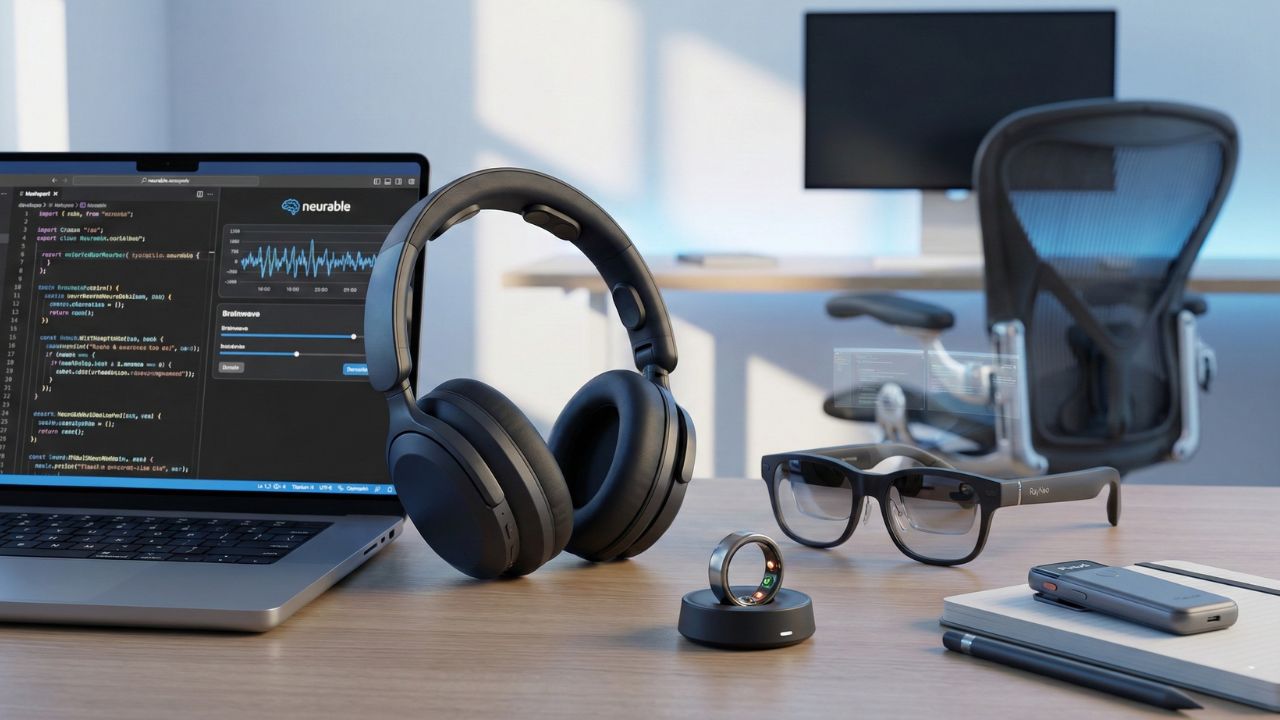
- Flow State on Demand: Neuro-tech headphones like Neurable can now visualize your "focus spikes," helping you schedule deep coding sessions when your brain is actually ready.
- Infinite Monitors: AR glasses from RayNeo and Xreal have replaced the triple-monitor desk setup, allowing you to deploy code from a coffee shop with three virtual 4K screens.
- Burnout Defense: Biometric trackers (Oura/Whoop) are no longer just for athletes; CTOs are using them to prevent "crunch" burnout by monitoring Heart Rate Variability (HRV) during sprints.
Upgrade Your Biological Stack
This deep dive is part of our extensive guide on Best AI Mode Checkers 2026.
For software engineers in 2026, the hardware war is over. The M5 chips and cloud GPUs are fast enough.
The new bottleneck is you.
As AI coding assistants generate thousands of lines of code per minute, the human developer's role has shifted from "writer" to "reviewer."
This requires immense cognitive endurance.
To maintain the best AI wearables for developer productivity 2026 standards, you need to treat your body like a server: monitor the temperature, manage the load, and cool down before you crash.
Below are the tools maximizing biological throughput in the age of Agentic AI.
1. The "Flow State" Guardian: Neurable MW75 Neuro
Best For: Real-time Cognitive Load Monitoring.
If you can’t measure it, you can’t optimize it.
Neurable has integrated EEG sensors directly into high-fidelity noise-canceling headphones.
For developers, this is a game-changer. It tracks your brainwave activity to determine exactly when you are in "Deep Work" mode and when you are mentally fatigued.
The "Burnout" Alert: Instead of pushing through brain fog and writing buggy code, the app alerts you when your cognitive fatigue hits a critical threshold.
Focus Playlists: It uses AI to adjust the noise cancellation and audio EQ in real-time based on your concentration levels.
Why it matters: It prevents "junk hours", those hours spent staring at the IDE without writing a single valid function.
2. The Portable Command Center: RayNeo Air 2s
Best For: The "Deskless" Triple-Monitor Setup.
The era of being chained to a desk is dead.
RayNeo (and competitors like Xreal) have perfected the AR "virtual monitor" experience.
These aren't just notification displays; they are 1080p-to-4K Micro-OLED screens that float in front of your eyes.
The Developer Setup: You can spawn a vertical monitor for your VS Code, a horizontal one for your browser documentation, and a side panel for Slack/Discord, all running off a single laptop connection.
Privacy: Unlike a physical screen in a coffee shop, no one can shoulder-surf your proprietary code.
Only you can see the display.
Productivity ROI: You regain the efficiency of your office setup while traveling or working remotely.
3. The "Runtime" Monitor: Oura Ring Gen 4
Best For: Predicting Mental Readiness.
You wouldn't deploy to production if your server health was at 20%.
Why do you code when your Readiness Score is 30?
The Oura Ring has evolved beyond sleep tracking into a "Readiness Engine" for knowledge workers.
Stress vs. Strain: Oura now distinguishes between physical stress (exercise) and physiological stress (coding crunch).
The "API" of You: New integrations allow you to correlate your Git commit velocity with your sleep scores.
Are you writing more bugs on days when your HRV is low? The data will tell you.
Integration: Connects with tools like Natural Cycles and wellness apps to provide a holistic view of your biological uptime.
4. The "External RAM": Plaud NotePin
Best For: Meeting Recall and Architectural Decisions.
Developers hate meetings because they flush the L1 cache of their working memory.
The Plaud NotePin acts as your external hard drive.
Unlike a phone recorder, this wearable pin records, transcribes, and summarizes complex technical architecture discussions in real-time.
The Use Case: You are in a standup, and the Lead Architect explains a new API schema.
Instead of scrambling to take notes, you let Plaud capture it.
Action Items: The AI automatically extracts JIRA tickets and "To-Do" lists from the audio, syncing them to your Notion or Linear workspace.
Privacy: Enterprise-grade encryption ensures that your trade secrets aren't training a public model.
Conclusion
The best AI wearables for developer productivity 2026 aren't gadgets; they are performance enhancers.
In a market where AI writes the boilerplate, your value is your judgment.
Judgment requires a rested, focused, and optimized brain.
Whether it is using Neurable to guard your focus or Oura to manage your recovery, optimizing your biological hardware is the only way to keep up with the silicon one.
For more on the limits of AI reasoning compared to human experts, check the Humanity’s Last Exam Leaderboard Scores.
Optimize Your AI Workflow. Try Proton VPN

We may earn a commission if you buy through this link. (This does not increase the price for you)
Frequently Asked Questions (FAQ)
Neurable MW75 Neuro headphones are currently the industry leader. They use EEG sensors to track brainwaves and quantify your "focus time," helping you schedule coding blocks when your brain is most alert.
Yes. Both devices track Heart Rate Variability (HRV), which is a strong indicator of the nervous system's recovery. Low HRV correlates with reduced cognitive function and higher error rates in complex tasks like coding.
RayNeo Air 2s and Xreal Air 2 Pro are top choices for 2026. They allow developers to project multiple high-resolution virtual monitors, enabling a multi-screen workflow from a laptop without physical hardware.
Wearables like Plaud NotePin integrate by automatically transcribing meetings and syncing "action items" directly to project management tools. Oura can integrate via API to correlate health data with productivity metrics.
Yes, EEG-enabled headphones (Neurable) and newer wristbands like Apollo Neuro monitor physiological stress signals in real-time, alerting users to take breaks before they reach cognitive burnout.