Digital Watermarking vs. AI Detection: Which Protects Truth Best?
Quick Answer: Key Takeaways
- The Difference: AI Detection makes a probabilistic "guess" based on patterns (like a detective), while Digital Watermarking embeds an invisible, mathematical "signature" at the source (like a DNA tag).
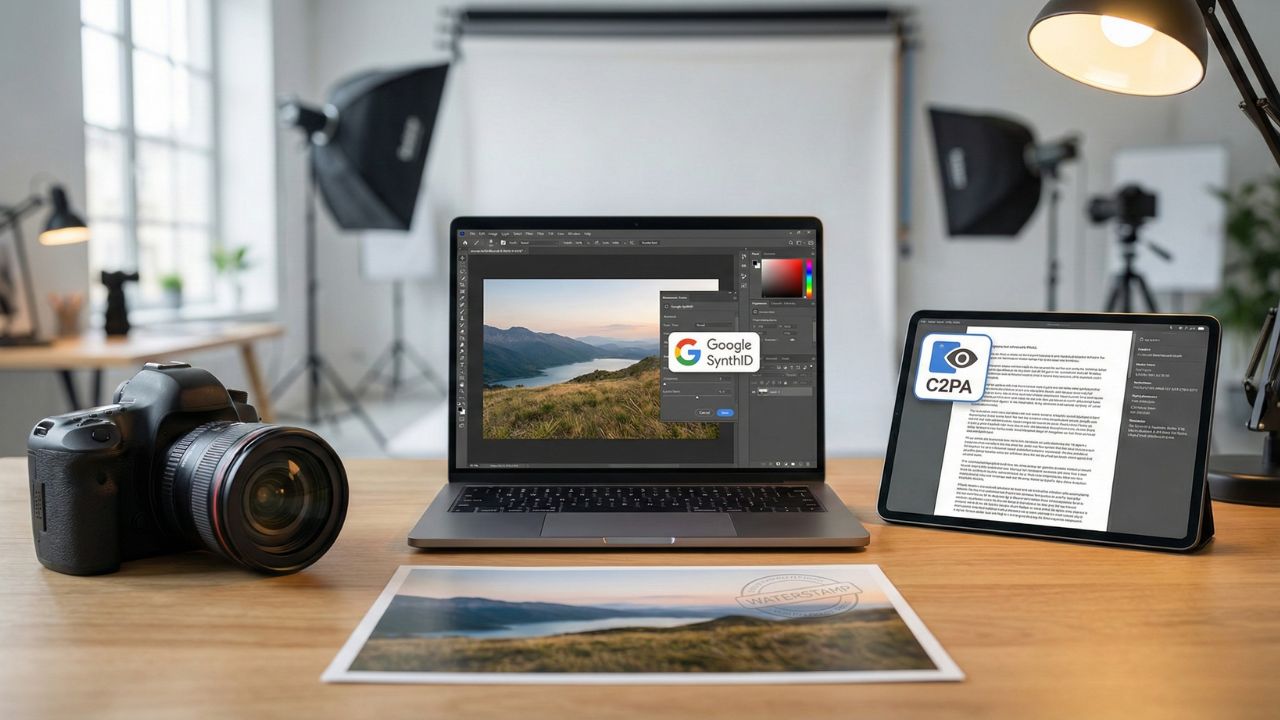
- SynthID Power: Google's SynthID is the 2026 standard for watermarking, modifying the statistical probability of tokens in a way that survives copy-pasting but remains invisible to humans.
- The Metadata Trap: Metadata tags (like C2PA) are useful but fragile, they can be stripped by a simple screenshot. Watermarks are embedded inside the content's data structure.
- The "Truth" Winner: For enterprise security, Watermarking provides definitive proof of origin, while AI Detection is better for screening incoming content from unknown sources.
- Best Practice: A "Layered Defense" is the only viable strategy in 2026, using watermarking to certify your content and detection to scan others'.
The Battle for Digital Reality
This deep dive is part of our extensive guide on Best AI Mode Checkers 2026.
In 2026, the question isn't "Is this fake?", it's "Can you prove it's real?"
As deepfakes become indistinguishable from reality, we are witnessing a war between two technologies trying to save the internet: AI Detection (the watchdog) and Digital Watermarking (the passport).
For CTOs, brand managers, and content creators, choosing the right side, or knowing how to combine them, is the difference between brand resilience and a PR nightmare.
Here is the definitive technical breakdown of which technology actually protects the truth.
1. AI Detection: The External Watchdog
Best For: Scanning incoming content you did not create.
AI Detection tools (like those covered in our Humanity’s Last Exam analysis) work by analyzing the "aftermath" of generation.
They look for the statistical mess left behind by an LLM.
How It Works: Detectors analyze burstiness (sentence variance) and perplexity (how surprised the model is by the text). If a text is too predictable, it's flagged as AI.
The Limitation: It is probabilistic. A detector might say "98% likely AI," which is great for filtering spam but dangerous for firing an employee.
The "Refactoring" Bypass: As detailed in our guide on AI Detector Evasion Techniques, developers can "scrub" these patterns by manually refactoring code or using "humanizer" prompts, rendering detection tools blind.
Verdict: Essential for filtering, but insufficient for proof.
2. Digital Watermarking: The Internal DNA
Best For: Certifying outgoing content you own.
Digital watermarking is the inverse of detection. Instead of guessing, it knows.
Tools like Google's SynthID or Digimarc embed a signal directly into the pixels of an image or the token probability of a text stream.
How SynthID Works (Text): It doesn't just write text; it alters the "tournament selection" of words.
When Gemini generates a sentence, it subtly biases the choice of synonyms in a mathematical pattern that a computer can read, but a human cannot.
How SynthID Works (Audio/Video): It converts the audio waveform into a spectrogram and embeds a hidden signal into the frequencies humans can't hear.
This survives compression, meaning even if someone records the audio with a microphone (the "analog hole"), the watermark often survives.
Why It Wins: It offers provenance. You aren't guessing if it's Gemini 3.0; the file tells you it is.
Verdict: The gold standard for authenticity and copyright.
3. The "Metadata" Myth vs. True Watermarking
A common confusion in 2026 is equating Watermarking with Metadata (C2PA/Content Credentials).
Metadata (C2PA): Think of this as a "digital sticker" on a file. It lists the author, edits, and camera used.
The Flaw: If you take a screenshot of a C2PA-protected image, the sticker falls off. The data is lost.
True Watermarking (Steganography): This is weaving the tag into the canvas itself.
The Advantage: You can crop, resize, screen-record, or compress the file, and the watermark (usually) remains readable.
For a deep technical look at how Gemini specifically handles this, read our How to Detect Gemini 3.0 Content guide.
4. Can Watermarks Be Removed?
The uncomfortable truth: Yes, but it's hard.
In 2026, "Watermark Remover" tools (like NoteGPT or VisualGPT) use AI to attempt to "scrub" these invisible signals.
The Attack: These tools use "Generative Inpainting" to predict what the pixels should look like without the mathematical noise of the watermark, effectively overwriting the signal.
The Defense: Enterprise-grade watermarking (like Steg.AI) is now "holographic." The watermark is distributed across the entire file.
You can't just scrub one corner; you have to destroy the quality of the entire image to remove the mark.
Conclusion: The "Layered Defense" Strategy
So, which protects the truth best?
Neither alone.
Use Digital Watermarking to protect your brand's assets (Marketing materials, CEO videos, Codebase). This proves your innocence if deepfakes appear.
Use AI Detection to filter the noise coming in from freelancers, applicants, and the web.
The future of truth isn't about finding a magic bullet; it's about building a wall where every brick, detection, watermarking, and human review, plays a specific, structural role.
For more on building this infrastructure, refer to our Enterprise AI Governance Framework 2026.
Optimize Your AI Workflow. Try Proton VPN

We may earn a commission if you buy through this link. (This does not increase the price for you)
Frequently Asked Questions (FAQ)
AI detection analyzes content after it's made to guess if it's synthetic based on patterns. Digital watermarking embeds an invisible ID during creation that definitively proves origin.
For text, it alters the probability of word choices (token sampling) to create a hidden statistical pattern. For audio, it hides data in the spectrogram frequencies that are inaudible to humans but robust against compression.
No. Metadata acts like a label that can be easily stripped by taking a screenshot or re-saving the file. True watermarking is embedded in the data itself and survives these actions.
Advanced watermarks are designed to survive resizing, cropping, and compression. However, "Watermark Remover" AI tools exist that attempt to scrub these signals by regenerating the image pixels.
Reasoning Trace analysis looks for the specific "step-by-step" logic structure that models like DeepSeek or Gemini use to solve problems, which differs significantly from human intuitive leaps.
Sources & References
- Best AI Mode Checkers 2026
- How to Detect Gemini 3.0 Content
- Enterprise AI Governance Framework 2026
- Google DeepMind: "SynthID: A Technical Deep Dive into Invisible Watermarking"
- C2PA.org: "The Coalition for Content Provenance and Authenticity Technical Standard"
- Magai: "AI Watermarks vs. Labels: Key Differences & Feature Comparison"
- NYU Stern: "Best Digital Watermarking Tools in 2026 (Forensic Analysis)"
Internal Resources:
External Resources: