Quantum Reality Check: DARPA Selects 11 Teams in the Race for a Utility-Scale Quantum Computer by 2033
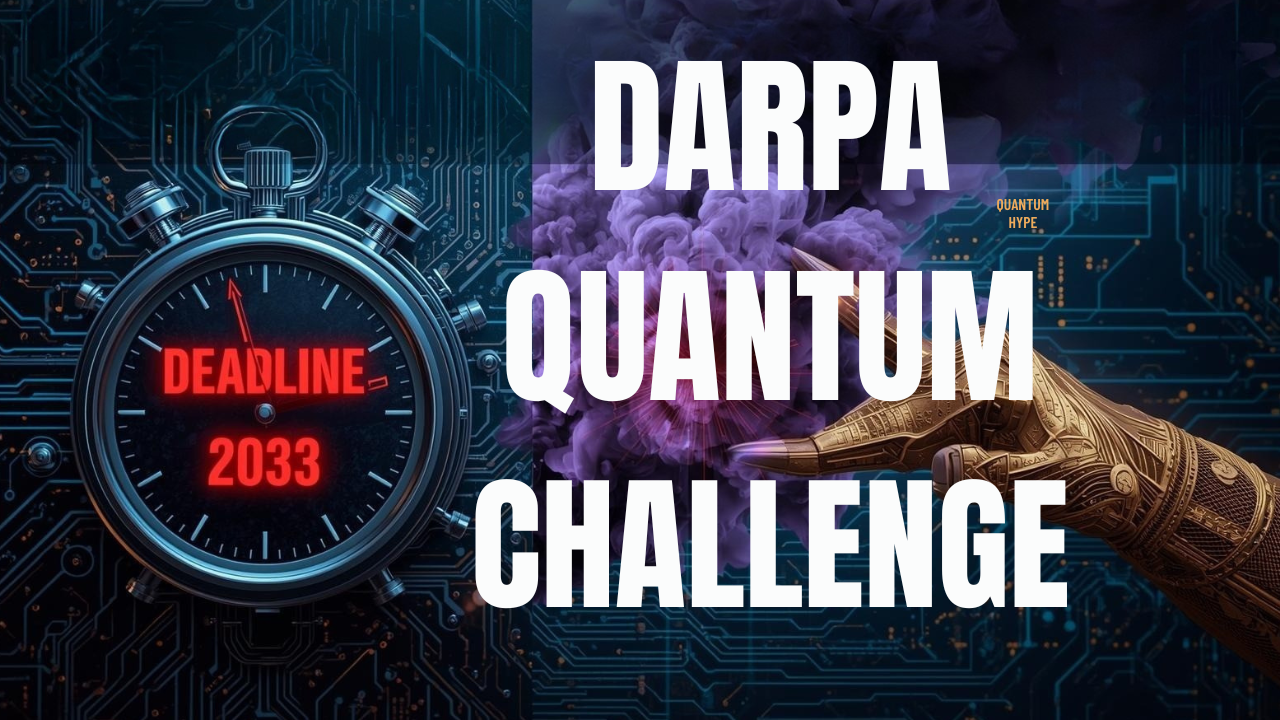
The U.S. Defense Advanced Research Projects Agency (DARPA) has selected 11 companies for the next phase of its ambitious DARPA Quantum Benchmarking Initiative (QBI). This program represents a pivotal, government-led effort to cut through the pervasive quantum computing hype that has clouded the industry with inflated claims and investor uncertainty. The central mission is to determine, through rigorous and unbiased evaluation, if any company can build a truly useful, utility-scale quantum computing system by 2033, finally providing a clear path toward a viable fault-tolerant quantum computer.
What is DARPA's Quantum Benchmarking Initiative (QBI)?
The QBI is a multi-stage, high-stakes program designed to rigorously test and validate the feasibility of building an industrially useful quantum computer within the next decade.
From Hype to Verifiable Utility
The primary goal of QBI is to verify and validate if any quantum computing approach can achieve utility-scale operation by 2033. As DARPA QBI program manager Joe Altepeter stated, the initiative is designed to rigorously test commercial approaches to determine "what’s viable and what’s hype".
The Three-Stage Gauntlet
The QBI program is structured as a three-stage gauntlet, each with increasing technical demands and funding potential:
- Stage A: Plausibility (6 months, up to $1M): In this initial phase, participants developed and described their technical concept for a cost-effective, utility-scale quantum computer with a plausible path to realization.
- Stage B: R&D Plan (12 months, up to $15M): This is the current phase for the 11 selected companies. They must now deliver a comprehensive research and development plan, identify major technical risks, propose mitigation strategies, and specify the prototypes needed to demonstrate progress.
- Stage C: Validation and Co-Design (variable, up to $300M): In the final stage, successful companies will work with DARPA's independent verification and validation (IV&V) team to test the hardware prototypes and determine if the proposed system can be built and operated as intended.
Defining Success: What Does "Utility-Scale" Mean?
Central to the QBI's mission is a practical definition of success. DARPA defines "utility-scale operation" as a state where a quantum computer's computational value exceeds its cost. This pragmatic metric moves beyond abstract measures and focuses on whether the technology can deliver a tangible, economic advantage for real-world problems.
🚀 Supercharge Your R&D!
Discover our curated list of cutting-edge AI tools designed to boost your productivity and creativity in research and development.
Explore AI & R&D ToolsWhy This Initiative is a "Make-or-Break" Moment for Quantum Computing
The QBI is not just another research program; it's a critical intervention aimed at stabilizing the future of the entire quantum industry by grounding it in verifiable reality.
Confronting the "Quantum Computing Hype"
The quantum computing field has been plagued by hype that threatens its long-term viability. This hype often stems from corporations misrepresenting facts to influence stock prices, venture capital-funded "vaporware" with little practical utility, and premature claims of "quantum advantage" that are later refuted by researchers. This environment of speculation erodes investor trust and makes it difficult to separate genuine progress from marketing. By providing an unbiased, third-party validation process, QBI aims to restore clarity and ensure that investment flows toward the most viable technological avenues.
The National Security and Economic Stakes
The push for a functional quantum computer is driven by immense national security and economic stakes. A fault-tolerant machine could both create and neutralize existential threats.
- Security Threat: The National Institute of Standards and Technology (NIST) has warned that "if large-scale quantum computers are ever built, they will be able to break many of the public-key cryptosystems currently in use. This would seriously compromise the confidentiality and integrity of digital communications on the Internet and elsewhere".
- Economic Disruption: The potential for economic transformation is vast. Industries that could be revolutionized include pharmaceuticals ($145B market), battery catalysis ($141B market), machine learning ($97B market), and materials discovery.
⏪ Relive Our Past Events
Curious about our previous conferences? Explore the sessions, speakers, and highlights from our flagship events.
View 2024 Highlights View 2025 HighlightsThe Quantum Lineup: 11 Innovators, One Vision
In direct response to this high-stakes, hype-fueled environment, DARPA is not picking a single favorite. Instead, the agency is pursuing a strategic portfolio approach, funding a diverse set of unproven qubit technologies to determine which, if any, have a credible path to reality.
A Diverse Portfolio of Qubit Technologies
DARPA has officially selected 11 teams to advance to Stage B of its cutting-edge quantum computing initiative. These teams represent a diverse range of scientific and technological approaches, each exploring unique pathways toward building scalable and reliable quantum systems. The chosen companies are working on different physical implementations of quantum bits (qubits), the fundamental units that power quantum computation.
| Company | Qubit Technology |
|---|---|
| Atom Computing | Scalable arrays of neutral atoms |
| Diraq | Silicon CMOS spin qubits |
| IBM | Modular superconducting processors |
| IonQ | Trapped-ion quantum computing |
| Nord Quantique | Superconducting qubits with bosonic error correction |
| Photonic Inc. | Optically-linked silicon spin qubits |
| Quantinuum | Trapped-ion quantum charged coupled device (QCCD) architecture |
| Quantum Motion | MOS-based silicon spin qubits |
| QuEra Computing | Neutral atom qubits |
| Silicon Quantum Computing | Precision atom qubits in silicon |
| Xanadu | Photonic quantum computing |
Why Diversity Matters?
Unlike classical computing, which is dominated by silicon-based transistors, no single dominant architecture for quantum computing has emerged. Each of the different qubit technologies has unique strengths and weaknesses. Recognizing this, DARPA has explicitly stated that QBI is not a competition designed to narrow the field. Instead, the agency will evaluate each company's approach on its own merits to understand the true potential of every viable path.
How Do You Measure a Quantum Breakthrough?
Effectively measuring progress in quantum computing is a profoundly complex scientific challenge that the QBI aims to formalize.
Beyond Simple Hardware Metrics
Early attempts to measure quantum computer performance, such as the Quantum Volume metric, have proven limited. While useful for gauging certain hardware characteristics, such metrics are often based on randomized workloads that are "little representative of real use cases" and do not reliably predict performance on practical, industrial applications.
An Application-Centric Approach
The QBI represents a shift toward an application-centric, full-stack approach to benchmarking, but its mission-driven nature sets it apart from other international efforts. For example, Europe’s BenchQC project focuses on creating modular, open-source frameworks to benchmark a wide range of specific applications for research and industry exploration. In contrast, DARPA's QBI is a large-scale, government-directed strategic program with a singular, high-stakes goal: verifying a concrete path to an industrially useful fault-tolerant quantum computer by a specific deadline. Backed by hundreds of millions in potential funding and a dedicated national lab testing team, its focus is less on broad exploration and more on a pragmatic, national security-oriented "go/no-go" assessment of the technology's readiness. Instead of focusing on a single number, this approach considers a holistic set of metrics related to problem complexity, resource cost, and solution quality.
Shaping Tomorrow: DARPA’s Collaborative Quantum Vision
To ensure the QBI's success, DARPA is building a comprehensive ecosystem of national labs, research institutions, and state-level partners to support the validation effort.
The Independent Verification and Validation (IV&V) Team
DARPA has assembled what it calls the "world's-largest quantum computer test and evaluation team" to provide unbiased third-party assessment. This team includes experts from premier national security and research institutions, including Los Alamos National Laboratory, MIT Lincoln Laboratory, Sandia National Laboratories, and Argonne National Laboratory, among others. This independent team is the core of the QBI's mission to provide objective validation of the participants' technological claims.
State-Level Hubs for Quantum Testing
DARPA is also forging partnerships with state governments to create physical hubs for testing and evaluation. On April 28, 2025, the agency announced the creation of the "Capital Quantum Benchmarking Hub" in Maryland, based at the University of Maryland’s Applied Research Laboratory for Intelligence and Security (ARLIS). This follows a similar 2024 agreement with Illinois to establish the "Quantum Proving Ground" in Chicago. These hubs will provide cutting-edge facilities for the IV&V team to evaluate the prototypes developed during the QBI program.
The Road to 2033: What Happens Next?
The selection of 11 companies for Stage B marks a major milestone, but the most challenging phases of the QBI are yet to come.
From R&D Plans to Hardware Prototypes
The 11 selected companies now have one year to refine their technical roadmaps, identify major engineering risks, and propose prototype systems that can demonstrate progress toward a scalable, fault-tolerant machine. Success in Stage B is the prerequisite for advancing to Stage C, the crucial hardware-testing phase where their designs will be put to the ultimate test by DARPA's independent evaluators.
The Endgame: Building a Fault-Proof Quantum Computer
The message from DARPA is clear: the era of speculative claims is ending. For the 11 companies entering the gauntlet, the next year is not about demonstrating potential, but about proving plausibility. The initiative's rigorous and transparent evaluation will ultimately provide the much-needed clarity to guide the future of quantum computing for national security, scientific discovery, and the global economy. The future of utility-scale quantum computing and the billions invested in it may depend on their results.
Frequently Asked Questions (FAQs)
1. What happens to the companies that were in Stage A but did not advance to Stage B?
Stage A began with a larger group of participants, including companies like Rigetti Computing and Hewlett Packard Enterprise. Not all of them were selected for the initial cohort of Stage B. However, DARPA has stated that additional teams may be advanced from earlier stages in the future as their contracting timelines are finalized, so the door may not be closed.
2. Why is DARPA focused on the 2033 deadline for a 'utility-scale' machine instead of nearer-term metrics?
DARPA's focus on a decadal, "utility-scale" goal is a strategic decision to move beyond incremental progress and short-term metrics that may not correlate with real-world usefulness. The 2033 deadline and the "value exceeds cost" definition of success are designed to force a confrontation with the fundamental engineering and physics challenges of building a large, fault-tolerant system. This long-term, high-stakes approach is driven by the immense national security and economic implications, demanding a definitive answer on the technology's viability rather than just tracking gradual improvements in a lab.
3. What does "unbiased third-party verification and validation" actually mean for the companies involved?
It means that a dedicated team of experts from government agencies and national labs, who have no commercial stake in any single company's success, will rigorously test the companies' technical plans and eventual hardware prototypes. This process is designed to provide an objective, data-driven assessment of their viability that goes beyond the companies' own performance claims and marketing materials, offering a true "reality check" for the technology.
Sources and references:
- https://www.reddit.com/r/singularity/comments/1ongklg/amazon-just-partnered-with-openai-in-a-38-billion/
- https://aws.amazon.com/blogs/machine-learning/build-agentic-workflows-with-openai-gpt-oss-on-amazon-sagemaker-ai-and-amazon-bedrock-agentcore/
- https://www.darpa.mil/research/programs/quantum-benchmarking-initiative
- https://www.darpa.mil/news/2025/companies-targeting-quantum-computers
Hungry for More Insights?
Don't stop here. Dive into our full library of articles on AI, Agile, and the future of tech.
Read More Blogs