Why Your Enterprise AI Pilot Will Fail Without an FDE (May 2026)
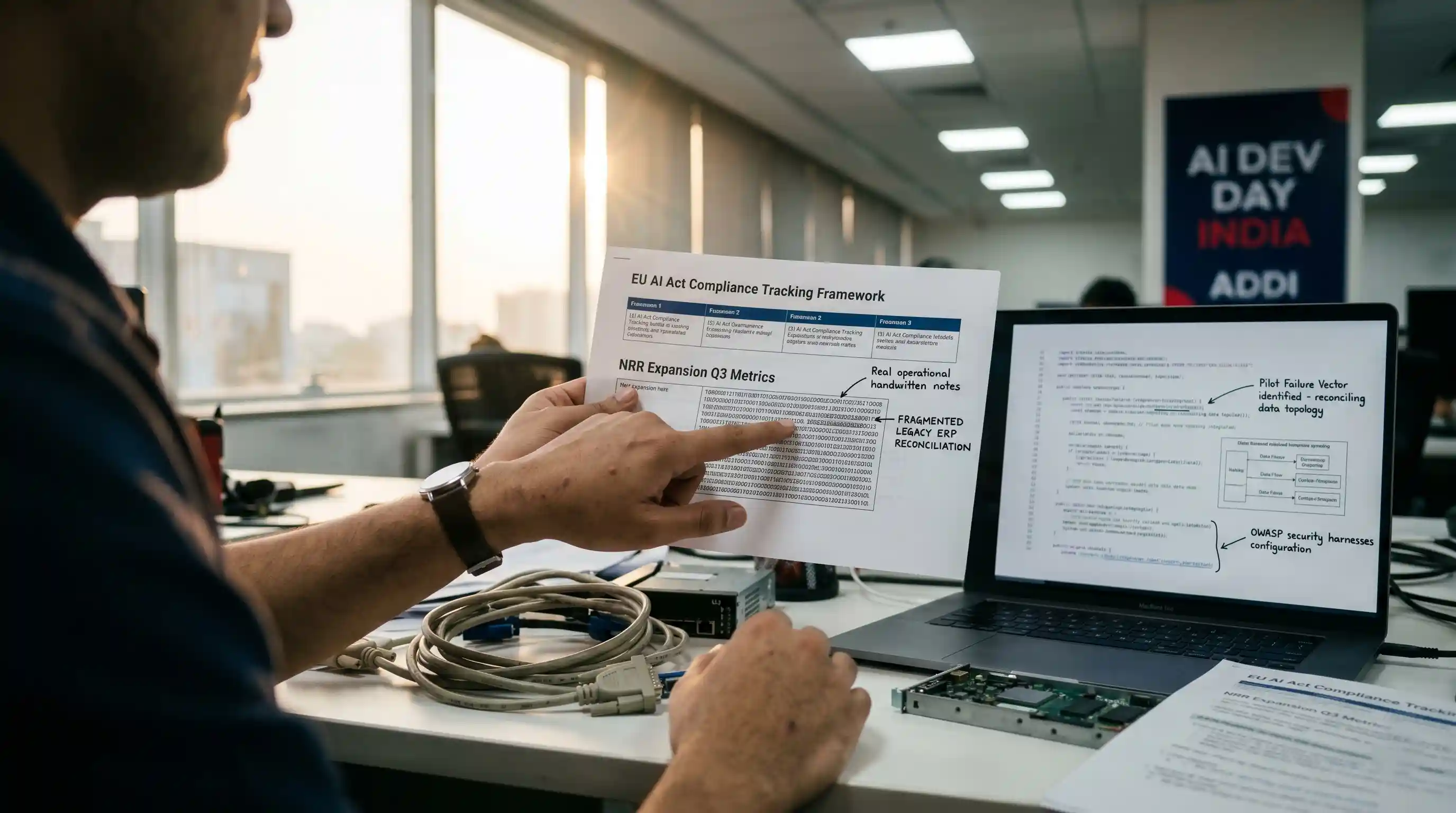
- The Failure Vector: Roughly 88% of enterprise AI agent initiatives experience critical operational failures when deployed without custom delivery frameworks.
- The Integration Barrier: Out-of-the-box vendor software fails systematically because it assumes clean corporate data topologies that legacy environments lack.
- Strategic Metrics: Success in the enterprise AI delivery role is measured rigorously by Net Revenue Retention (NRR) and post-sale statement of work (SOW) expansions.
- Compliance Gatekeeping: Forward-deployed engineering teams build the structural guardrails required to enforce EU AI Act and OWASP security frameworks at the database level.
An incredible 88% of organizations report critical AI agent incidents because their pilots are shipped directly to production without a dedicated delivery engineering architecture.
If your enterprise AI pilot has stalled because the vendor's out-of-the-box system assumed a perfectly clean data warehouse that you simply do not have, the gap is deployment engineering, not business strategy.
Enterprise environments require a complete structural shift from sandboxed demos to post-sale delivery systems.
Navigating this massive deployment friction requires embedding a seasoned Forward-Deployed AI Engineer directly into your internal infrastructure layers to build the custom integration glue legacy stacks demand.
Without this specialized technical ownership, your pilot will join the growing category of enterprise software projects that fail to clear the baseline production quality bar.
This operational blueprint unpacks the mechanics of the enterprise AI delivery role and provides the governance audit your technology leadership needs.
The Enterprise AI Delivery Role Explained
Why 88% of AI Pilots Stall at the Proof-of-Concept Stage
The high failure rate among modern enterprise AI initiatives is rarely caused by foundational model limitations. Instead, it is driven by a severe delivery bottleneck at the integration layer.
Most enterprise buyers launch pilots assuming that connecting a vendor API to their application front-end is sufficient.
However, when faced with real-world workloads, these wrappers experience immediate failures in accuracy, latency, and data governance.
Shifting from Generalist Software to Probabilistic Delivery Infrastructure
Traditional enterprise application development is completely deterministic, relying on structured pathways where input strings produce predictable output patterns.
Large language models operate in a highly probabilistic environment. Managing this non-deterministic layer inside legacy environments requires specialized infrastructure configurations.
An engineering delivery specialist must build automated validation workflows, configure isolated semantic caching proxies, and construct data orchestration systems to wrap non-deterministic outputs in predictable code frameworks.
FDE vs. Management Consultant: Closing the Implementation Gap
Why a Memo Cannot Fix Outdated ERP Data Warehouses
When an enterprise pilot stalls due to underlying system friction, management consultants write strategic memos diagnosing the organizational gap.
Unfortunately, strategic briefs cannot write production code or configure complex system integrations.
A Forward-Deployed AI Engineer closes this implementation gap entirely by operating as a senior individual contributor inside the client's stack.
They write the required PySpark transformations, configure cloud security parameters, and modify vendor SDKs to integrate seamlessly with outdated legacy databases.
The Post-Sale Value Chain: NRR and SOW Expansion Metrics
Unlike traditional pre-sales engineering teams focused strictly on securing upfront signatures, delivery engineers operate fully post-sale.
They are evaluated directly against enterprise metrics like Net Revenue Retention (NRR) and organic contract expansions.
This structural focus ensures that system metrics align perfectly with operational realities.
If an enterprise integration remains reliable two years down the line, the engineering delivery framework captures the value.
To see how top foundational labs value these post-sale metrics, study our unmasked market compensation guide.
What a Forward-Deployed AI Engineer Delivers in the First 90 Days
The standard implementation roadmap for an embedded delivery engineering engagement is divided into three highly technical execution sprints.
Days 1–30: Pipeline Integration and Security Proxies
The initial phase focuses on establishing secure, low-latency connectivity to protected enterprise data structures.
The delivery engineer builds custom, HIPAA or SOC 2 compliant proxy layers to mask sensitive data before it passes to external foundational APIs.
Concurrently, they configure cloud access controls and establish isolated network environments inside the customer's cloud infrastructure.
Days 31–60: Reconciling Legacy Systems into Standard Ontologies
During the second month, the FDE addresses the core data complexity issue.
They build data pipelines using technologies like PySpark to ingest, clean, and map highly fragmented legacy exports into a single target ontology.
This structural groundwork transforms chaotic historical database records into optimized context vectors that downstream agent workflows can accurately interpret.
Days 61–90: Fine-Tuned Automated Evaluation Suites
The final month of the engagement focuses on verifying production reliability.
The engineer constructs automated evaluation harnesses that continuously test the deployed model architecture against custom ground-truth datasets.
These safety gates are wired directly into the client's continuous integration pipelines to catch regressions or hallucinations before any new code versions ship.
Enterprise AI Governance and Regulatory Compliance
Navigating EU AI Act Compliance at the Stack Level
Deploying artificial intelligence within modern commercial spaces requires strict adherence to international legal parameters.
The EU AI Act and regional frameworks introduce stringent data lineage, bias mitigation, and transparency requirements for high-risk applications.
An enterprise delivery engineer builds automated tracking systems right into the integration layer to log every model decision and vector retrieval step.
This programmatic tracking ensures compliance audits can easily verify data history boundaries.
Enforcing Risk Mitigation under OWASP LLM Frameworks
Security vulnerabilities within language models can expose protected enterprise assets to exploitation.
Only 34.7% of organizations actively protect their orchestration layers against malicious manipulation.
Delivery engineers systematically enforce security mitigation by stress-testing applications against prompt injection, data poisoning, and unauthorized tool-use.
They implement runtime guardrails that validate agent behavior against established security standards before allow-listing automated actions.
For a structured look at how offensive teams actively test these parameters, review our comprehensive career blueprint.
Conclusion & CTA
Do not let your enterprise AI strategy stall at the proof-of-concept phase due to deployment complexity.
By shifting your focus from abstract strategy to production-grade delivery infrastructure, you insulate your applications from runtime failure modes and severe regulatory risks.
To trace how these technical delivery competencies compare to traditional software engineering trajectories over the past several years, study the comprehensive ai engineer roadmap on the legacy site.

Frequently Asked Questions (FAQ)
The enterprise AI delivery role is a highly specialized engineering discipline focused on operationalizing probabilistic systems within legacy corporate codebases. It exists to bridge the technical gap between clean vendor APIs and messy, real-world data infrastructure.
Pilots fail systematically because generic software solutions assume optimized data warehouses that enterprises lack. Without an embedded engineer to build custom data integration layers, applications experience immediate failures in accuracy, security, and performance.
Management consultants focus on high-level organizational workflows and strategy briefs. An enterprise AI delivery engineer is a senior individual contributor who works directly inside the client's codebase, writing production-grade integration layers, data models, and automated evaluation harnesses.
Within the first 90 days, an FDE builds secure API proxy setups, cleans and maps highly fragmented legacy database exports into unified ontologies, and establishes automated regression testing harnesses within the client's CI/CD pipeline.
FDE performance is measured using core post-sale financial and operational metrics. Success is defined by long-term contract renewals, net revenue retention growth, and the successful conversion of pilot applications into scaled production environments.
Yes, technical consultants looking to maintain high-leverage alignment should pivot toward delivery engineering. Modern foundational labs heavily prioritize professionals who can combine customer communication fluency with deep backend systems coding and cloud architecture capability.
Delivery roles ensure system configurations align directly with global regulatory requirements and industry standard security matrices, focusing heavily on data lineage auditing, access controls, and automated compliance tracking systems.
The FDE builds custom data tracking frameworks directly into the deployment application stack. These automated mechanisms capture model metrics, training bounds, and system decisions to ensure the application satisfies international transparency mandates.
Enterprises unlock massive efficiency gains by shortening time-to-production cycles from months to weeks. Staffing an FDE eliminates costly architecture reworks and ensures the core application survives enterprise security and compliance reviews.
While consulting firms often design the high-level business workflow strategy, they increasingly hire or partner with specialized FDE talent to execute the actual low-level code integration, data modeling, and security proxy configuration.