50 FDE Interview Questions: Land a $238K Offer (May 2026)
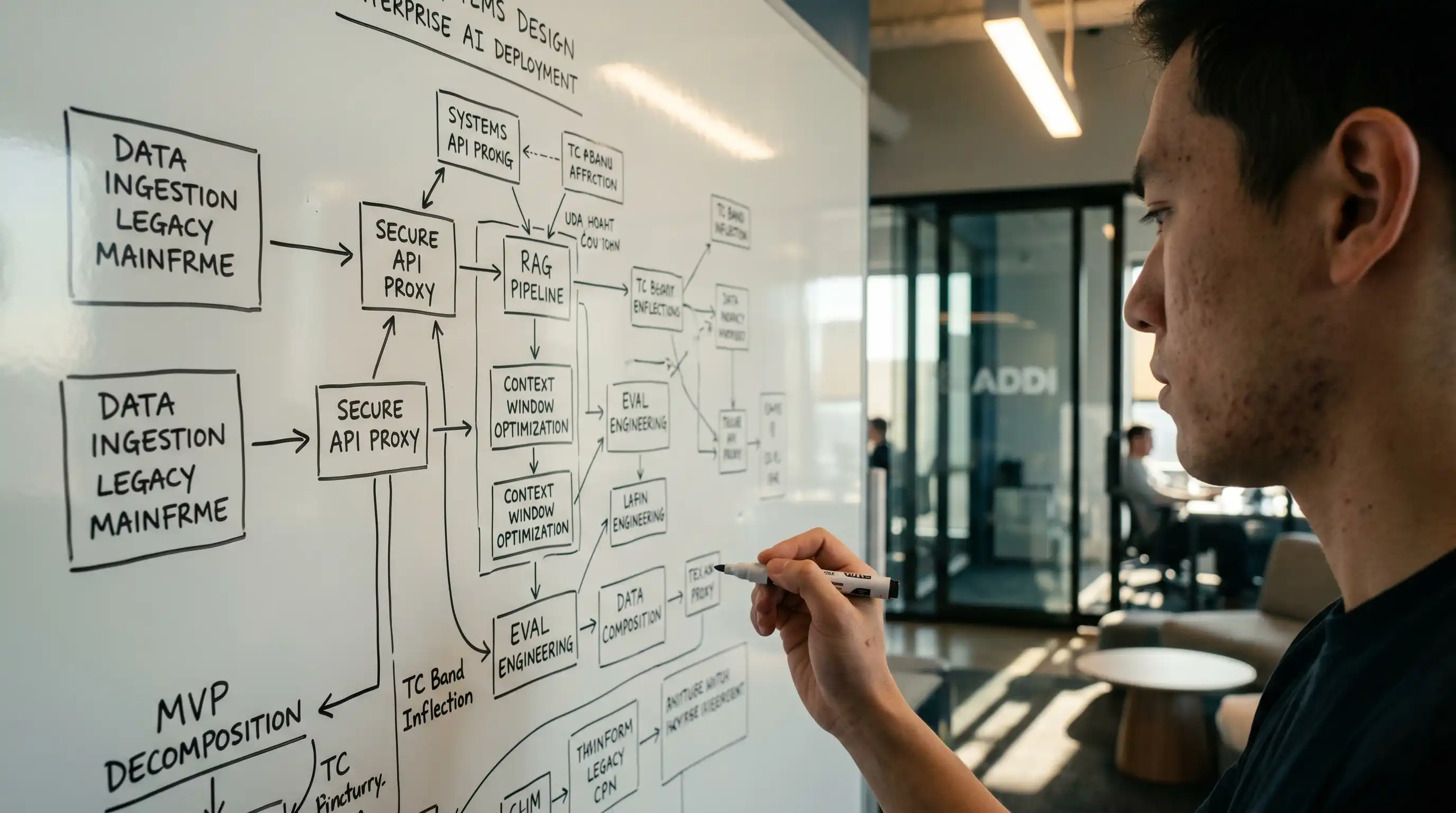
- Decomposition Focus: The core filter of the interview process is the system decomposition case study, not competitive programming.
- Integration Mindset: Live coding rounds prioritize real-world API management, proxy configurations, and end-to-end data pipelines.
- The Client Element: Top-tier labs simulate high-friction stakeholder scenarios to test your real-time customer engineering posture.
- Eval Engineering: True mastery requires designing robust evaluation harnesses to catch model regressions before enterprise deployment.
Candidates who prepare for Forward-Deployed Engineering roles with LeetCode marathons consistently underperform in case study rounds. The interview loop is explicitly screening for problem-structuring and integration thinking, not algorithmic recall.
If you approach these loops like a standard software engineering interview, you are likely exposing yourself to a fast rejection. Landing an offer as a Forward-Deployed AI Engineer requires mastering a multi-stage process that balances deep technical systems execution with high-leverage customer posture.
Navigating this pipeline successfully unlocks access to elite compensation bands that median $238K and scale past $630K at staff level.
This comprehensive question bank pulls back the curtain on the exact interview questions, case studies, and behavioral scripts deployed across top frontier labs like OpenAI, Anthropic, and Palantir.
The 3-Stage FDE Interview Framework
The standard evaluation pipeline spans roughly three weeks and consists of distinct screening gates. Each stage tests a unique layer of your delivery engineering capability.
Stage 1: The Behavioral and Ownership Screen
This initial 45-minute technical screen evaluates how you compress complex engineering narratives into business-comprehensible outcomes.
Interviewers look for explicit signals of ownership, resilience under scope ambiguity, and past experience managing high-friction stakeholder environments.
Stage 2: Integration-Heavy Technical Deep Dives
Expect two distinct technical evaluation rounds lasting 60 to 75 minutes each. The first round focuses on interactive coding, but shifts emphasis from algorithmic puzzles to live API composition, cloud infrastructure security, and real-world data parsing.
The second round centers on systems design specifically scoped to a messy enterprise migration or data ontology challenge.
Stage 3: The Decomposition Case Study and Client Simulation
This final loop tests your core deployment posture. You are handed a highly vague enterprise problem statement and evaluated on how you ask discovery questions, isolate an MVP, and map technical risks.
Some labs add a live customer simulation where an interviewer actively challenges your architecture to see if you can hold your ground while protecting the relationship.
Core Technical & Systems Design Questions
API Composition and Data Pipeline Engineering
- Design an enterprise-grade ingestion pipeline that processes 50,000 multi-format documents per hour into a vector database. How do you handle chunking strategies for mixed tables and text?
- How do you build a secure, HIPAA-compliant proxy layer between an enterprise healthcare stack and a third-party LLM API? Detail your consent-revocation and data masking logic.
- If a client's legacy database exports highly unstructured ERP data, how do you construct a PySpark pipeline to enforce a clean target ontology?
- Explain how you would architect a real-time retrieval pipeline using an MCP (Model Context Protocol) server layout. What are the primary latency bottlenecks?
- How do you handle rate-limiting and token throttling when scaling an enterprise AI application across multiple downstream API keys?
Infrastructure, Security, and Cloud IAM
- How do you configure cross-account AWS IAM roles to allow secure agentic tool access without exposing root administrative privileges?
- Detail your mitigation strategy against prompt injection attacks that target backend data storage systems via user input.
- What mechanisms do you implement to detect and defend against training data poisoning in an active production feedback loop?
- How do you establish isolated staging and production environments inside a highly regulated financial services stack?
- A client demands an on-premise deployment of an enterprise model suite. What are the key infrastructure trade-offs compared to a managed cloud API?
Evaluation & Retrieval-Augmented Generation (RAG) Scenarios
Quantifying Model Performance
How do you design an automated evaluation suite to catch subtle model regressions before a new version ships to production?
Detail the exact mathematical differences between tracking recall@k, Mean Reciprocal Rank (MRR), and hit-rate analysis in a RAG system.
How do you build an LLM-as-a-Judge pipeline that remains deterministic and cost-effective at enterprise scale?
What baseline datasets do you construct to validate that an enterprise chatbot does not leak proprietary company information?
A client's compliance team flags a critical hallucination pattern during a pilot phase. How do you wire an automated rollback gate into the CI/CD pipeline?
Context Window and Retrieval Optimization
How do you optimize context window usage when an application needs to reference long, multi-turn conversational histories?
What are the architectural benefits of utilizing a hybrid search pattern (sparse + dense) over dense vector embeddings alone?
How do you resolve the "lost in the middle" phenomenon when passing long retrieved contexts to foundational language models?
Explain your approach to dynamically adjusting chunk sizes based on document metadata filters.
How do you manage vector database index fragmentation when an enterprise client runs thousands of real-time data updates daily?
The Decomposition Case Study: Scenarios and Worked Scripts
The decomposition round separates traditional software developers from true delivery engineers. You must avoid jumping straight to system architecture before completely validating the underlying business reality.
Case Scenario: The Legacy Financial Services Migration
The Prompt: "A Fortune 100 bank wants to deploy an AI agent to automate internal portfolio compliance audits. Their data is trapped across three legacy mainframes, and their compliance parameters change quarterly based on multi-state regulations. Design the deployment strategy."
The Optimal Discovery Questions:
- What is the baseline latency threshold for an individual compliance audit report generation?
- How are regulatory updates currently ingested and verified by the human compliance team?
- Do we have direct access to place a secure API proxy layer over the legacy mainframe environments, or must we work via intermediate batch exports?
The MVP Framework: Propose a localized, read-only document extraction pipeline that targets a single regulatory framework first. Build a validated evaluation dataset using historical audit reports before expanding the scope to multi-state parallel processing.
Case Scenario: The Supply Chain Disruption Engine
The Prompt: "An international logistics enterprise wants an active agentic workflow to automatically reroute shipping shipments based on real-time weather alerts and global port delays. They want the system running in production in 45 days."
The Optimal Discovery Questions:
- What specific downstream systems are authorized to execute shipping changes, and do they support transactional rollbacks?
- What is the historical ground-truth data available for training our evaluation suite against past rerouting decisions?
The MVP Framework: Prioritize a human-in-the-loop advisory dashboard that outputs optimized rerouting recommendations along with clear confidence scores, completely bypassing autonomous execution tools during the initial pilot phase.
Behavioral, Posture, & Client Persona Questions
Navigating High-Friction Engagements
- Tell me about a time you embedded with a client and discovered the problem in the SOW was completely different from their actual technical bottleneck.
- How do you respond to a client CTO who insists on using a highly complex custom fine-tuning framework when a simple RAG implementation solves the business goal?
- Describe a scenario where you made a critical technical mistake during a live client deployment. How did you communicate the issue and handle remediation?
- How do you balance writing clean, sustainable production code with the intense timeline pressures of an on-site enterprise pilot?
- A client's internal data engineering team views your presence as an outsourced threat to their jobs. How do you establish trust and collaboration?
Structuring Strategic Value Narrative
How do you translate a complex system regression metrics shift into a clear ROI metric for a non-technical corporate sponsor?
Give an example of how you proactively identified a contract expansion opportunity during a routine technical integration phase.
How do you manage scope creep when a customer requests custom platform enhancements that fall completely outside the original deployment roadmap?
What metrics do you track to prove to an enterprise buyer that an AI deployment has successfully moved from experimental pilot to production readiness?
How do you handle a scenario where a client's internal security team completely blocks your cloud deployment architecture due to legacy data policies?
Advanced Agentic Workflow & Compliance Scenarios
Multi-Agent Coordination and Tool Execution
How do you architect a deterministic routing layer to prevent multi-agent systems from getting trapped in infinite loop states?
What safeguards do you implement when an enterprise agent is granted direct write access to a production customer relationship database?
Detail your approach to logging and auditing agentic execution paths for compliance tracking in a highly regulated industry.
How do you optimize state management when an agentic workflow spans multiple asynchronous, long-running human approval steps?
What are the primary operational failure modes when an application relies heavily on dynamic, model-generated tool schema definitions?
Global Regulatory Compliance and E-E-A-T
- How does your deployment strategy change when implementing an enterprise AI pipeline within the strict geographical boundaries of the EU AI Act?
- What architectural steps ensure an application strictly adheres to localized SOC 2 Type II data handling requirements?
- How do you prevent sensitive personally identifiable information (PII) from leaking into shared foundational model caching layers?
- Explain how you build a verifiable audit trail for an AI-generated decision within an insurance claims adjustment application.
- How do you handle data governance and retention boundaries when utilizing public model APIs for private enterprise workflows?
Conclusion & CTA
Cracking the interview pipeline at elite foundational labs requires treating problem decomposition as a core technical skill. If you want to transform your technical prep into a verified offer, shift your focus from abstract algorithms to production-grade system integrations, continuous evaluation metrics, and clear client-facing posture.
To systematically map out your complete 90-day transition timeline, study the comprehensive guide on building your delivery portfolio.
For an understanding of how these deployment trends integrate with historical developer growth trajectories, you can track the broader structural changes outlined in the ai engineer roadmap on the legacy site.

Frequently Asked Questions (FAQ)
Palantir loops focus heavily on your ability to work under intense ambiguity. Expect deep-dive questions on data engineering scalability, PySpark mechanics, and live customer simulations where interviewers actively stress-test your communication posture under pressure.
OpenAI's process balances systems integration design with business case problem-solving. Their loops extensively evaluate how you deploy and secure large-scale applications around their core model APIs, alongside a dedicated problem-structuring architecture round.
The decomposition round tests your ability to translate vague corporate problems into clean, structured engineering roadmaps. Prepare by practicing breaking down complex business scenarios into minimal viable products, isolating technical dependencies, and calling out implementation risks unprompted.
They are heavily weighted toward systems design, practical integration, and operational architecture. While basic coding proficiency is verified, loops deliberately avoid abstract competitive programming puzzles in favor of real-world data pipeline and API composition challenges.
Anthropic typically runs a three-stage loop including a technical behavioral screen, an integration-heavy systems design round, and an architecture case study. Their process places an exceptional emphasis on operational safety, alignment, and consulting fluency.
Behavioral rounds prioritize real-world ownership and client management stories. Expect variations of "tell me about a project that stalled due to legacy infrastructure constraints" and questions testing your ability to navigate corporate environments.
Yes, several premier labs integrate a client simulation element. An interviewer will roleplay a challenging stakeholder to evaluate whether you can defend an optimal technical implementation choice without damaging critical corporate relationships.
Typical assignments require candidates to build a functional retrieval pipeline against a chaotic, public data source. The evaluation indices heavily penalize developers who submit code without an accompanying system design document outlining their trade-off assumptions.
Focus your answer on the engineering impact of solving the industry's ultimate delivery bottleneck. Emphasize your passion for translating commoditized foundational APIs into high-value, highly secure enterprise infrastructure directly inside complex customer ecosystems.
The primary red flag is jumping straight into technical architecture before validating business constraints. Other major signals include an inability to speak to compliance frameworks, low data engineering depth, and freezing during highly ambiguous case study questions.