AutoGen vs OpenClaw: The Orchestration Myth
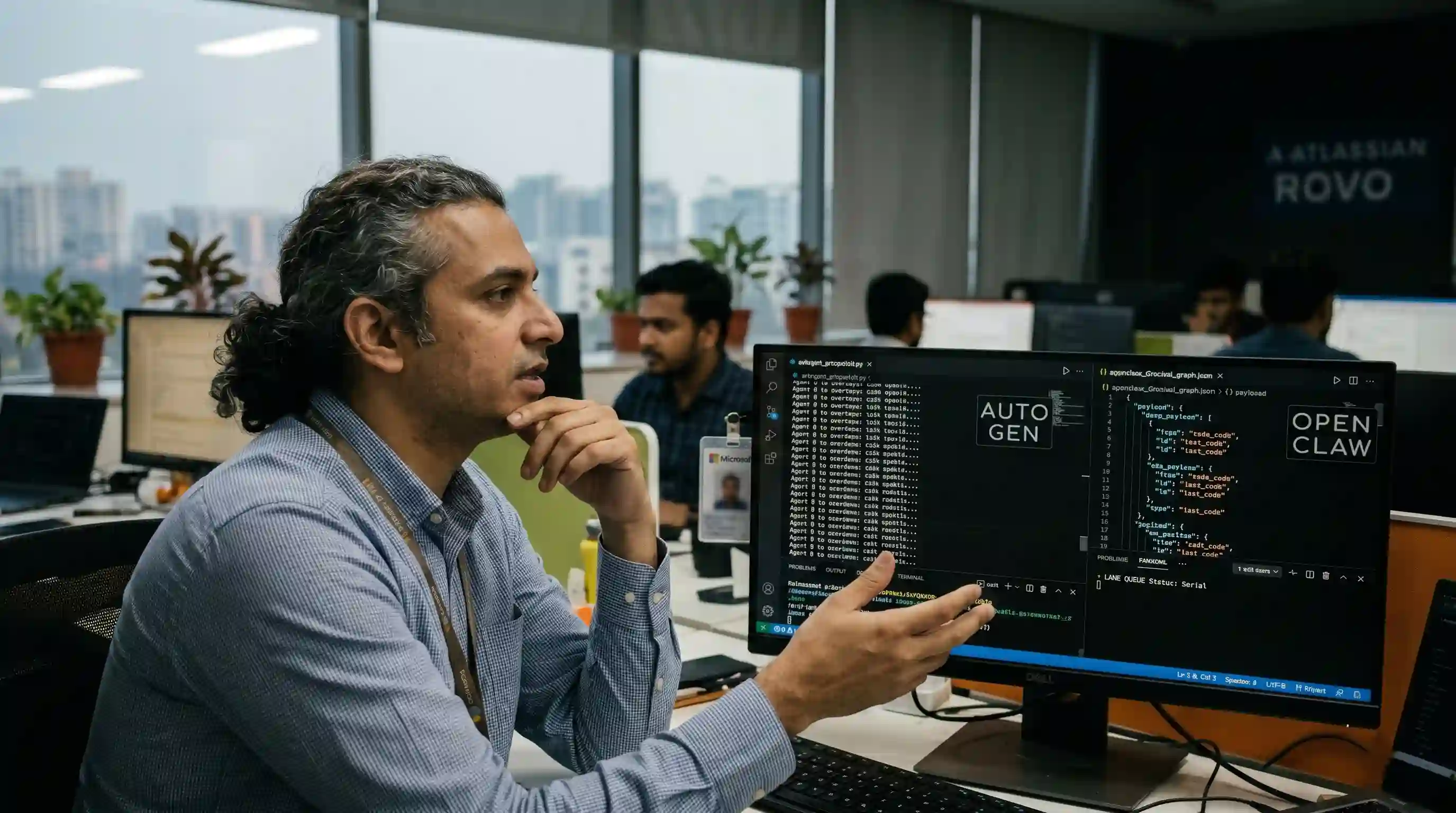
- Routing Architecture: AutoGen uses a conversational broadcast model, while OpenClaw relies on rigid, directed graph payloads.
- Token Efficiency: OpenClaw's direct handoffs prevent the exponential token bloat seen in AutoGen's GroupChat rooms.
- Execution Safety: OpenClaw's Lane Queue system enforces serial execution by default, preventing fatal concurrency bugs.
- Enterprise Fit: AutoGen excels in open-ended R&D brainstorming, whereas OpenClaw dominates structured CI/CD pipelines.
- Context Isolation: Proper orchestration requires locking down shared memory to avoid catastrophic hallucination loops.
Are your AI agents spending more time talking to each other than actually writing code? Stop the token bloat.
The "orchestration myth" is killing your ROI. Here is the architectural truth behind Microsoft AutoGen vs OpenClaw, and exactly which framework your enterprise actually needs.
Scaling your engineering operations requires fundamentally mastering the broader architecture of Agentic AI in software engineering. Vendors sell "multi-agent orchestration" as a magic bullet, but they fundamentally misunderstand how machines should route data.
Treating AI agents like human employees having a meeting is a massive architectural flaw.
This guide strips away the marketing hype to reveal how data actually flows through these two dominant frameworks, ensuring your choice aligns seamlessly with your established Agile development best practices.
The Orchestration Myth: Why "Multi-Agent" Is Meaningless
The term "multi-agent" has lost all technical meaning. Simply throwing three LLM prompts into a single script does not constitute enterprise orchestration.
True orchestration is about state management, execution queues, and deterministic routing.
If your agents are freely talking to each other without strict constraints, you do not have an orchestrated pipeline—you have an expensive chatbot.
To achieve real automation ROI, you must understand the underlying networking protocols that govern how Agent A passes data to Agent B.
Microsoft AutoGen: The Conversational Broadcast Model
Microsoft AutoGen pioneered the GroupChat paradigm. In this model, orchestration is treated like a virtual conference room where agents converse using natural language.
When an AutoGen coding agent writes a script, it broadcasts that output to the entire chat. The testing agent reads it, critiques it, and broadcasts its reply back to the room.
This conversational approach is incredibly intuitive for developers to set up. However, every single message appends to the shared context window, leading to massive token bloat and degraded reasoning on long tasks.
OpenClaw: The Directed Graph and Lane Queues
OpenClaw approaches orchestration like a strict microservices architecture. It completely abandons the "group chat" metaphor in favor of a directed graph structure.
Instead of broadcasting messages, OpenClaw passes highly specific, JSON-structured payloads only to the necessary downstream nodes.
The testing agent never sees the irrelevant system prompts of the coding agent.
Furthermore, OpenClaw introduced the Lane Queue innovation. It enforces serial execution by default per session, eliminating the data corruption and context leakage that plagues concurrent AI setups.
Benchmarking Architecture: Token Bloat vs Latency
When scaling to hundreds of autonomous pull requests, cloud compute costs become a critical factor. You cannot afford to pay for agents reading irrelevant chat history.
Because OpenClaw isolates context to specific graph nodes, it routinely cuts processing latency by 40% compared to conversational models.
Conversely, AutoGen's shared memory allows for serendipitous problem-solving, but at a massively inflated token cost.
When to Use AutoGen (Complex R&D)
Do not deploy AutoGen for predictable, repetitive software tasks. Use it for complex, open-ended R&D where the final architecture is completely unknown.
If you need a security persona, a performance persona, and a design persona to debate the merits of a new database schema, AutoGen's broadcast chat is unparalleled.
It mimics human brainstorming, making it ideal for the initial discovery phases of software architecture.
When to Use OpenClaw (Production CI/CD)
OpenClaw is the undisputed champion of operational automation. If the task has a defined start, middle, and end, you should be using a directed graph.
Deploy OpenClaw for your daily CI/CD tasks: writing unit tests, updating documentation, and fixing localized bugs.
Its strict Lane Queues guarantee that a localized database timeout will not cause your agents to hallucinate across the entire repository.
Building a Scalable Agent HQ
Choosing between AutoGen and OpenClaw is just the first step. You must securely integrate your chosen framework into your version control system.
You cannot run these frameworks on local machines and expect enterprise scalability. You must transition to a secure GitHub Agent HQ setup.
By establishing strict role-based access controls and leveraging OpenClaw's directed payloads, you can finally run multiple agents concurrently without destroying your main branch.

Frequently Asked Questions (FAQ)
The core difference lies in routing architecture. Microsoft AutoGen uses a conversational, broadcast-based GroupChat model where agents converse in a shared room. OpenClaw utilizes a directed graph architecture, passing specific data payloads strictly to necessary downstream nodes, eliminating massive token bloat.
OpenClaw routes tasks using a directed graph system and manages state via Lane Queues. This Lane Queue system enforces serial execution by default for each session. This strictly isolates memory and drastically reduces context leakage, concurrency bugs, and data corruption in production.
OpenClaw is highly superior for operational, CI/CD-driven enterprise pipelines because of its rigid payload routing and channel adapters. AutoGen is better suited for open-ended, complex R&D environments where conversational brainstorming between multiple distinct AI personas is required before generating a final output.