Claude vs Codex vs Copilot: Stop Picking One
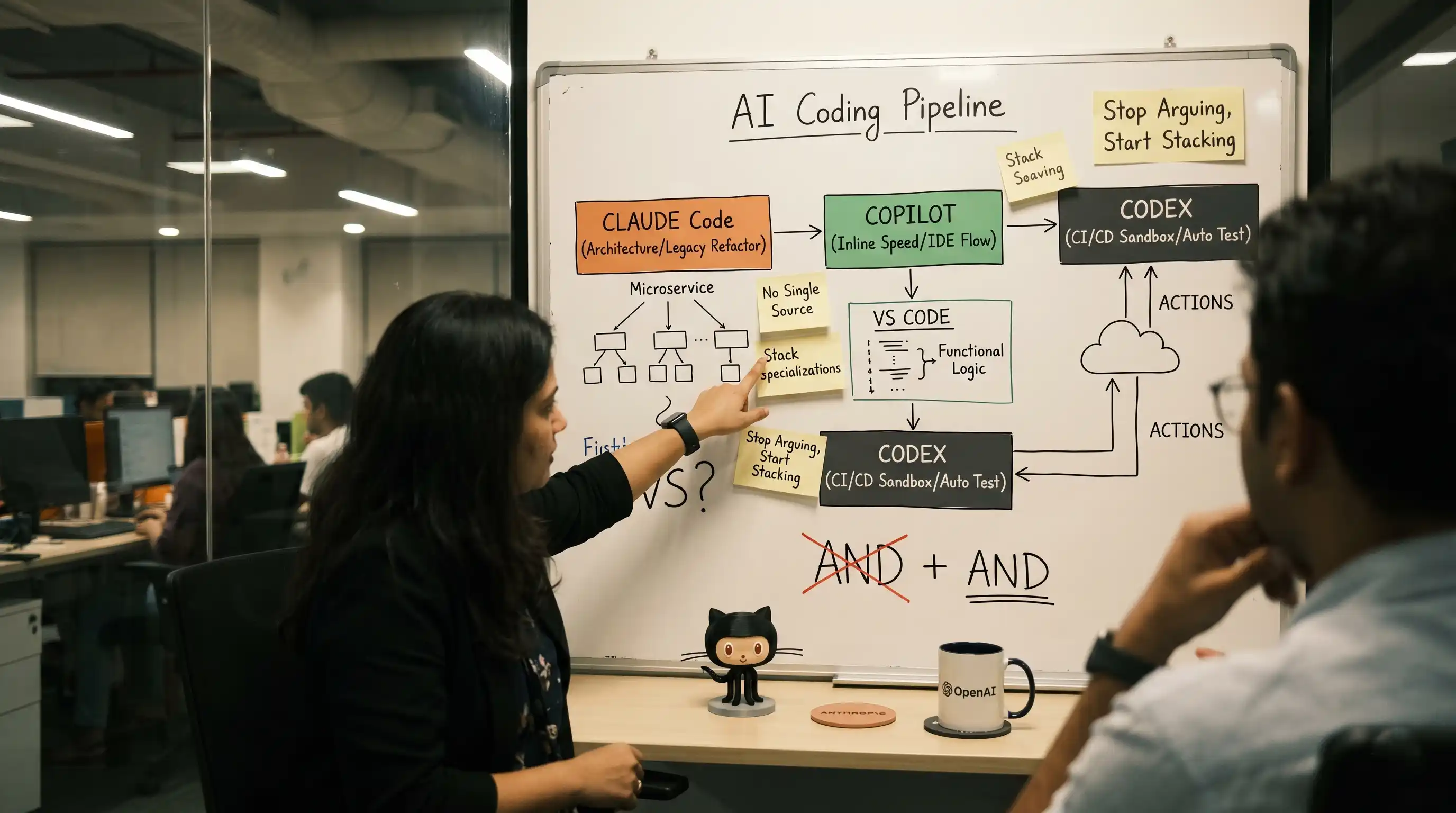
- Stop Single-Sourcing: Relying on one AI tool limits your velocity; stack them based on their unique architectural strengths.
- Copilot for the IDE: GitHub Copilot remains the undisputed king of inline, real-time code completion within your editor.
- Claude for Deep Context: Claude Code dominates multi-file refactoring and architectural reasoning due to its continuous execution loops.
- Codex for Autonomy: OpenAI Codex excels at sandboxed task delegation and parallel execution without freezing your local machine.
- Strategic Stacking: Route small tasks to Copilot, complex system architecture to Claude, and autonomous testing to Codex.
Are you still arguing over whether Claude, Codex, or Copilot is the best AI coding tool? Stop the chaos.
The most elite engineering teams are no longer choosing one; they are stacking all three to build an unstoppable development pipeline. Scaling your engineering output requires fundamentally rethinking the broader architecture of GitHub Agent HQ multi-agent orchestration in software engineering.
Relying on a single tool for every stage of the software development lifecycle creates bottlenecks and context loss. This guide strips away the marketing hype and provides a strict implementation protocol.
We will break down where each AI excels, ensuring your toolchain directly supports your established Agile development best practices.
The Core Difference: Collaboration vs Delegation
Throwing all your software tasks at a single AI model is a recipe for hallucination. To maximize ROI, you must understand the philosophical differences between these three platforms.
These tools are not direct competitors across all features. They were built for fundamentally different workflows and require entirely different management strategies.
You need a centralized understanding of when to collaborate with an AI and when to entirely delegate a task to an autonomous agent.
GitHub Copilot: The IDE Collaborator
GitHub Copilot is built for moment-to-moment, real-time collaboration. It thrives on keeping you in a state of deep focus without ever leaving your IDE.
Its underlying models are highly optimized for inline completion. When you need a quick regex pattern, a standard API call, or boilerplate logic, Copilot predicts your next move instantly.
However, Copilot struggles with deep, multi-file context. It is an AI pair programmer, not an autonomous agent meant to navigate your entire repository unsupervised.
OpenAI Codex: The Autonomous Delegator
Codex is engineered for end-to-end task delegation. Instead of suggesting lines as you type, Codex wants you to hand over a prompt and step away.
It thrives in CLI-first environments and cloud sandboxes. You can dispatch Codex to build an entire feature branch, and it will iteratively write, test, and correct its own code in isolation.
This isolated execution makes Codex incredibly powerful for parallel processing. You can run multiple Codex tasks simultaneously without bogging down your local GitHub Agent HQ setup.
Claude Code: The Contextual Architect
Claude Code bridges the gap with unparalleled reasoning capabilities. Unlike Copilot, which suggests snippets, or Codex, which requires rigid scoping, Claude continuously executes.
It can read your entire repository, trace complex call chains, and understand how a change in one microservice impacts an entirely different database schema.
When you need an AI to hunt down a systemic bug or refactor legacy architecture across dozens of files, Claude is the most capable tool on the market.
How to Stack All Three in Your Pipeline
Successfully running a multi-tool system requires strict compartmentalization. You must route the right task to the right AI to prevent overlapping efforts.
Step 1: Copilot for Inline Velocity
Keep GitHub Copilot running locally in VS Code or JetBrains for your day-to-day coding. Let it handle your unit tests, docstrings, and quick functional logic.
Do not expect it to rewrite your core application logic. Use it strictly as a high-speed autocomplete mechanism to keep your fingers moving while you guide the architecture.
Step 2: Claude for Architecture and Multi-File Edits
When you face a sprawling, undocumented legacy module, spin up Claude Code in your terminal.
Feed it the high-level objective and let it map the dependencies. Because Claude can spawn sub-agents to analyze different parts of your codebase simultaneously, it is the only tool trusted for sweeping structural changes.
Step 3: Codex for CI/CD and Sandboxed Testing
Integrate Codex into your continuous deployment pipeline. When a pull request is submitted, trigger Codex to autonomously spin up a sandbox environment.
Let Codex run aggressive vulnerability checks and test generation entirely in the background. It will review the output and flag issues before a human ever has to look at the PR.
Maximizing ROI with a Multi-Tool Strategy
The upfront effort of learning three different interfaces pays exponential dividends. You are transitioning from manual AI prompting to a highly specialized, automated software factory.
By leveraging Copilot for speed, Claude for context, and Codex for autonomous delegation, you eliminate hallucination loops and ship enterprise software at unprecedented speeds.

Frequently Asked Questions (FAQ)
GitHub Copilot is designed for real-time, inline collaboration directly within your IDE, acting as a pair programmer. OpenAI Codex is built for autonomous task delegation, allowing you to hand off entire features for independent execution in cloud sandboxes.
Claude Code excels in large codebases because of its massive context window and continuous execution architecture. It can seamlessly trace dependencies, analyze multi-file relationships, and execute complex refactoring across an entire repository without needing constant human intervention.
Your team should use all three strategically. Use Copilot for moment-to-moment inline coding, rely on Claude Code for complex architectural reasoning and multi-file refactoring, and deploy Codex for autonomous, sandboxed testing and CI/CD integration.