Run AI Agents in Parallel: Cut Review Time 40%
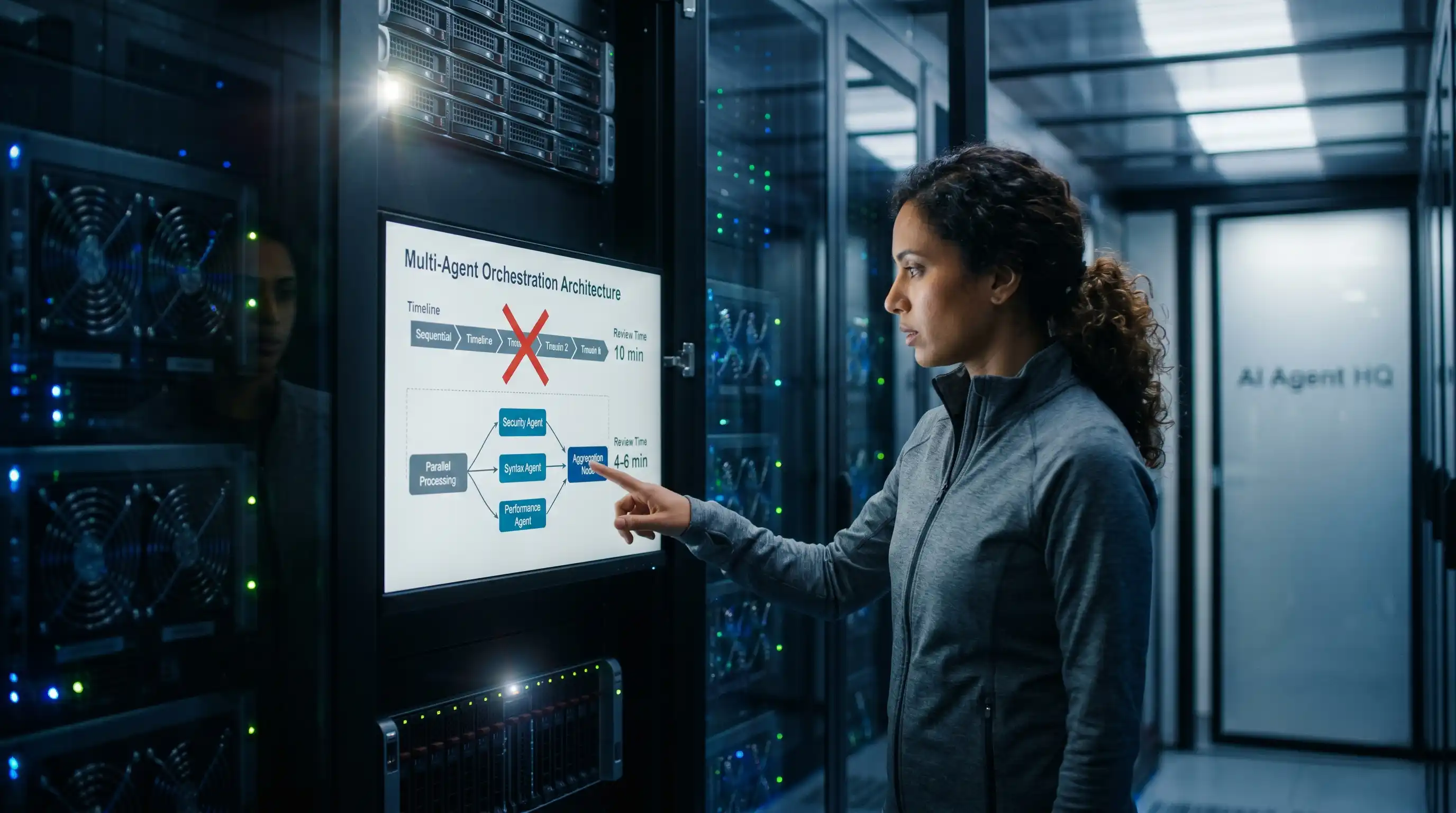
- Eliminate Queues: Sequential AI processing artificially inflates PR review times; parallel execution cuts this by 40%.
- Domain Partitioning: Never assign two agents to the same file segment. Isolate tasks by logic (e.g., security, syntax, performance).
- Asynchronous Callbacks: Use webhook-driven architectures to gather parallel agent responses without freezing your pipeline.
- Agile Alignment: Concurrent AI execution perfectly maps to the fast-feedback loops required by modern Agile workflows.
- Unified Aggregation: Always use a single orchestrator node to compile parallel findings into one cohesive human-readable report.
Are your AI dev agents waiting in line to read the same pull request? Stop the sequential bottleneck.
Here is exactly how to run AI agents in parallel and slash your code review cycle time by 40%. To truly scale your development velocity, you must mature your adoption of Agentic AI in software engineering.
Running a single AI agent on a massive pull request creates an immediate processing queue.
By restructuring your CI/CD pipeline to support concurrent AI execution, you force multiple specialized models to review different logical domains simultaneously.
This deep-dive framework reveals the exact architectural steps to deploy parallel agents without triggering catastrophic race conditions or merge conflicts.
The Mathematical Limit of Sequential Agent Workflows
Treating an AI agent like a human developer creates immediate scaling limits.
A human reads a file sequentially, top to bottom. When you force an LLM to read a 1,500-line pull request sequentially, context windows degrade.
The agent forgets the initial architecture by the time it reaches the final functional components.
Worse, you are paying for idle compute time. While an agent checks for security vulnerabilities, it is completely ignoring algorithmic efficiency and style guide compliance.
Identifying the Code Review Bottleneck
The primary bottleneck in automated code review is synchronous execution.
If Agent A takes three minutes to run, and Agent B waits for Agent A to finish, your pipeline is stalling.
This sequential wait time completely destroys your deployment velocity. It fundamentally violates the core principles of rapid iteration found in standard Agile development best practices.
You must transition from a synchronous queue to an asynchronous, concurrent event loop.
How to Run AI Agents in Parallel (The Architecture)
Executing multiple agents at once requires strict orchestration. If multiple agents attempt to write to the same branch simultaneously, your repository will lock.
You must build a highly deterministic architecture. This is the natural evolution of your foundational GitHub Agent HQ setup, shifting from basic automation to enterprise-scale orchestration.
Phase 1: Micro-Task Partitioning
Before triggering any agent, your CI/CD pipeline must parse the incoming pull request and split it into micro-tasks.
Do not send the entire diff to every agent. Instead, partition the payload based on specialized domains:
- Agent 1 (Security): Receives only authentication and database query files.
- Agent 2 (Performance): Receives only algorithmic loops and state management files.
- Agent 3 (Standards): Receives the raw text to verify linting and internal naming conventions.
Phase 2: Concurrent Sandbox Execution
Once partitioned, dispatch the payloads simultaneously via asynchronous webhook triggers.
Each agent must operate in a completely isolated cloud sandbox.
They must be granted read-only access to the partitioned diff to prevent accidental state mutations.
Because they are running in isolated execution environments, you eliminate the risk of race conditions. A failure in the syntax agent will not crash the security agent.
Phase 3: Merging Results without Hallucination Collisions
This is where parallel systems usually fail. If three agents post three separate comments on a GitHub PR simultaneously, human developers get overwhelmed.
You must introduce an Aggregator Node. This is a lightweight, fast LLM (like Claude 3.5 Haiku) whose sole job is to wait for all parallel agents to return their JSON payloads.
The Aggregator compiles the findings, deduplicates overlapping warnings, and posts a single, structured code review comment to the PR.
Achieving the 40% Code Review Time Reduction
By splitting the workload across three specialized, parallel instances, the total execution time drops to the duration of your single slowest agent.
If a sequential review took 10 minutes, parallel execution immediately reduces it to roughly 4 to 6 minutes, factoring in the slight latency of the Aggregator Node.
You are no longer waiting on compute. You are leveraging simultaneous intelligence to ship enterprise-grade code faster, safer, and with mathematically proven efficiency.

Frequently Asked Questions (FAQ)
Parallel AI execution works by splitting a single software engineering task, like a pull request review, into distinct logical domains. These micro-tasks are simultaneously dispatched to multiple isolated AI agents, which process the data concurrently before returning it to an aggregator.
The primary risks are race conditions, repository write-locks, and hallucination collisions. If multiple agents attempt to commit code to the same branch at the exact same time, it causes fatal merge conflicts, which is why read-only sandboxing is strictly required.
By moving from a sequential queue to an asynchronous execution model, parallel agents eliminate idle wait times. Instead of one AI taking ten minutes to check security, performance, and syntax sequentially, three agents complete all checks simultaneously in under six minutes.