Anthropic Overhauls Responsible Scaling Policy to Combat Catastrophic AI Risks (February 2026)
- Realistic Unilateralism: Anthropic is moving toward achievable individual safety commitments while pushing for industry-wide multilateral action on risks that no single company can mitigate alone.
- Frontier Safety Roadmap: A new requirement to publish concrete mitigation plans across Security, Alignment, Safeguards, and Policy, with progress openly graded by the public.
- Systematic Risk Reporting: The company will publish detailed Risk Reports every 3-6 months, explaining how model capabilities and active safeguards interact.
- Independent Oversight: Expert third-party reviewers with minimally-redacted access will now subject Anthropic’s safety reasoning and decision-making to public review.
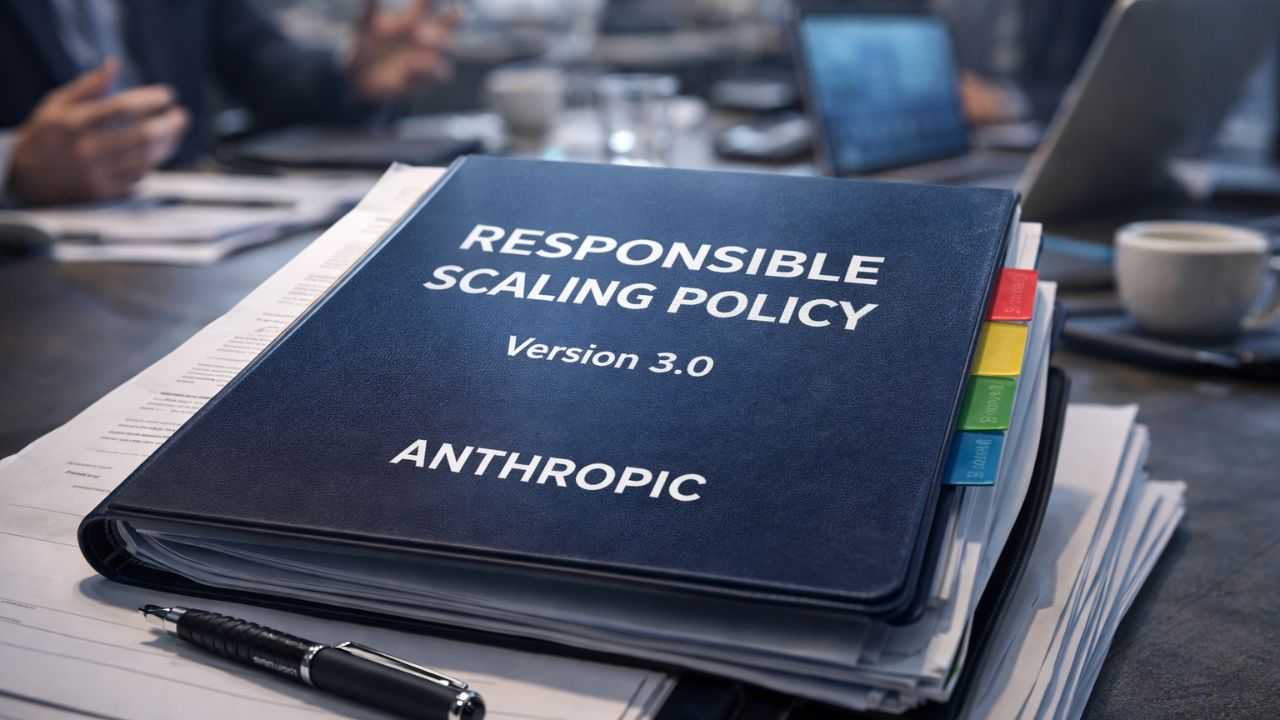
Anthropic has officially released Version 3.0 of its Responsible Scaling Policy (RSP), a voluntary safety framework designed to manage the emerging risks of exponentially advancing AI. This overhaul, a major focus for our latest-ai-news hub, marks a critical transition from treating AI as a simple chat interface to managing autonomous agents capable of multi-step actions, computer usage, and biological research.
This update addresses the growing complexity of governing AI as it integrates into core business architectures. It highlights the industry shift toward accountability and systematic reporting to maintain trust in the face of rapid capability growth.
The Challenge of the "Zone of Ambiguity"
Anthropic's update addresses a major flaw in previous safety models: the difficulty of determining exactly when a model crosses a dangerous capability threshold. The company admitted that the science of model evaluation is currently not developed enough to provide definitive answers.
Specifically, the company highlighted biological risks as a primary concern. While models show significant biological knowledge, current testing cannot conclusively prove if the risk to public safety is low or high, creating a "zone of ambiguity" that requires precautionary safeguards.
Moving Beyond ASL-3
While Anthropic successfully implemented ASL-3 safeguards—designed to block chemical and biological weapon knowledge—it warned that higher levels like ASL-4 may be impossible to achieve without help from the national security community. This structural challenge forced the pivot to Version 3.0.
As organizations adopt the GCC product ownership framework 2026, these safety protocols become the foundational layer for responsible enterprise deployments. Ensuring that autonomous agents operate within these safety boundaries is no longer an option but a technical necessity.
Safety as a Public Roadmap
The core of Version 3.0 is the Frontier Safety Roadmap, which shifts safety from static promises to an evolving R&D project. This roadmap includes "moonshot" goals for unprecedented information security and the development of automated red-teaming methods that surpass current human capabilities.
Anthropic is also implementing centralized monitoring systems to detect concerning behavior from both human and AI "insiders". This aims to provide a "regulatory ladder" that scales policy requirements as AI capabilities increase.
Why It Matters
The update to the Responsible Scaling Policy proves that AI safety is no longer a theoretical exercise but a high-stakes operational requirement in 2026. By acknowledging the limits of what one company can do unilaterally, Anthropic is pressuring governments to move faster on safety-oriented policy.
For the broader industry, this policy sets a new benchmark for transparency. By exposing the gaps between current safeguards and ideal safety standards, Anthropic is attempting to trigger a "race to the top" where models are judged as much by their security as their performance.
Frequently Asked Questions (FAQ)
The Responsible Scaling Policy (RSP) is a voluntary safety framework released by Anthropic designed to manage the emerging risks of exponentially advancing AI.
Biological risks refer to an AI model's ability to provide significant biological knowledge that could potentially be misused, requiring precautionary safeguards.