DeepEval vs Langfuse: Stop Using the Wrong One
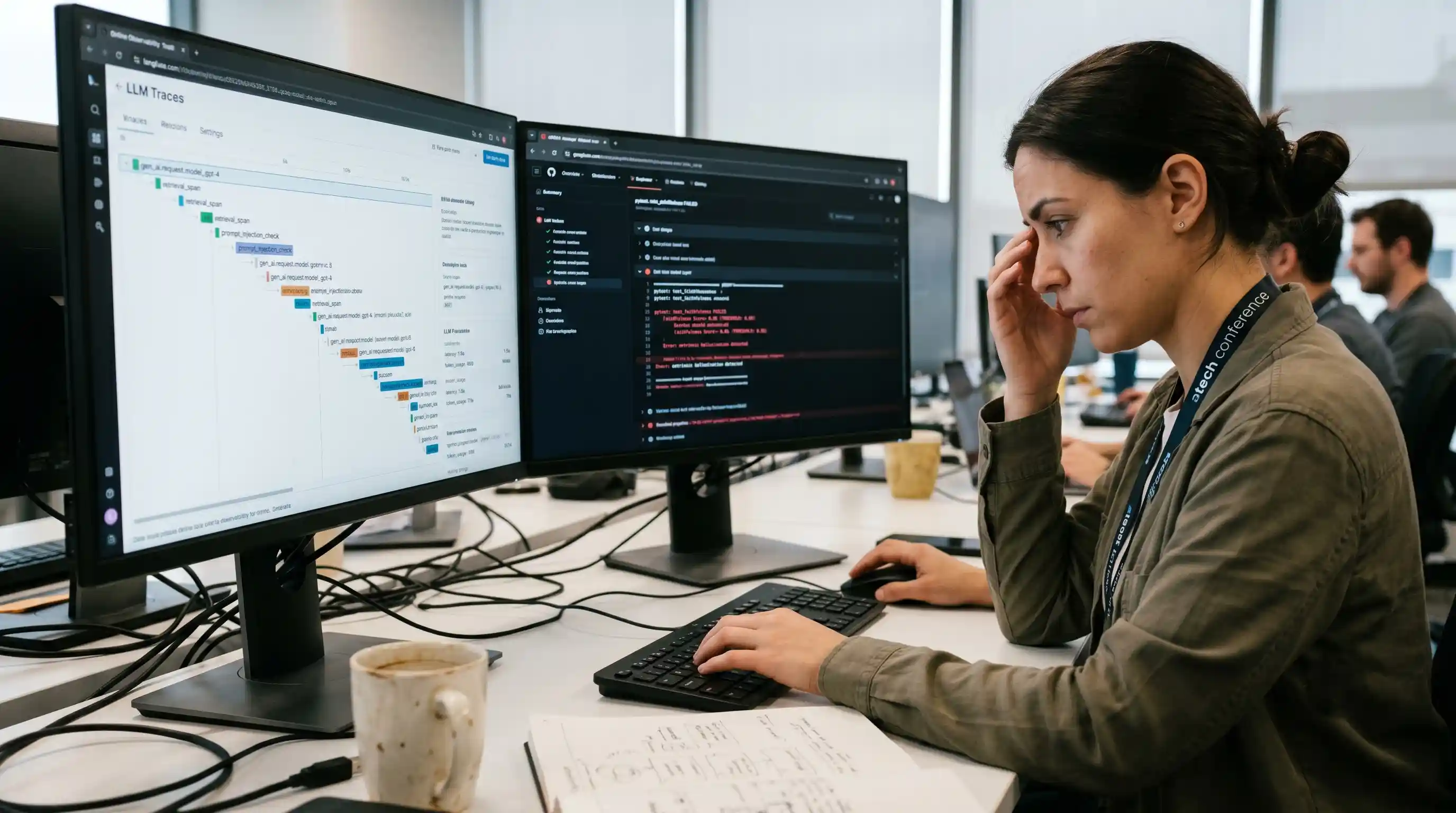
- Fundamental Divide: DeepEval is an automated evaluation framework for testing; Langfuse is an observability layer for production tracing.
- Metric Calculation: DeepEval handles complex scoring like G-Eval and faithfulness locally during CI/CD.
- Production Telemetry: Langfuse excels at capturing nested multi-agent traces and latency metrics in real time.
- The Winning Stack: The best teams do not choose one over the other; they run DeepEval offline and push the scores into Langfuse for online dashboards.
DeepEval and Langfuse solve entirely different problems—but 71% of engineering teams conflate them and build brittle AI pipelines as a result. You are either using a testing framework to do observability, or an observability tool to do unit testing.
If you are stepping into the high-stakes role of an LLM Evals Engineer, architecting the correct tool boundary is your first mandate.
Conflating these two layers results in invisible production degradation and massive technical debt.
The Fundamental Conflation: Evaluation vs. Observability
The AI tooling market is noisy, leading teams to treat "LLM evaluation open source python" tools as interchangeable. This is a critical architectural mistake.
Observability answers the question: What exactly happened during this LLM call? It captures token usage, latency, prompt inputs, and trace hierarchies.
Evaluation answers the question: Was this output actually any good? It applies statistical scoring, LLM-as-a-judge frameworks, and custom rubrics to assert quality.
Using Langfuse to strictly calculate offline evaluation metrics is inefficient. Using DeepEval to monitor live production traffic latency is impossible.
DeepEval: The Offline Evaluation Engine
DeepEval operates exactly like pytest for language models. It is designed to run in your development environment and act as a quality gate before your code ever hits production.
When you integrate DeepEval, you define deterministic thresholds for probabilistic outputs. If a developer alters a system prompt, DeepEval runs your golden dataset and scores it.
If the prompt causes the faithfulness score to drop below 0.85, the pipeline fails. This is the exact mechanism required for true LLM regression testing in CI/CD.
Out-of-the-Box Metrics: G-Eval and Faithfulness
DeepEval shines because it abstracts away the complex prompt engineering required for robust LLM-as-a-judge scoring.
It natively supports G-Eval, Hallucination, Answer Relevance, and Context Precision metrics out of the box.
You do not need to manually write scoring prompts; you simply call the DeepEval metric class.
Confident AI and the Enterprise Tier
For teams scaling beyond local command-line tests, the creators of DeepEval offer Confident AI.
Confident AI is the commercial dashboard that aggregates your DeepEval test runs over time.
It allows non-technical product managers to view CI/CD pass/fail rates without digging through GitHub Actions logs.
Langfuse: The Production Tracing Layer
Langfuse is an open-source observability platform designed to ingest massive volumes of production data. Its primary job is trace visualization.
When a user submits a complex query to your RAG application, Langfuse maps the entire execution tree.
It shows the retrieval latency, the embedding generation, and the final LLM response generation in a single cascading waterfall view.
Without this trace data, debugging a hallucination in production is effectively impossible. You must know exactly which context document was injected into the prompt.
Seamless LangChain and LangGraph Integration
Langfuse provides native callbacks for popular orchestration frameworks. This Langfuse integration with LangChain requires exactly two lines of Python.
For complex, multi-agent workflows, tracing a LangGraph run natively in Langfuse is unparalleled.
It maps cyclic agent loops flawlessly, ensuring you can audit exactly where a reasoning agent got stuck.
The Legacy Tooling Trap
Many teams realize their evaluation stack is broken only when they attempt to scale.
If you are currently relying on proprietary vendor platforms and hitting a trace-cap wall, you must plan an infrastructure migration carefully.
We strongly recommend reviewing our legacy comparison of LangSmith vs Langfuse vs AgentOps before committing to a self-hosted architecture.
The Ultimate Matrix: Combining DeepEval and Langfuse
The industry standard in 2026 is not to pick one, but to integrate them.
Run DeepEval in your GitHub Actions pipeline to block bad prompt changes.
Run Langfuse in production to trace live traffic.
Then, periodically sample Langfuse traces, pull them into DeepEval, score them for hallucination, and push the scores back to Langfuse for continuous quality monitoring.
Conclusion
DeepEval and Langfuse are not competitors; they are the two halves of a robust AI quality architecture. Use DeepEval to test your models before they ship, and use Langfuse to trace them once they are live. Stop conflating the two, and start building deterministic quality gates for your probabilistic pipelines.

Frequently Asked Questions (FAQ)
DeepEval is an open-source Python evaluation framework built like pytest for LLMs. It runs in your development or CI/CD environment, automatically scoring model outputs against predefined metrics like faithfulness and relevance to ensure quality before deployment.
Yes, the core DeepEval Python framework is open-source and free to use locally and in CI/CD pipelines. The team monetizes through Confident AI, an optional enterprise platform for hosting dashboards and managing evaluation datasets at scale.
DeepEval is generally not meant for live production routing. Instead, you integrate it into the FastAPI testing suite. You write test files that trigger your FastAPI endpoints, capture the LLM response, and run DeepEval assertions against those outputs during your build phase.
DeepEval natively supports G-Eval, Faithfulness, Answer Relevance, Context Precision, Context Recall, and Hallucination. It uses sophisticated LLM-as-a-judge templates under the hood, saving engineers from writing and calibrating their own evaluation prompts.
Langfuse complements DeepEval. Langfuse handles the observability, capturing the execution traces and production latencies. DeepEval handles the evaluation, running complex statistical checks on those traces. They are designed to be used together in a mature AI stack.
Langfuse offers native Python callbacks for LangGraph. By passing the Langfuse handler into your LangGraph execution configuration, Langfuse automatically captures the nested execution nodes, conditional edges, and cyclic loops of the agentic workflow in real-time.
Absolutely. DeepEval is built specifically for this workflow. You can trigger deepeval test run inside a standard GitHub Actions YAML file, configuring it to block pull requests if evaluation metric scores fall below a predetermined passing threshold.
Confident AI is the commercial enterprise platform built by the creators of DeepEval. While DeepEval runs the tests locally, Confident AI provides the collaborative UI, historical dataset versioning, and visual dashboards for tracking evaluation regressions over time.
DeepEval provides superior hallucination detection out of the box because it contains specialized, pre-calibrated evaluation metrics designed strictly for that purpose. Langfuse requires you to build or integrate an external evaluator to score the traces it collects.
Migrating from LangSmith to Langfuse 2026 requires writing a custom ETL script. You must export historical traces from LangSmith via their REST API, transform the JSON payloads to match Langfuse's trace schema, and POST them to your Langfuse instance.