Cost of Running LLM Locally vs Cloud (April 2026): The ROI Analysis for Devs
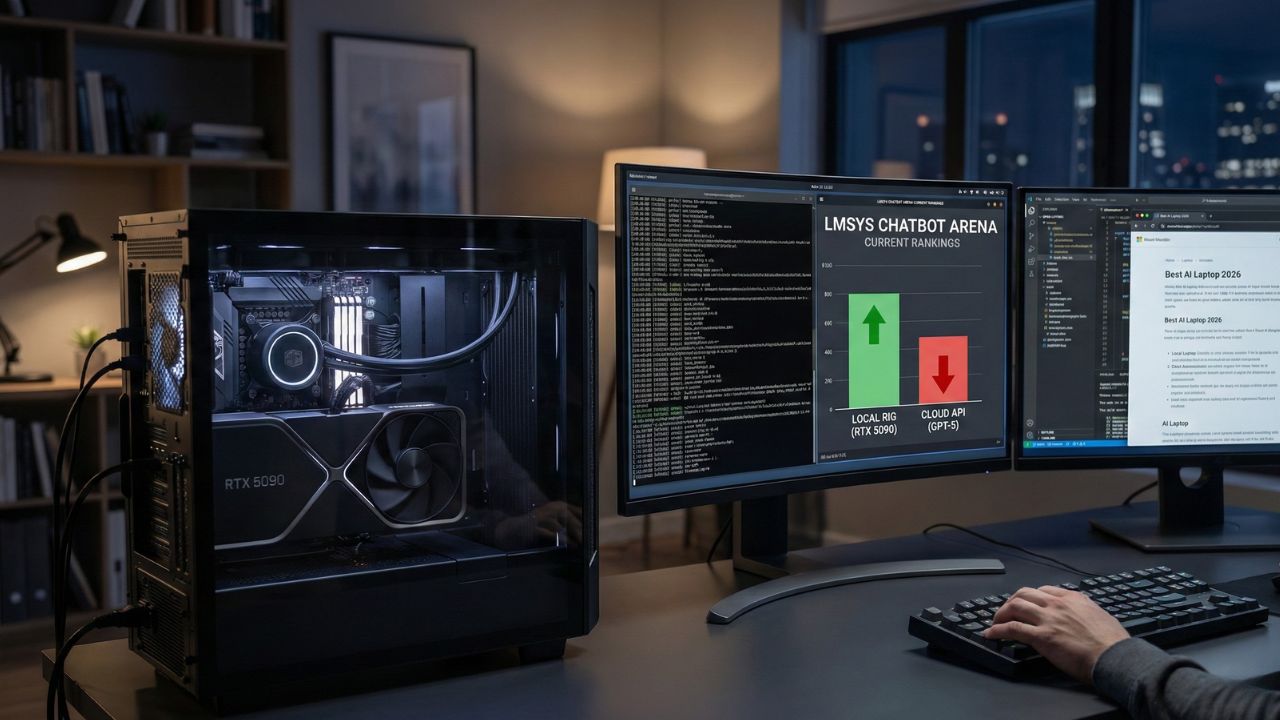
Key Takeaways: Quick Summary
- The Break-Even Point: For heavy coding workflows, a $3,000 local rig often pays for itself in under 5 months compared to GPT-5.4 API fees.
- Privacy Premium: Self-hosting eliminates the risk of IP leakage, a value that often outweighs raw compute costs for enterprise teams.
- Token Inflation: As "Agentic" workflows loop thousands of times per task, cloud bills are skyrocketing exponentially in 2026.
- Hardware Efficiency: Modern consumer hardware (Mac M4/M5, RTX 50-series) now rivals commercial cloud instances for inference speed.
- Hidden Costs: While you save on tokens, you must account for electricity (approx. $15-30/month) and setup time.
Introduction
In 2026, the most expensive line item for many engineering startups isn't cloud storage, it's intelligence.
As developers shift from simple chatbots to autonomous agents that run extensive loops, the cost of running LLM locally vs cloud has become the deciding factor in profitability. When your AI agent needs to "think" for 10 minutes to solve a bug, paying per token is financial suicide.
This deep dive is part of our extensive guide on LMSYS Chatbot Arena Current Rankings. While the leaderboard tells you which model is smartest, this financial breakdown tells you which deployment method keeps you in business.
LMSYS Chatbot Arena Target Benchmark (April 2026)
To understand the cloud costs you are offsetting, look at the intelligence level of the top commercial APIs dominating the latest LMSYS Arena. These are the models local setups aim to replace with open-weights equivalents:
| Rank | Model | Elo Score |
|---|---|---|
| 1 | claude-opus-4-6-thinking | 1504 |
| 2 | claude-opus-4-6 | 1500 |
| 3 | gemini-3.1-pro-preview | 1493 |
| 4 | grok-4.20-beta1 | 1491 |
| 5 | gemini-3-pro | 1486 |
*Note: Replicating the intelligence of models like Claude 4.6 or GPT-5.4 locally requires significant VRAM, driving the ROI calculations below.
The Token Trap: Why Cloud APIs Are Bleeding You Dry
Cloud APIs like OpenAI's GPT-5.4 or Anthropic's Claude 4.6 Opus are convenient, but they penalize "thinking."
The Agent Multiplier: A single complex coding task might require an agent to read files, plan, write code, error check, and rewrite. This loop can easily consume 50,000 to 100,000 tokens per task.
The Bill: At premium API rates, a team of 5 developers can easily rack up $2,000+ per month just on inference. If you are building autonomous swarms, the cloud model is fundamentally broken. You are renting intelligence at a markup.
The Hardware Investment: Owning Your Intelligence
The alternative is CapEx (Capital Expenditure). Instead of renting, you buy. Building a local machine requires an upfront investment, but it caps your costs.
Once you buy the GPU, your "cost per token" drops effectively to the price of electricity. For a detailed look at the specific machines that yield the best ROI, refer to our guide on the Best AI Laptop 2026, which breaks down the most cost-effective hardware investments for developers.
The Math: RTX 5090 vs. GPT-5.4 API
Let's look at a standard 2026 scenario for a heavy-user developer:
Cloud Scenario:
- Usage: 50 million tokens/month (heavy agentic coding).
- Est. Cost: ~$1,000 - $1,500 per month (depending on the model).
- Yearly Cost: $12,000 - $18,000.
Local Scenario (Custom Rig):
- Hardware: High-end Desktop with NVIDIA RTX 5090 (24GB VRAM).
- Upfront Cost: ~$3,500.
- Electricity: ~$25/month.
- Yearly Cost: ~$3,800.
The Verdict: The local rig pays for itself in roughly 3 months. After that, you are essentially printing intelligence for free.
Hidden Costs: It’s Not Just About Hardware
To be intellectually honest, we must look at the TCO (Total Cost of Ownership).
1. Electricity: Running a 450W GPU at full load for 8 hours a day adds up. Average Impact: Expect your electric bill to increase by $20-$40 per month depending on your region's kWh rates.
2. Setup & Maintenance: Your time is money. Configuring drivers, managing CUDA versions, and updating Ollama takes time. Cost: Expect to spend 2-4 hours a month on "Ops" work that the cloud handles for you.
3. Privacy Value (The Intangible): What is the cost of your source code leaking? For many firms, the cost of running LLM locally vs cloud tilts heavily toward local simply because the risk of data exfiltration via an API is unacceptable.
When Does Cloud Still Win?
Local isn't always the answer. Stick to the cloud if:
- Bursty Traffic: You only need AI once a week for a summary.
- Massive Models: You absolutely require the full 1-Trillion parameter reasoning of a frontier model that simply won't fit in 24GB or even 128GB of VRAM.
- Zero Ops: You have zero patience for Linux terminals or driver updates.
Conclusion
The cost of running LLM locally vs cloud in 2026 comes down to volume. For casual users, the cloud is cheap flexibility.
But for "Power Users" and engineering teams leveraging agentic workflows, local hardware is no longer a luxury, it is a financial necessity. By moving your compute to the edge, you lock in your costs, secure your data, and uncap your potential to experiment.
Optimize Your AI Workflow. Try SimilarWeb AI

We may earn a commission if you buy through this link. (This does not increase the price for you)
Frequently Asked Questions (FAQ)
Heavy users (coding agents, creative writing) can save over $10,000 per year per seat. The break-even point for a $3,000 rig is typically 3-4 months of heavy API usage.
For a single GPU workstation running heavy inference during work hours, expect to pay between $15 and $30 per month in electricity, depending on local energy rates.
A $3,000 AI laptop is roughly equivalent to 100-150 million input/output tokens on a premium frontier model (like GPT-5.4-Turbo). An active autonomous agent can burn this in a few months.
The intersection usually happens when you move from "Chat" (human speed) to "Agents" (machine speed). Once you automate the prompting loop, cloud costs spiral vertically while hardware costs remain flat.
TCO = (Hardware Cost) + (Monthly Electricity × 24 months) + (Maintenance Hours × Hourly Wage). Compare this total against (Monthly API Bill × 24 months).