How to Benchmark Custom LLM Prompts (April 2026): Professional Prompt Ops
Quick Summary: Key Takeaways
- Stop "Vibe Checking": Relying on manual spot-checks is professional malpractice in 2026; you need automated, statistical validation.
- LLM-as-a-Judge: The industry standard now involves using a frontier model (like Claude 4.6 Opus or GPT-5.4) to systematically grade the outputs of faster, cheaper production models.
- The "Golden Dataset": You cannot benchmark without a ground truth. Curating 50-100 perfect Q&A pairs is the first step in Prompt Ops.
- Metric Selection: Move beyond basic "correctness." Measure nuance, tone consistency, JSON formatting adherence, and refusal rates.
- CI/CD for Prompts: Treat prompts like code. Every change to a system prompt should trigger an automated regression test before deployment.
From Art to Engineering: The Rise of Prompt Ops
In the early days of generative AI, prompt engineering was an art form. You tweaked words until the output "felt right." In April 2026, that approach is obsolete. To build reliable AI applications, you must know how to benchmark custom LLM prompts using rigorous data science principles.
If you change one word in your system prompt, how do you know it didn't break 5% of your edge cases? You don't, unless you measure it.
The Evaluators: LMSYS Top 6 (April 2026)
To implement an effective "LLM-as-a-Judge" pipeline, your judge must be significantly more capable than the model it is evaluating. Based on the latest LMSYS Arena data, these are the current industry standard evaluators:
| Rank | Model | Elo Score |
|---|---|---|
| 1 | claude-opus-4-6-thinking | 1504 |
| 2 | claude-opus-4-6 | 1500 |
| 3 | gemini-3.1-pro-preview | 1493 |
| 4 | grok-4.20-beta1 | 1491 |
| 5 | gemini-3-pro | 1486 |
| 6 | gpt-5.4-high | 1484 |
*Note: Using these high-Elo models to grade faster production models like DeepSeek R1 or Llama 4 is the preferred enterprise strategy for April 2026.
Phase 1: Building the "Golden Dataset"
You cannot improve what you cannot measure. The foundation of Prompt Ops is a "Golden Dataset", a collection of inputs and their ideal outputs. Do not use synthetic data for this. Use real logs.
- Extract: Pull 100 real user queries from your logs.
- Filter: Select the 20 most difficult and 20 most common queries.
- Label: Manually write the "perfect" answer for each.
This dataset becomes your "Ground Truth." Every time you update your prompt, you run these 100 queries and compare the new AI output against your Ground Truth.
Phase 2: The "LLM-as-a-Judge" Framework
Human evaluation is too slow and expensive. The 2026 standard is to use an AI to grade an AI.
The Workflow:
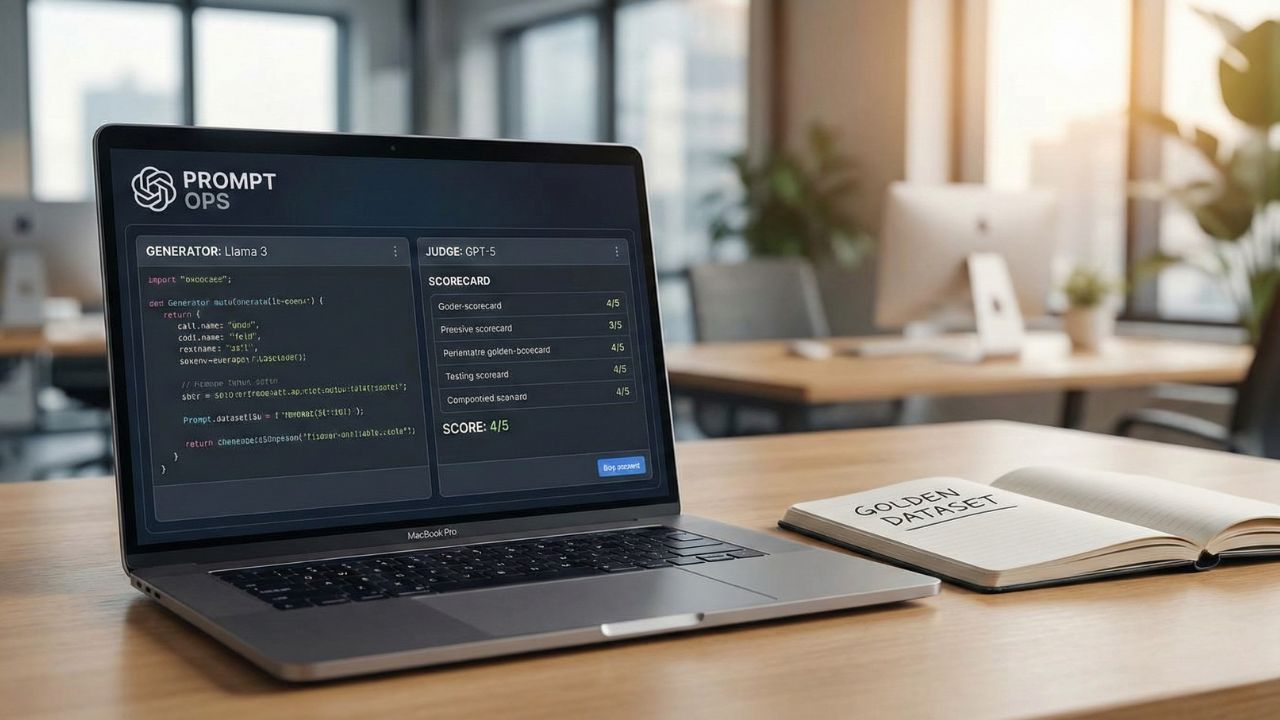
- Generator: Your production app (running a model like DeepSeek R1) generates an answer.
- Judge: A frontier model (running Claude 4.6 Opus or GPT-5.4) reads the generated answer and the Ground Truth.
- Score: The Judge assigns a score (1-5) based on specific criteria (accuracy, tone, brevity).
Phase 3: Defining Success Metrics
"Did it work?" is not a metric. You need specific KPIs for your prompts.
- Semantic Similarity: How close is the meaning to the Ground Truth?
- Strict Adherence: Did the model output valid JSON/SQL?
- Refusal Rate: How often did the model falsely claim it couldn't answer?
Phase 4: Continuous Integration (CI/CD) for Prompts
Treat your prompts like software code. They should live in a version control system (Git), not a Google Doc.
The Pipeline:
- Commit: Developer pushes a new prompt version to Git.
- Test: CI/CD triggers a script to run the "Golden Dataset" against the new prompt.
- Deploy: If the score improves, the prompt is pushed to production.
Conclusion: Trust in Data, Not Vibes
As AI models commoditize, your competitive advantage lies in your ability to rigorously control and evaluate them. Knowing how to benchmark custom LLM prompts ensures that every update you make improves your product rather than breaking it.
Optimize Your AI Workflow. Try SimilarWeb AI

We may earn a commission if you buy through this link. (This does not increase the price for you)