How to Fine-Tune Small Language Models (SLMs) Locally (April 2026): Training Your Own AI
Quick Summary: Key Takeaways
- Specialized Edge: A fine-tuned 7B parameter model often outperforms a generic GPT-5.4 class model on specialized niche tasks.
- The QLoRA Revolution: You no longer need a server farm; Quantized Low-Rank Adaptation (QLoRA) allows training on consumer GPUs.
- Privacy First: Local training ensures your proprietary data never leaves your firewall, solving critical IP concerns.
- Speed King: New tools in April 2026 like Unsloth have accelerated training speeds by up to 5x compared to standard setups.
- Instruction Tuning: 500 high-quality instruction pairs are more valuable than 50,000 lines of raw, messy text.
The Era of Specialized Intelligence
In 2025, the focus was on massive, general-purpose models. In April 2026, the edge belongs to the specialists. Learning how to fine tune small language models locally is the single most valuable skill for AI engineers today.
It allows you to transform a generic model into a master of your specific domain. General models like the new GPT-5.4 are impressive, but they are expensive and often hallucinate on niche industry jargon.
This deep dive is part of our extensive guide on LMSYS Chatbot Arena Leaderboard Current. Below, we break down the hardware and strategy needed to build your own "Specialist AI."
The Frontier Baseline: LMSYS Top 5 (April 2026)
To understand why local fine-tuning is so powerful, look at the scores of the "Generalists." Your goal with a fine-tuned SLM is to match these top-tier logic scores within your specific domain (e.g., Legal, Medical, or Coding):
| Rank | Model | Elo Score |
|---|---|---|
| 1 | claude-opus-4-6-thinking | 1504 |
| 2 | claude-opus-4-6 | 1500 |
| 3 | gemini-3.1-pro-preview | 1493 |
| 4 | grok-4.20-beta1 | 1491 |
| 5 | gemini-3-pro | 1486 |
*Note: While these giants command the overall leaderboard, a fine-tuned 7B model on specialized data can frequently beat them in a blind test for niche vertical tasks.
Why Go Local? The "Sovereign" Advantage
Why bother with the headache of local training when APIs exist? Two reasons: Cost and Control. Fine-tuning via an API creates a permanent recurring cost. Every time you iterate, you pay.
Local training is a one-time hardware investment. Once you buy the GPU, the compute is free. Furthermore, models like the ones featured in our DeepSeek LMSYS Rankings have proven that open-weights models are now capable of reasoning performance that rivals closed sources.
The Hardware Reality: Minimum Specs
Thanks to QLoRA (Quantized Low-Rank Adaptation), we can freeze the main model in 4-bit precision and only train a tiny "adapter" layer.
Minimum Specs for 7B/8B Models:
- GPU: NVIDIA RTX 3090 or 4090 (24GB VRAM is the sweet spot).
- RAM: 32GB System RAM minimum (64GB recommended).
- Storage: 1TB NVMe SSD for fast dataset tokenization.
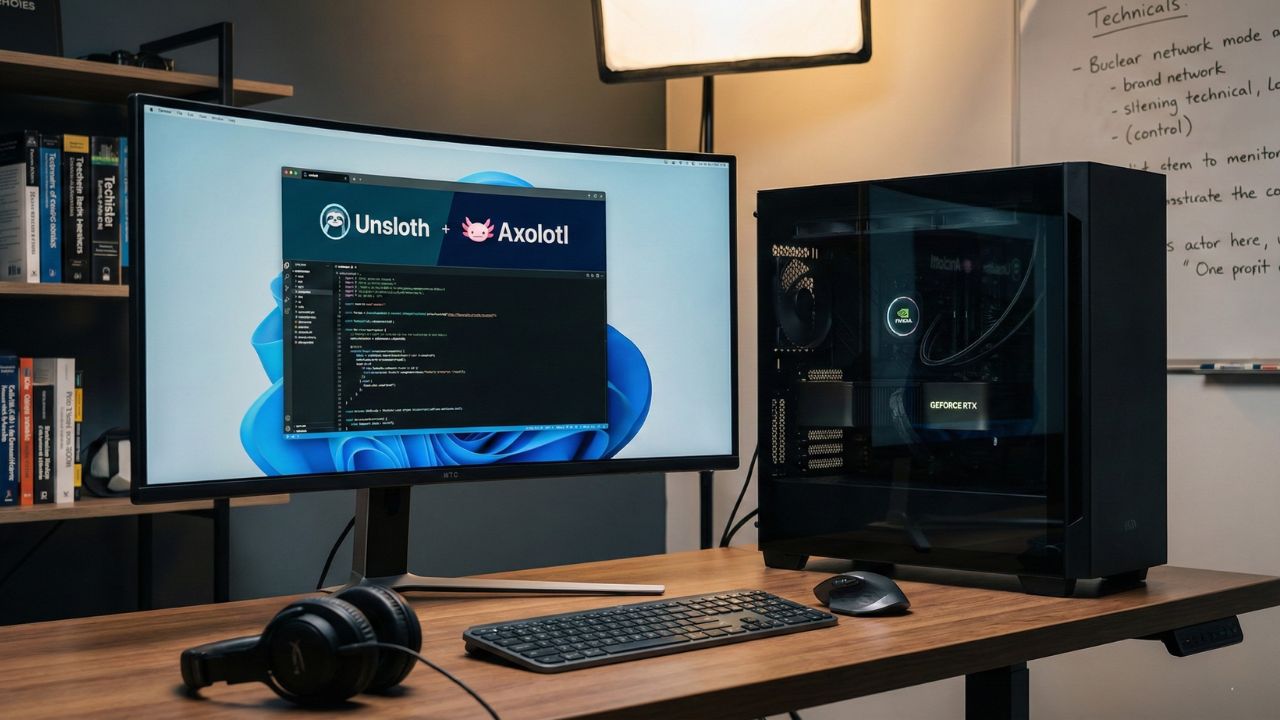
The Software Stack: Axolotl and Unsloth
The April 2026 meta revolves around config-based training. You no longer need to write raw PyTorch loops.
1. Unsloth (The Speed King): Optimized for Llama and Mistral. It reduces VRAM usage by up to 60%, allowing you to train on modest hardware.
2. Axolotl (The Versatility King): Manage everything via a single YAML file. It supports the widest variety of model architectures including the latest Llama 4 and DeepSeek V3 variants.
The Workflow:
- Load the base model in 4-bit via Unsloth.
- Attach LoRA adapters (training only 1-2% of total parameters).
- Feed your domain-specific instruction dataset.
- Merge and export to GGUF or EXL2 for local deployment.
Conclusion: Owning Your Intelligence
Mastering how to fine tune small language models locally in 2026 ensures you stop being a consumer of AI and become an architect of it. By focusing on quality data and efficient training frameworks, you can build proprietary models that are faster, cheaper, and more private than any cloud API.
Optimize Your AI Workflow. Try SimilarWeb AI

We may earn a commission if you buy through this link. (This does not increase the price for you)
Frequently Asked Questions (FAQ)
Yes. Using QLoRA (4-bit quantization), a 7B parameter model typically requires about 6-8GB of VRAM to load. A standard RTX 3060 (12GB) or RTX 4070 can handle this comfortably. For full 16-bit fine-tuning, you would need enterprise hardware, but QLoRA bridges this gap for consumers.
QLoRA stands for "Quantized Low-Rank Adaptation." It reduces the memory footprint of the Large Language Model by loading it in 4-bit precision (instead of 16-bit), while preserving performance by training a small set of high-precision adapters. This reduces memory requirements by nearly 75%.
LoRA works by freezing the pre-trained model weights and injecting trainable rank decomposition matrices into each layer of the Transformer architecture. This prevents "catastrophic forgetting" (where the model loses its original knowledge) because the original core brain of the model remains untouched.
In 2026, Unsloth and Axolotl are the industry standards. Unsloth is preferred for speed and memory efficiency on NVIDIA GPUs, while Axolotl offers a robust, configuration-based approach that supports a wider variety of model architectures.
While VRAM (Video RAM) is the bottleneck for the GPU, your system RAM is used to load the dataset and model before offloading to the GPU. For a 7B model, 32GB of system RAM is the safe minimum. If you are processing massive datasets, 64GB is recommended to prevent system crashes during the tokenization phase.