Naive RAG Is Dead: Agentic RAG's 2026 Architecture Win
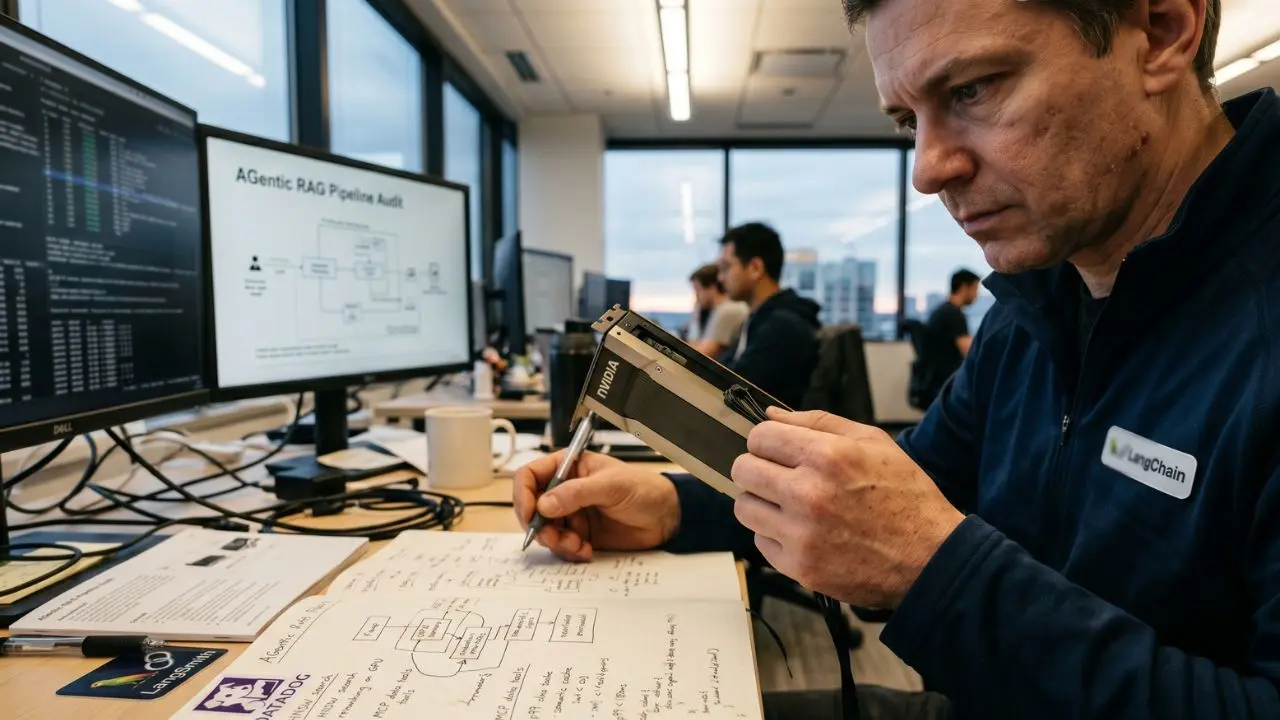
- The 41% Failure Rate: Standard vector search breaks down entirely when users ask comparative, multi-step, or aggregate questions.
- Intelligent Routing: Agentic architectures dynamically route queries to specialized tools, avoiding unnecessary—and expensive—vector database calls.
- Self-Reflection Loops: Corrective RAG (CRAG) enables the system to grade its own retrieval results and search again if context is irrelevant.
- MCP Integration: Modern agentic pipelines integrate directly with the Model Context Protocol (MCP) to read live systems alongside static vector stores.
When evaluating the agentic rag vs naive rag architecture 2026 landscape, the enterprise reality is stark: naive RAG fails on 41% of multi-hop queries. See the routing pattern that ships with MCP support today to fix your broken pipelines.
If you recently audited your infrastructure using our foundational guide, Your RAG Bill Is $9K/Month: 2026 Production Cost Reality, you already know that brute-forcing context windows is financially unsustainable.
The "retrieve-then-generate" baseline is no longer enough for complex reasoning. Today’s enterprise users expect systems to cross-reference multiple documents, synthesize disparate data, and self-correct when data is missing.
For deep dives into how engineering teams are evolving these standards, the developer ecosystem overviews at aidevdayindia.org provide excellent context.
The Death of Naive Single-Shot Retrieval
Standard naive RAG assumes every user question requires a semantic search. It blindly converts the prompt to a vector, pulls the top five nearest neighbors, and hopes the LLM can cobble an answer together.
This works perfectly for "What is our sick leave policy?" It fails spectacularly for "How does our Q3 revenue compare to the Q4 projection given the new API pricing?"
When semantic search retrieves documents based on vector proximity, it grabs chunks that sound similar. It cannot execute multi-step logic, sort by date, or aggregate numerical data across dozens of isolated PDFs.
The Agentic Paradigm: Treating Retrieval as a Tool
Agentic RAG flips the architecture. Instead of retrieval being the mandatory first step, the LLM acts as an orchestrator. It receives the user prompt and actively decides what needs to happen.
If the user asks a simple greeting, the agent answers instantly without burning a vector database read. If the user asks a complex question, the agent decomposes it into a multi-step plan.
It might query a SQL database for the revenue numbers, run a standard vector search for the pricing policy, and then synthesize both distinct inputs into a coherent, highly accurate response.
Corrective RAG (CRAG) and Self-Reflection
The hallmark of a robust 2026 architecture is the introduction of self-reflection loops. Corrective RAG empowers the agent to act as its own quality assurance team.
After executing a retrieval, the agent mathematically grades the relevance of the retrieved chunks. If the chunks don't hold the answer, the agent rejects them.
It then rewrites the search query from a different angle and queries the vector database again, or pivots to a fallback tool like an enterprise web search, guaranteeing fewer hallucinations.
Model Context Protocol (MCP) Integration
Vector databases are inherently static snapshots. By integrating the Model Context Protocol (MCP), agentic RAG breaks out of the vector silo.
MCP standardizes how AI agents securely access live enterprise tools. Your agent can simultaneously retrieve an embedded PDF from Pinecone while securely checking real-time Jira statuses via MCP.
This hybrid retrieval model—merging dense vector archives with live operational states—is exactly why the industry has declared naive single-shot architecture effectively obsolete for production-grade GenAI.
Streamline Your Business Communications with AI. Try Cloud Talk

We may earn a commission if you buy through this link. (This does not increase the price for you)
Frequently Asked Questions
What is the fundamental difference between agentic RAG and naive RAG?
Naive RAG uses a linear "retrieve once, generate once" path. Agentic RAG employs an LLM as a reasoning engine to break down complex queries, plan multiple retrieval steps, grade the results, and self-correct before generating the final answer.
Why does naive single-shot retrieval fail on complex enterprise queries?
Naive RAG relies purely on semantic similarity. When a user asks a comparative or multi-hop question (e.g., "How did our Q3 revenue compare to Q4 given the new pricing?"), a single vector search cannot retrieve the disparate documents required, leading to a 41% failure rate.
How does Corrective RAG (CRAG) improve retrieval accuracy?
CRAG introduces a self-reflection loop. The agent evaluates the retrieved chunks against the original query. If the context is deemed irrelevant or insufficient, it rewrites the query and searches again—or utilizes a web-search fallback—before drafting the response.
What role does the Model Context Protocol (MCP) play in agentic RAG?
MCP allows agents to interface directly with live, operational systems instead of just static vector databases. This enables the RAG pipeline to securely pull up-to-the-minute data from CRMs, internal APIs, and active databases.
Are agentic routing architectures more expensive to run than naive RAG?
In isolation, an agentic query burns more tokens due to reasoning loops. However, in aggregate, agentic routing saves money by directing simple questions to cheap, local models while reserving expensive vector searches and frontier LLMs strictly for complex multi-hop tasks.
Which framework is best for building agentic RAG: LangGraph or CrewAI?
LangGraph is superior for highly deterministic, graph-based execution paths where strict control over state and loops is required. CrewAI is better suited for collaborative, multi-agent workflows where distinct personas must communicate to solve open-ended tasks.
Does agentic RAG require a different evaluation methodology?
Yes. You cannot just measure the final output. You must evaluate the agent's intermediate steps: the accuracy of its query routing, the quality of its query rewrites, and the precision of its self-grading loops during the retrieval phase.
What's the latency penalty of agentic RAG vs naive single-shot retrieval?
Agentic RAG generally adds 500ms to 2.5 seconds of latency per query. This happens because the LLM must "think" (execute reasoning tokens), grade context, and potentially perform secondary database lookups before streaming the final answer to the user.
How do you debug an agentic RAG pipeline when retrieval fails silently?
You must use LLM observability tools (like LangSmith or Phoenix) that capture full execution traces. You need to inspect the exact prompt the agent generated for its internal tool calls to see where its reasoning or query rewriting deviated.
Can I upgrade my existing naive RAG pipeline without rebuilding the vector DB?
Yes. The vector database remains unchanged. Upgrading to agentic RAG only requires replacing your static orchestration layer with an agent framework that treats your existing vector database as an accessible tool rather than a mandatory first step.