Chunking 500K Docs: The 3 Mistakes That 2x Your Cost
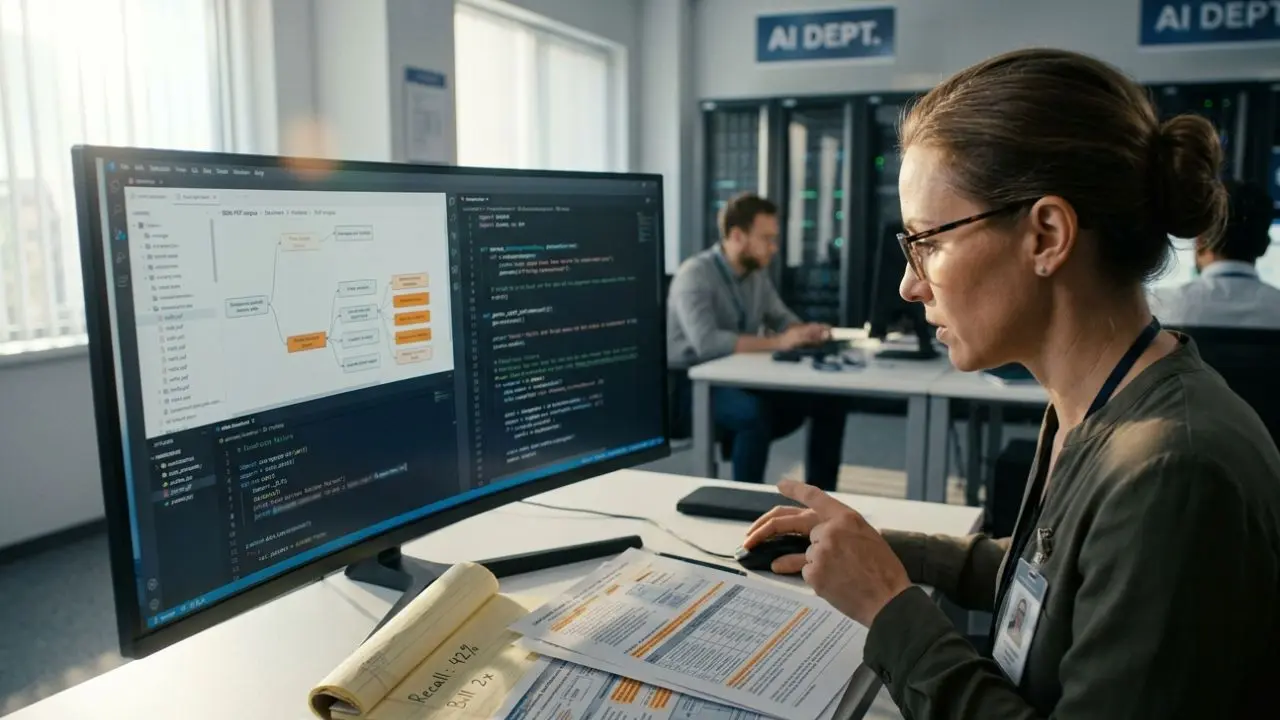
- Fixed-size failure: Blindly splitting by character count destroys context, forcing LLMs to hallucinate answers from fractured sentences.
- Format blindness: Treating complex PDFs, markdown, and code as identical unstructured strings guarantees lost table and figure context.
- The overlap trap: Relying on massive chunk overlaps to preserve context artificially inflates your vector database size and embedding costs.
- Reranker misalignment: Generating chunks larger than your cross-encoder's context window leads to silent truncation and massive recall drops.
Your RAG POC worked flawlessly on 1,000 PDFs. But scaling to a 500K-document enterprise corpus broke your recall, and your infrastructure bill just doubled. The culprit isn't your vector database or your LLM. It's your naive approach to chunking.
Here are the three parsing mistakes silently draining your budget and destroying your system's accuracy. As we broke down in our comprehensive production RAG cost architecture analysis, ingestion inefficiencies are the silent killer of AI ROI.
At enterprise scale, your rag chunking strategy 500k documents is the difference between a highly performant retrieval engine and a chaotic, hallucination-prone money pit. Let's audit the semantic-boundary playbook every senior engineer needs to deploy.
Mistake 1: Fixed-Size Slicing Over Semantic Boundaries
Most engineering teams start with a recursive character text splitter set to 512 or 1024 tokens. For a quick demo, this works. For 500,000 documents, it is financial malpractice.
When you split text at a fixed token limit, you inevitably cut sentences in half. You separate a core claim from its evidence. The LLM receives a context chunk that says, "...due to these reasons," but the actual reasons are stuck in the previous chunk that wasn't retrieved.
The result? The LLM hallucinates to fill the gap, your users lose trust, and you pay for a "failed" retrieval call. Switching to semantic chunking—where boundaries are determined by sentence completion or topic shifts—reduces hallucination rates by up to 22% in multi-hop query benchmarks.
Mistake 2: Ignoring Document-Specific Layout Logic (Format Blindness)
A Python code file, a legal contract PDF, and a Slack export should never be chunked the same way. Format blindness is the second major cost driver.
If you treat a table in a PDF as standard text, the row-and-column relationships are destroyed. The vector search will pull "Cell A1" and "Cell B7," but the LLM will have no idea they belong to the same row. This forces engineering teams to increase retrieval depth (top-k) to compensate, which triples your LLM token burn.
High-performance teams utilize layout-aware parsers. By identifying headers, tables, and lists before chunking, you ensure that related data stays together. This "structural integrity" allows you to reduce your retrieval count from top-20 to top-5, saving thousands in monthly generation costs.
Mistake 3: The Overlap Trap: Redundancy vs. Context
To fix the "cut-off" problem in fixed-size splitting, many teams implement a 10% or 20% chunk overlap. This is the "Overlap Trap."
At 500,000 documents, a 20% overlap means you are paying to store 100,000 "extra" documents in your vector database. You are paying to embed them, and you are paying for the RAM to host them. It is a brute-force solution to a precision problem.
Instead of global overlaps, move toward "Parent-Document Retrieval." Store small, precise chunks (the children) for the vector search, but retrieve the larger surrounding context (the parent) for the LLM. This delivers perfect context without bloating your vector index with redundant data.
Optimizing Chunk Sizes for Frontier Models
The optimal chunk size is not a constant; it is a variable that must be aligned with your specific embedding model and LLM context window. Models like OpenAI's `text-embedding-3-small` handle larger context windows differently than specialized models like Voyage-3.
Furthermore, if you use a reranker (like Cohere Rerank), your chunks must fit within the reranker’s much smaller context window. If your chunks are 1,000 tokens but your reranker only sees 512, the most important context is silently truncated before it ever reaches the LLM.
Metadata Enrichment for Hybrid Search
Chunking is not just about cutting text; it’s about adding data. Every chunk in a 500K-corpus must be enriched with metadata: source URL, page number, document type, and a summary of the parent document.
This allows for "Hybrid Search," where you can filter by metadata (e.g., "only search docs from 2024") before the vector search even starts. This dramatically improves retrieval accuracy and reduces the compute load on your vector database, further lowering your TCO.
Streamline Your Business Communications with AI. Try Cloud Talk

We may earn a commission if you buy through this link. (This does not increase the price for you)
Frequently Asked Questions (FAQ)
Does chunk size directly impact vector database storage costs?
Yes. Smaller chunks create a higher total vector count for the same corpus, increasing storage fees and retrieval compute overhead. Conversely, overly large chunks reduce storage costs but hallucination rates rise due to context starvation.
What's the chunking sweet spot for OpenAI vs Cohere vs Voyage embeddings?
OpenAI's text-embedding-3 works well with slightly larger chunks (500-800 tokens), while Cohere and Voyage models are highly optimized for precision with tighter, 250-400 token semantic blocks. Always align your chunk size with the model's specific training distribution.
How do you A/B test chunking strategies without re-embedding the whole corpus?
Create a highly representative "golden dataset" of 5,000 documents. Run varying chunking pipelines on this subset, generate embeddings, and test them against your standard evaluation queries. Only push the winning strategy to the full 500K production corpus.
What chunking metadata should I store to enable hybrid filtering later?
Always append robust metadata to every chunk: source URL, document type, author, date, and the parent document ID. This enables pre-filtering using standard keyword or SQL queries before the vector search, drastically improving speed and accuracy.