Claude for Creative Work: Anthropic’s MCP Coup on Adobe & Blender
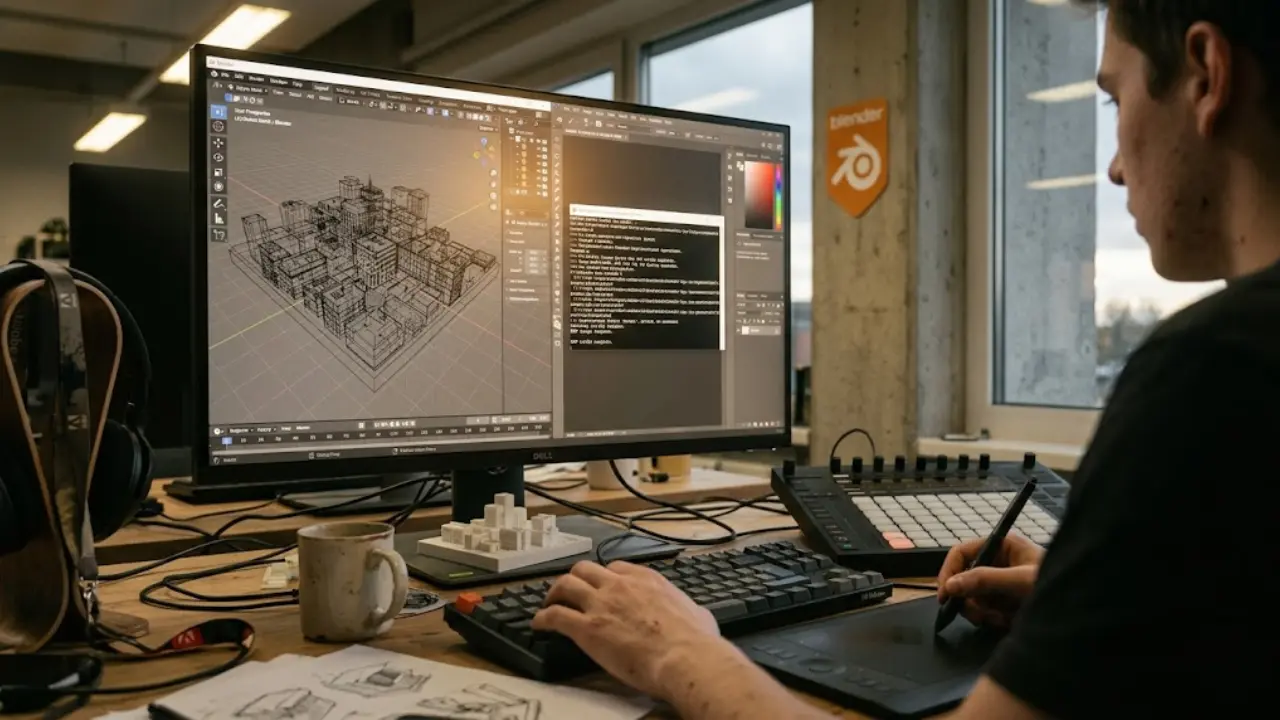
On April 28, 2026, Anthropic quietly executed one of the most consequential platform plays of the year: it shipped Claude for Creative Work, a coalition release with Blender, Autodesk, Adobe, Ableton, and Splice that embeds Claude directly inside the software creative professionals already pay for.
This is not another image-generation model or a standalone “AI canvas.” It is a connector layer — a set of MCP-based bridges that let Claude read, write, and execute inside the tools where actual production work happens.
The launch ships with eight named connectors covering the creative stack end-to-end. Adobe for creativity draws from 50+ tools across Creative Cloud apps including Photoshop, Premiere, and Express; Autodesk Fusion lets subscribers create and modify 3D models through conversation; Blender exposes its Python API as a natural-language interface.
Ableton grounds Claude’s answers in official documentation for Live and Push; Splice opens its royalty-free sample catalog from inside Claude; Affinity by Canva automates batch image adjustments, layer renaming, and file export; SketchUp turns conversations into 3D starting points; and Resolume Arena and Wire give VJs real-time control of live visual rigs through natural language.
Two structural moves underline how seriously Anthropic is treating this vertical. First, Anthropic has joined the Blender Development Fund as a patron to support Blender’s continued development of the Python API that makes integrations like this possible — a direct financial subsidy of an open-source dependency.
Second, the company is partnering with three art and design programs as launch partners: Art and Computation at Rhode Island School of Design, Fundamentals of AI for Creatives at Ringling College of Art and Design, and the MA/MFA Computational Arts program at Goldsmiths, University of London. Anthropic is buying the curriculum pipeline, not just the install base.
Inside the MCP Layer: How Connectors Collapse the Creative Pipeline Into a Single Agent Loop
The architecture matters more than the partnership list. Every connector here is built on the Model Context Protocol — the same open standard Mistral, OpenAI, and an expanding cohort of vendors have rallied behind.
Because the connector is built on MCP, it is accessible to other LLMs in addition to Claude, a reflection of Blender’s commitment to open source and interoperability. That single sentence carries enormous weight: the Blender connector is not a Claude moat. It is a public standard that any conformant agent runtime can consume.
For developers and technical artists, this changes the unit of work. Today, a procedural-animation task in Blender means writing a Python script against bpy, debugging in the scripting workspace, and re-running.
With the connector live, 3D artists can use the Blender connector to analyze and debug entire Blender scenes, or build custom scripts to batch-apply changes to objects in a scene. And using Blender’s Python API, the connector lets Claude add new tools directly to Blender’s interface. Claude is not generating screenshots of Blender — it is calling bpy operators, inspecting the scene graph, and writing back.
The same shift applies across the stack. Claude Code can write scripts, plugins, and generative systems for the software you already use — custom shaders, procedural animations, parametric models — and produce documented code you can reuse and modify.
For pipeline engineers at studios that span Maya-to-Houdini-to-Nuke handoffs, the bridging promise is direct: Claude can translate formats, restructure data, and keep assets in sync across a project that spans multiple applications, so you can move work between design, 3D, and audio tools without manual handoffs.
The agile and product-management implications are non-trivial. Sprint stories that previously read “TA writes batch-rename script for 400 assets” collapse into a single conversational instruction. The skill ceiling for a junior 3D generalist drops, but the floor of expected output rises.
Engineering managers running creative-tech teams should expect velocity charts to distort within one to two sprint cycles as repetitive production tasks move out of the backlog entirely. Claude can act as an on-demand tutor for complex software — explain a modifier stack, walk you through a synthesis technique, or demonstrate an unfamiliar feature — meaning onboarding cycles for new hires on Blender, Ableton, or Fusion compress from weeks to days.
The Boardroom Calculus: Subscription Stacking, Vendor Lock-In, and What This Does to India’s Creative GCCs
For CTOs and CEOs, the headline is not the connector list — it is the bundling math. A mid-sized animation studio or in-house brand team running Adobe Creative Cloud, Autodesk Fusion, Ableton Live, and Blender now has a credible reason to add a Claude enterprise seat on top of every other SaaS line item.
The vendors clearly negotiated this together: every named partner gets Claude as a multiplier on their own subscription rather than a substitute. The pricing pressure flows downward, not upward.
The infrastructure question is sharper. Connector traffic is not free. Every “build me a procedural city block in SketchUp” or “batch-export 200 layers from Affinity” prompt is a context-heavy, tool-calling-intensive Claude session.
Finance teams modeling 2026 software budgets need to treat creative-AI token spend as a separate line — distinct from the engineering Copilot line — because the prompt patterns, context windows, and call frequencies look nothing alike. Studios doing high-volume batch operations through these connectors will burn through Max-tier quotas faster than developer teams.
The security and IP angle deserves explicit board-level attention. A Claude session connected to Blender or Adobe Creative Cloud has read-write access to in-flight client work — unreleased game assets, pre-launch ad creative, architectural visualizations under NDA.
CISOs need MCP-connector governance policies before procurement, not after. Which connectors are sanctioned? Which projects are off-limits? Are conversations zero-data-retention? The frameworks that enterprises spent 2025 building for engineering AI assistants now need a creative-vertical clone.
For the Indian tech ecosystem, this lands directly on the country’s largest creative-services revenue pool. India’s animation, VFX, post-production, and digital-design services industry — the engine behind global ad agencies, OTT content, and architectural rendering pipelines — is built on labor arbitrage in exactly the production tasks Claude’s connectors now automate: batch image adjustments, layer renaming, file export, format translation, asset cleanup, and procedural setup.
Captive GCCs running creative ops for global parents face the same restructuring conversation that Adobe Creative Agent’s enterprise architecture and GCC impact already triggered. The Indian advantage shifts from production throughput to creative direction, brief interpretation, and cultural adaptation — the layers Claude explicitly says it cannot replace.
Frequently Asked Questions
What is Claude for Creative Work and which tools does it support?
Claude for Creative Work is Anthropic’s April 28, 2026 release of native MCP connectors that link Claude to creative software. Launch partners include Blender, Autodesk Fusion, Adobe Creative Cloud, Ableton, Splice, SketchUp, Affinity by Canva, and Resolume Arena and Wire.
Does the Blender connector lock users into Claude only?
No. The Blender connector is built on the Model Context Protocol, which Anthropic explicitly notes makes it accessible to other LLMs as well. Blender developers built it as an open integration consistent with the project’s open-source commitments.
How does Claude actually modify a Blender or Fusion file?
Claude calls each application’s native scripting interface through the connector — Blender’s Python API for scene manipulation, and Fusion’s subscription API for 3D model creation and modification. It does not generate images of the software; it executes inside it and returns the result.