Google Drops Gemma 4: Fully Open Apache 2.0 AI Changes Everything
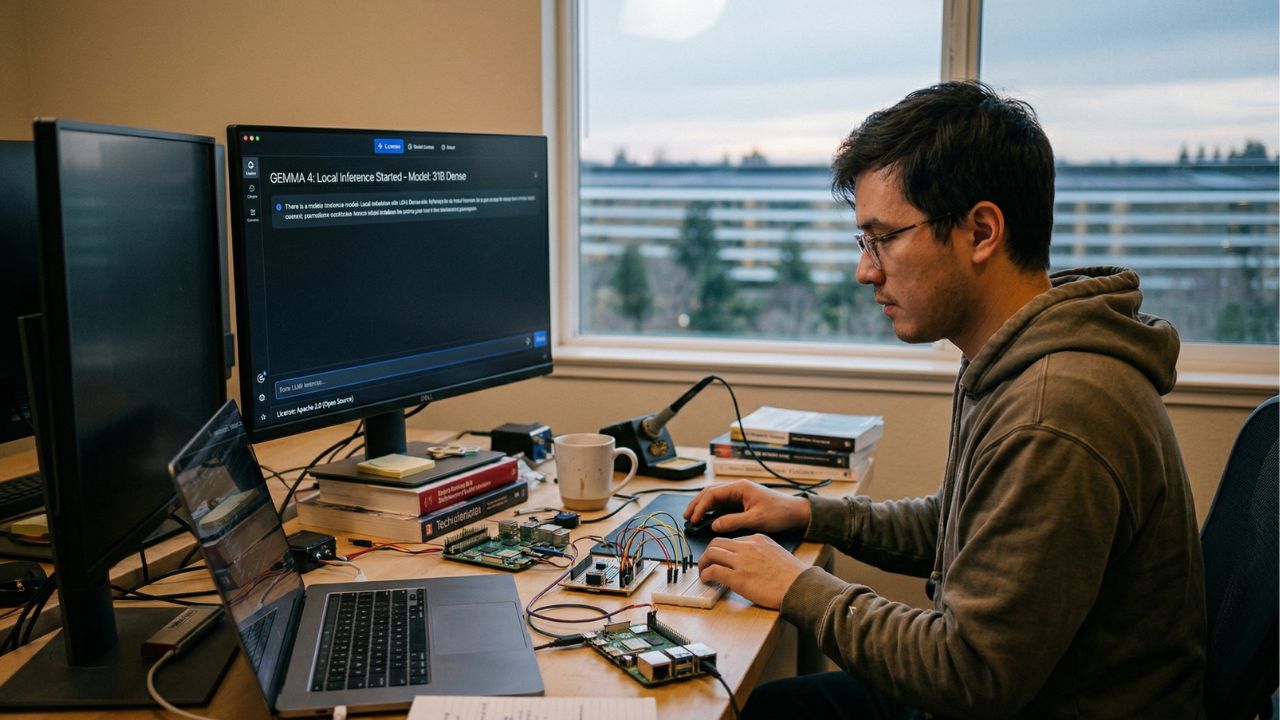
Google just handed developers the keys to the kingdom by releasing Gemma 4, its most capable family of open AI models, under a fully unrestricted Apache 2.0 license.
Moving away from past usage restrictions, this launch brings frontier-level reasoning, native multimodal processing, and offline agentic workflows directly to consumer hardware without commercial limits.
Quick Facts
- The bottom line: Gemma 4 is now completely open-source under the Apache 2.0 license, granting developers ultimate control over data and commercial deployment.
- Hardware flexibility: Released in four distinct sizes, these models run locally on everything from Android phones and Raspberry Pis to high-end NVIDIA H100 servers.
- Native multimodality: All models process video and images out of the box, while the mobile-first edge models add native audio input for real-time speech recognition.
- Unprecedented memory: The smaller variants support a 128,000-token context window, and the larger variants scale up to an enormous 256,000 tokens.
The Apache 2.0 Rebellion
For the first two years of the Gemma lifecycle, Google kept its open models under a permissive yet tightly controlled usage agreement.
That changes today. Gemma 4 is officially true open-source software.
Anyone can download, modify, and deploy these advanced models for personal or commercial use. You owe no royalties to Google.
You face no artificial barriers.
This shift grants developers total digital sovereignty. Healthcare providers, enterprise software engineers, and privacy-conscious users can now run powerful local AI on their own infrastructure without beaming sensitive data back to a corporate cloud.
"The release of Gemma 4 under an Apache 2.0 license is a huge milestone. We are incredibly excited to support the Gemma 4 family on Hugging Face on day one."
— Clément Delangue, co-founder and CEO, Hugging Face
Beating the Heavyweights
Gemma 4 arrives in four distinct sizes tailored for specific hardware footprints.
The lineup includes an Effective 2B (E2B), Effective 4B (E4B), a 26B Mixture of Experts (MoE), and a 31B Dense model.
They punch far above their weight class. The 31B model currently ranks as the third-best open model in the world on the industry-standard Arena AI text leaderboard.
The latency-focused 26B model secures the sixth spot.
Google claims these local models successfully outcompete alternatives that are twenty times their size.
Built directly from the research behind Gemini 3, they deliver exceptional intelligence-per-parameter.
You can fit the unquantized weights of the massive 31B model onto a single 80GB GPU.
Quantized versions run effortlessly on standard consumer graphics cards to power local coding assistants and complex autonomous agents directly from your workstation.
Mobile-First Multimodal Power
The smaller E2B and E4B models redefine edge computing. They activate extremely tiny parameter footprints during inference to save battery life and preserve RAM on mobile devices.
All four models process text, code, video, and images natively.
They support variable aspect ratios and excel at optical character recognition.
The edge models take it a step further by featuring native audio input for localized speech recognition and translation.
Context limits just vanished as a severe bottleneck. The mobile-friendly E2B and E4B variants digest up to 128,000 tokens.
The heavy-duty 26B and 31B models push that ceiling to 256,000 tokens.
You can feed entire code repositories or massive documents into a single prompt on your laptop.
Why It Matters
Gemma 4 obliterates the walled garden of enterprise AI. By stripping away licensing restrictions and shrinking frontier-level logic into models that run on a Raspberry Pi or an Android phone, Google is attacking proprietary cloud-dependent competitors directly.
Developers no longer need to pay massive API fees to build highly capable, autonomous AI agents.
The future of artificial intelligence is moving rapidly to the edge, prioritizing user privacy, offline availability, and absolute local control.