Mistral AI Fixes the Biggest Flaw in Autonomous Coding Agents
Mistral AI just dropped Spaces, a completely re-engineered command-line interface designed to force human developers and autonomous coding agents to speak the exact same language.
The breakthrough permanently eliminates the blindspots that cause AI systems to crash when building complex software projects.
Quick Facts
- The bottom line: Spaces introduces a dual-interface architecture where every interactive prompt has a machine-readable flag equivalent.
- Why it works: The CLI automatically generates context.json and AGENTS.md files to explicitly instruct AI on project rules and directory structures.
- The performance impact: Mistral reports that autonomous agents can now scaffold and deploy multi-service live environments in under ten minutes.
Mistral AI engineers hit a wall while building an internal tool to accelerate project deployments.
Human developers loved the shiny terminal UI, but autonomous coding agents immediately choked on the raw ANSI escape codes.
The realization forced Mistral’s Applied AI team to rethink software architecture entirely.
They identified a massive interface gap between human intuition and machine execution.
To bridge this divide, the team built Spaces. The tool serves as a translation layer that strips away implicit human assumptions like current working directories and interactive confirmation prompts.
Designing the Universal Translator
Mistral rebuilt the CLI so that every interactive input now operates with a hidden flag equivalent and smart default parameters.
If an agent hits a roadblock, the system resolves it programmatically rather than hanging indefinitely on an interactive terminal screen.
They also shifted to structured data. Spaces relies on an introspectable plugin registry where humans see interactive menus, but agents read clean, actionable JSON data.
"Every hidden assumption, CWD, environment variables, dotfiles in $HOME, is a place where an agent will trip. Explicit parameters with sensible fallbacks solve it for agents and make scripting easier for humans too."
This architectural pivot removes the guesswork from the agent's workflow.
It stops the AI from hallucinating incorrect port numbers or running the wrong test commands.
Eliminating the Context Blindspot
The most aggressive feature in Spaces is its automated context generation.
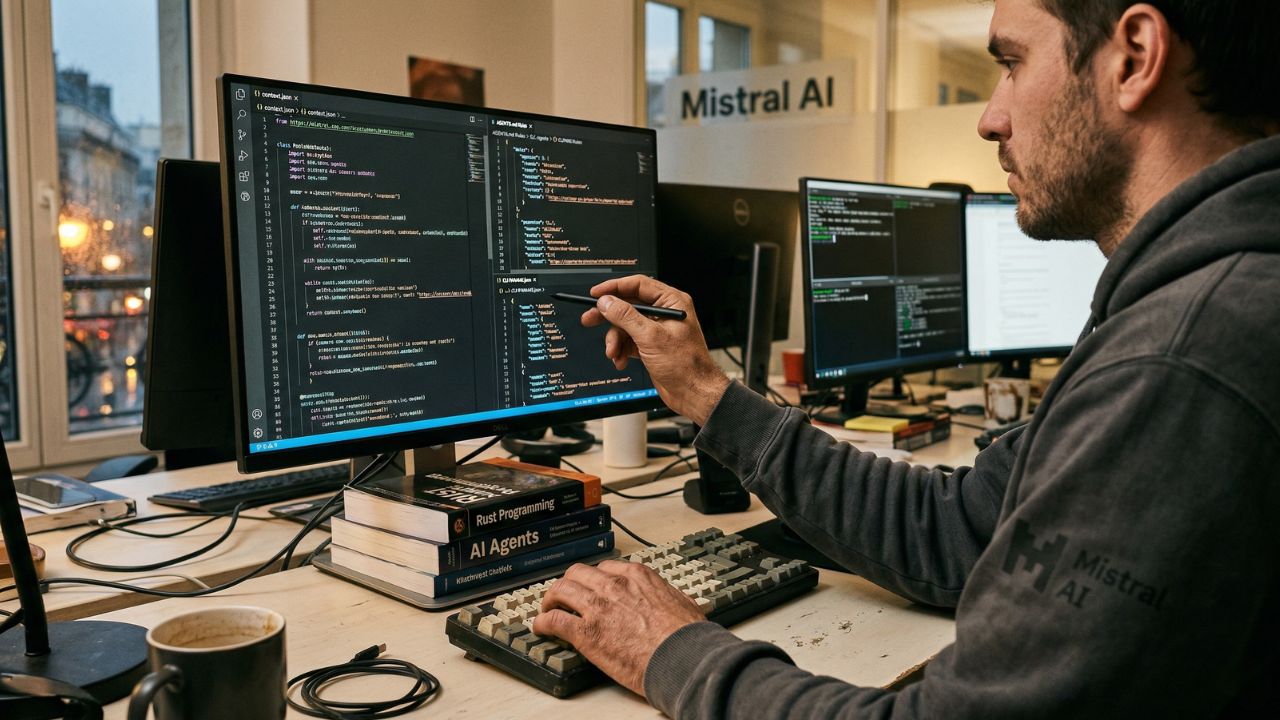
Every time a project initializes, the CLI creates a context.json snapshot alongside an AGENTS.md rulebook.
These files give the AI explicit, non-negotiable instructions about the project structure.
The system automatically updates these files during any development cycle, serving as a cache-buster that wipes out stale assumptions from the agent's memory.
The approach proved highly effective in internal testing. Mistral challenged an agent to wire a completely fresh repository into the Spaces CLI for deployment.
The AI successfully parsed the interface, generated configuration files, connected Docker registries, and executed a live deployment via GitHub Actions.
Why It Matters
The release of Spaces signals a massive shift in how the tech industry views developer tools.
We are moving away from software built exclusively for human operators.
By standardizing the environment where AI agents operate, Mistral is laying the groundwork for a future where autonomous systems build, test, and deploy software end-to-end without human intervention.
Competitors will now have to re-evaluate their own development stacks or risk alienating the incoming wave of agentic coders.