OpenAI Drops GPT-5.4 Mini and Nano: Why Massive AI Models Are Now on Notice
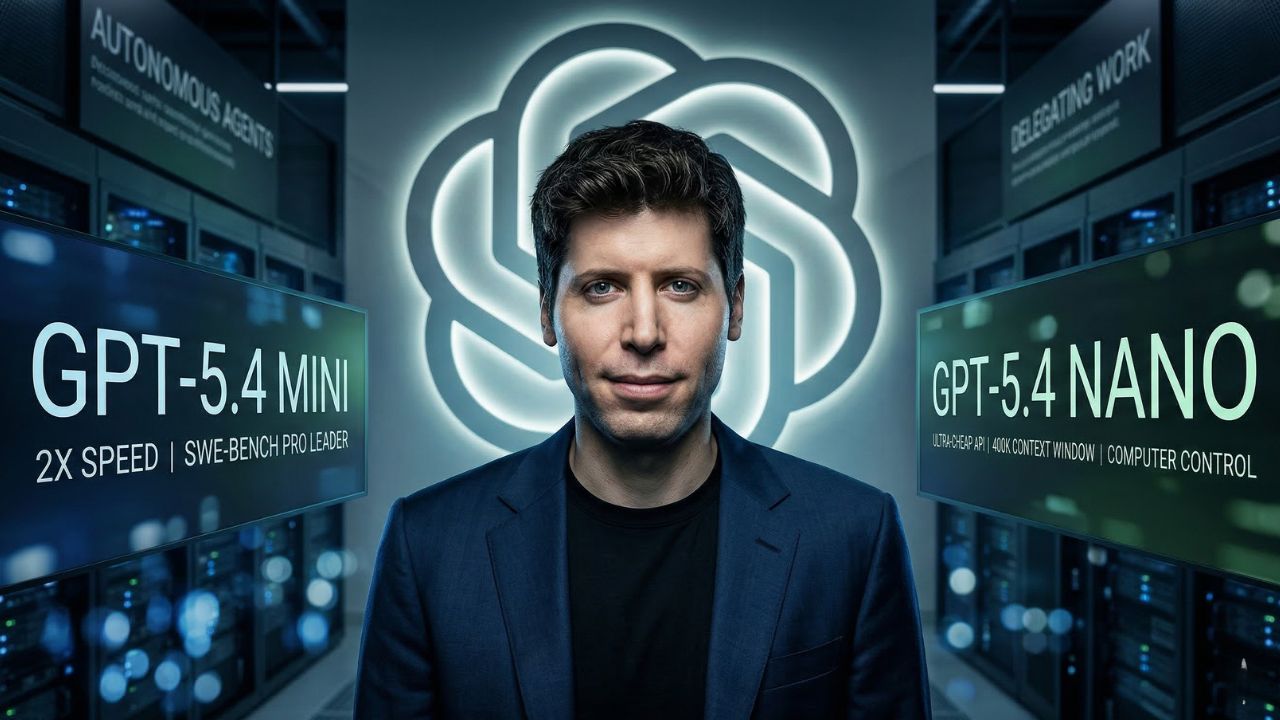
OpenAI just released GPT-5.4 mini and GPT-5.4 nano, a duo of lightning-quick, ultra-cheap AI models engineered to run autonomous agents and coding tasks at scale.
Forget the hype around monolithic mega-models, this aggressive pricing and speed update fundamentally rewires how developers will deploy artificial intelligence starting today.
The Bottom Line
- Blazing speed: GPT-5.4 mini runs more than twice as fast as its predecessor while scoring dangerously close to the flagship GPT-5.4 on top coding benchmarks.
- Rock-bottom costs: The API-only GPT-5.4 nano prices in at a staggering $0.20 per one million input tokens.
- Native computer operation: The mini model boasts built-in capabilities to read dense UI screenshots and control computer interfaces.
- ChatGPT integration: Free and Go tier users can immediately access GPT-5.4 mini through the interface's "Thinking" dropdown.
The Rise of the Subagent
OpenAI is aggressively pushing a new architecture for software development.
The strategy relies on delegating work rather than asking one giant neural network to do everything.
Developers realize that hitting a flagship model for every single prompt burns through cash and compute.
With the release of GPT-5.4 mini, companies can now assign a larger model to act as the project manager while spinning up dozens of cheaper subagents to execute the grunt work.
These lightweight models handle targeted code edits, file searches, and raw data extraction in parallel.
The benchmarks back up the strategy. On the SWE-Bench Pro coding evaluation, GPT-5.4 mini punches way above its weight class.
It delivers an unprecedented performance-to-latency ratio, meaning software engineers get near-flagship code generation without the agonizing wait times.
Vision and Screen Control Out of the Box
Text generation is only half the story. OpenAI baked advanced multimodal features directly into these lightweight engines.
GPT-5.4 mini possesses an uncanny ability to interpret dense user interface screenshots.
It can parse a chaotic desktop environment and execute computer-use tasks almost instantly.
This unlocks a new wave of automated testing and background operations where the AI literally sees what the human user sees and clicks exactly where it needs to.
"In these settings, the best model is often not the largest one, it’s the one that can respond quickly, use tools reliably, and still perform well on complex professional tasks."
— OpenAI Official Announcement
For the everyday consumer, the benefits arrive immediately. ChatGPT Free and Go users no longer have to settle for outdated models.
By toggling the "Thinking" feature, they can tap into GPT-5.4 mini's massive 400,000 token context window to parse giant documents in seconds.
Why It Matters?
The era of relying solely on one omnipotent AI model is ending.
OpenAI's aggressive pricing on the nano model signals a massive commoditization of basic machine reasoning.
Competitors will be forced to slash their own API prices to match this new floor.
For consumers and developers, the barrier to entry for building complex, multi-agent AI systems just collapsed.
As software increasingly writes and tests itself, the models operating quietly in the background will be exactly these fast, cheap, and relentless mini-engines.