TPU vs. GPU for Agentic Systems: A Developer’s Guide
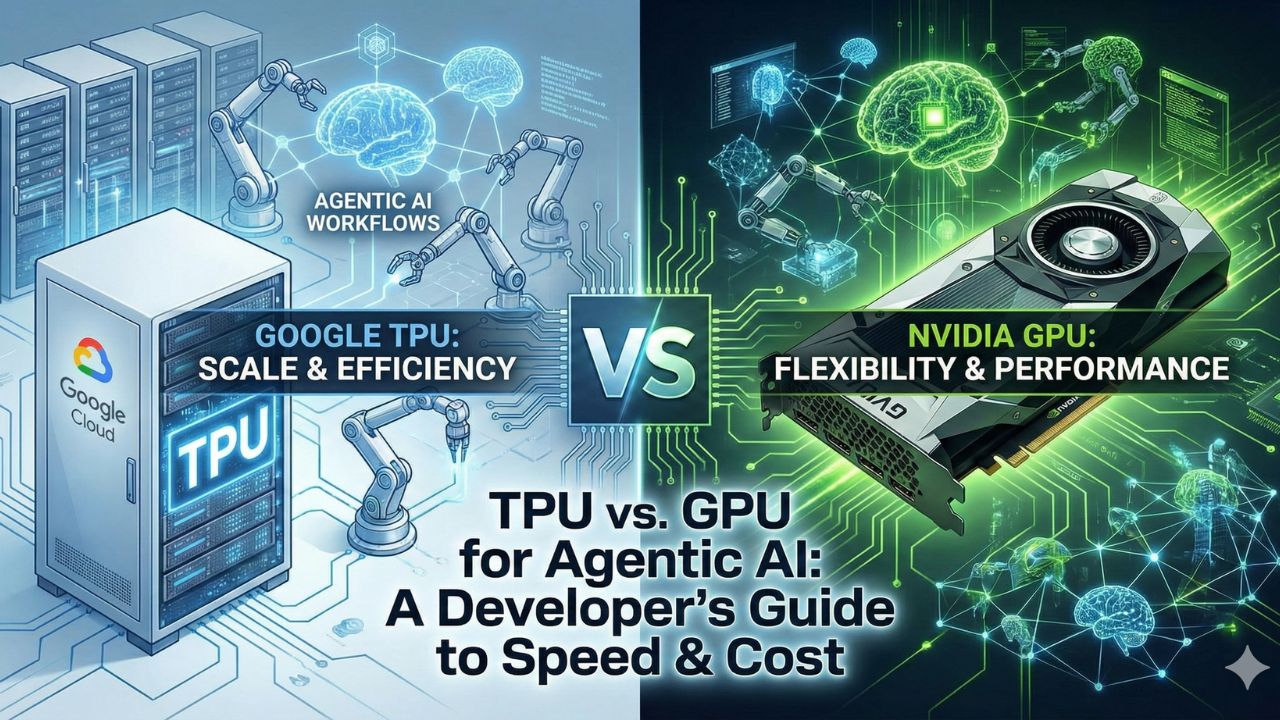
For AI engineers building agentic systems—architectures that don't just generate text but reason, plan, and execute multi-step workflows—the hardware choice between Google’s Tensor Processing Units (TPUs) and Nvidia’s GPUs is no longer just about raw FLOPs.
It is a choice between two distinct engineering philosophies. This guide compares the developer experience, cost efficiency, and speed of these platforms, specifically through the lens of Agentic AI.
Author: AgileWoW Team
Category: AI Infrastructure / Hardware Engineering
Read Time: 10 Minutes
Parent Guide: The Agentic AI Engineering Handbook
Executive Summary
| Feature | Nvidia GPUs (H100/A100) | Google Cloud TPUs (v5e/v6) |
|---|---|---|
| Primary Strength | Flexibility & Ecosystem. The "Swiss Army Knife" that runs any model, agent framework, or custom kernel out of the box. | Scale & Efficiency. Specialized ASICs that offer superior performance-per-dollar for massive, uniform workloads. |
| Developer Experience | High. Mature tools (CUDA, PyTorch), vast community support, and easy debugging. | Medium. Steeper learning curve (XLA, JAX), though improving with tools like vLLM. |
| Agent Suitability | Best for Research/Complex Agents. Handles dynamic control flows and custom logic (e.g., complex tool use loops) gracefully. | Best for Production Serving. Unbeatable for serving standard agent foundation models at massive scale with low latency. |
| Cost | Higher. Premium pricing due to high demand and versatility. | Lower. Generally 30-50% cheaper for equivalent throughput in dedicated serving setups. |
1. Developer Experience: The "Lock-in" vs. The "Wild West"
Building agents often involves "messy" computation: dynamic loops, variable-length tool outputs, and rapid context switching.
Nvidia GPUs: The Path of Least Resistance
- The "It Just Works" Factor: If you grab an open-source agent framework (like LangGraph, AutoGen, or CrewAI) and a model from Hugging Face, it is guaranteed to run on Nvidia GPUs. The CUDA ecosystem is the default target for virtually every AI library.
- Debugging: When an agent gets stuck in a tool-calling loop or hallucinations spike, GPU profiling tools (Nvidia Nsight) and standard PyTorch debuggers allow you to step through execution easily.
- Portability: You can develop on a local GeForce RTX 4090, scale to an AWS P5 instance, and move to Azure or GCP without changing a line of code.
Google Cloud TPUs: The Specialized Factory
- The Compilation Hurdle: TPUs rely on the XLA (Accelerated Linear Algebra) compiler. Unlike GPUs, which handle dynamic operations well, TPUs prefer static, predictable computation graphs. Historic friction points included needing to "pad" data to fixed sizes, which can be annoying when dealing with variable-length agent trajectories.
- The JAX/PyTorch Bridge: While historically tied to TensorFlow/JAX, the ecosystem has matured. The vLLM library now supports TPUs, meaning you can serve high-throughput agent models using standard, popular tooling. However, you are effectively locked into Google Cloud’s infrastructure.
- Agent-Specific Friction: If your agent requires custom, experimental CUDA kernels (e.g., for a new type of attention mechanism or retrieval), porting these to TPU (via Pallas or JAX) requires specialized knowledge.
2. Speed: Latency vs. Throughput
In agentic systems, latency is critical. An agent that takes 5 seconds to "think" before calling a tool feels sluggish.
TPUs for Serving (Inference):
- Throughput King: For serving the foundation model that powers your agent (e.g., Llama 3 70B), TPUs (specifically v5e) often deliver higher tokens-per-second per dollar.
- Unified Memory Architecture: TPUs have high bandwidth inter-chip interconnects. This makes them exceptionally fast for large models that must be sharded across multiple chips.
- Serving Agents: With the recent vLLM integration, TPUs can handle massive batches of concurrent agent requests efficiently, making them ideal for a production endpoint serving thousands of users.
GPUs for Reasoning (Dynamic Workloads):
- Handling Sparsity: Agents often have "sparse" activation patterns—sometimes they just output a "Yes/No", other times they generate a 2,000-word report. GPUs handle this dynamic variance slightly better due to their general-purpose nature.
- Time-to-First-Token (TTFT): H100s currently hold the crown for raw lowest latency (TTFT), which is crucial for real-time voice agents or interactive bots where perceived speed matters most.
3. Cost: The Deciding Factor
- Nvidia GPUs: High demand means high prices. Renting an H100 cluster can cost upwards of $2-$4/hour/chip, and availability is often scarce ("GPU poor"). You pay a premium for the ability to run anything.
- Google Cloud TPUs: Google subsidizes these chips to drive cloud adoption. A TPU v5e can cost significantly less (often under $1.00/chip/hour in reserved pricing) and offers comparable performance to A100s for inference.
- The "Agent Economy": If your agent requires 50 interactions to solve a task, a 30% reduction in inference cost (via TPUs) scales directly to your bottom line.
Recommendation
Choose Nvidia GPUs if: You are in the R&D phase, building complex custom agent architectures, need to deploy across multiple clouds, or require the absolute lowest latency for a single user.
Choose Google TPUs if: You are moving a stable agent system to production, need to serve thousands of concurrent users, and want to optimize strictly for price-performance on Google Cloud.
Frequently Asked Questions (FAQ)
Yes, but with a clarification. High-level agent frameworks (like LangChain) run their orchestration logic (loops, tool calls, JSON parsing) on the CPU, not the accelerator. They only hit the accelerator when they need to generate tokens. The Setup: You host the LLM (e.g., Llama 3) on the TPU using a serving engine like vLLM. You then point your LangChain/AutoGen code to that TPU endpoint (just like you would an OpenAI API key).
For single-user, real-time voice agents? Yes. For batch workflows? No. If you are building a real-time voice agent where a 200ms delay in "Time to First Token" (TTFT) breaks the illusion of conversation, the H100 is currently unbeaten. However, most agentic workflows take 30+ seconds and require multiple steps, so shaving 50ms off the initial token generation is irrelevant. The TPU v5e will process the total tokens for ~40% less cost.
Much easier than in 2023, thanks to vLLM. The old way required rewriting layers using torch_xla. The new way (2025) allows you to use vLLM (the standard serving library) with native TPU support. You essentially change `docker run --gpus all` to a TPU-compatible command, and it handles the PagedAttention and memory mapping for you.
Yes, and often more efficiently. TPUs have massive High Bandwidth Memory (HBM). A TPU v5e pod can pool memory across chips very efficiently via the high interconnect speed (ICI), allowing them to handle large KV caches. You must ensure you are using a serving framework that supports PagedAttention on TPU (like vLLM).
You should stick to Nvidia GPUs if your agent uses custom kernels (e.g., a new State Space Model requiring custom CUDA), you need on-prem/hybrid consistency across AWS/Azure, or you need local development parity with a machine running CUDA/MPS.

Sources and References
The following resources were used to compile the technical specifications, pricing models, and developer workflows outlined in this guide.
1. Official Hardware Documentation & Architecture
- Google Cloud TPU Architecture:
- System Architecture: Cloud TPU System Architecture (v5e, v5p, v4) – Technical deep dive into the inter-chip interconnect (ICI) and sparse core capabilities.
- Trillium (v6) Announcement: Google Cloud TPU Trillium (v6) Launch – Details on the latest generation's improved energy efficiency and matrix multiplication units (MXUs).
- Nvidia Hopper Architecture:
- H100 Whitepaper: NVIDIA H100 Tensor Core GPU Architecture – Comprehensive documentation on the Transformer Engine, NVLink, and DPX instructions.
2. Benchmarking & Cost Analysis
- Inference Performance: TPU v5e Inference Performance vs. Cost – Official benchmarks comparing throughput per dollar against A100/H100 instances.
- Pricing Models:
- Cloud TPU Pricing Guide – Current on-demand and Spot (Preemptible) pricing for v5e and v4 Pods.
- Nvidia GPU Cloud Pricing Comparison – Comparative pricing for A100 and H100 instances.
3. Developer Tools & Frameworks
- Serving Engines:
- vLLM for TPU: vLLM TPU Support Documentation – The definitive guide for running PagedAttention-enabled inference on Google TPUs without rewriting PyTorch code.
- PyTorch XLA: PyTorch/XLA GitHub Repository – The underlying compiler bridge that enables PyTorch models to run on TPU hardware.
- Agent Frameworks:
- LangChain Integration: LangChain Google Vertex AI Integration – Documentation on connecting high-level agent frameworks to TPU-hosted endpoints.
4. Open Source Resources: