Why Your AI Agent Eval Suite Will Fail Its First Audit
Key Takeaways
- The Compliance Gap: Default Ragas metrics measure basic retrieval quality, entirely missing the multi-step tool call accuracy required for strict enterprise audits.
- Golden Datasets: Relying on synthetic, LLM-generated data for evaluation will fail; you must curate a golden dataset built directly from complex production traces.
- Rule-Based Necessity: Discover why relying solely on LLM-as-a-judge models fails at deterministic tool evaluations and why hard, rule-based assertions are mandatory.
- Continuous Monitoring: Ad hoc staging tests are insufficient; enterprise compliance demands continuous production evals that automatically alert on specific metric regression.
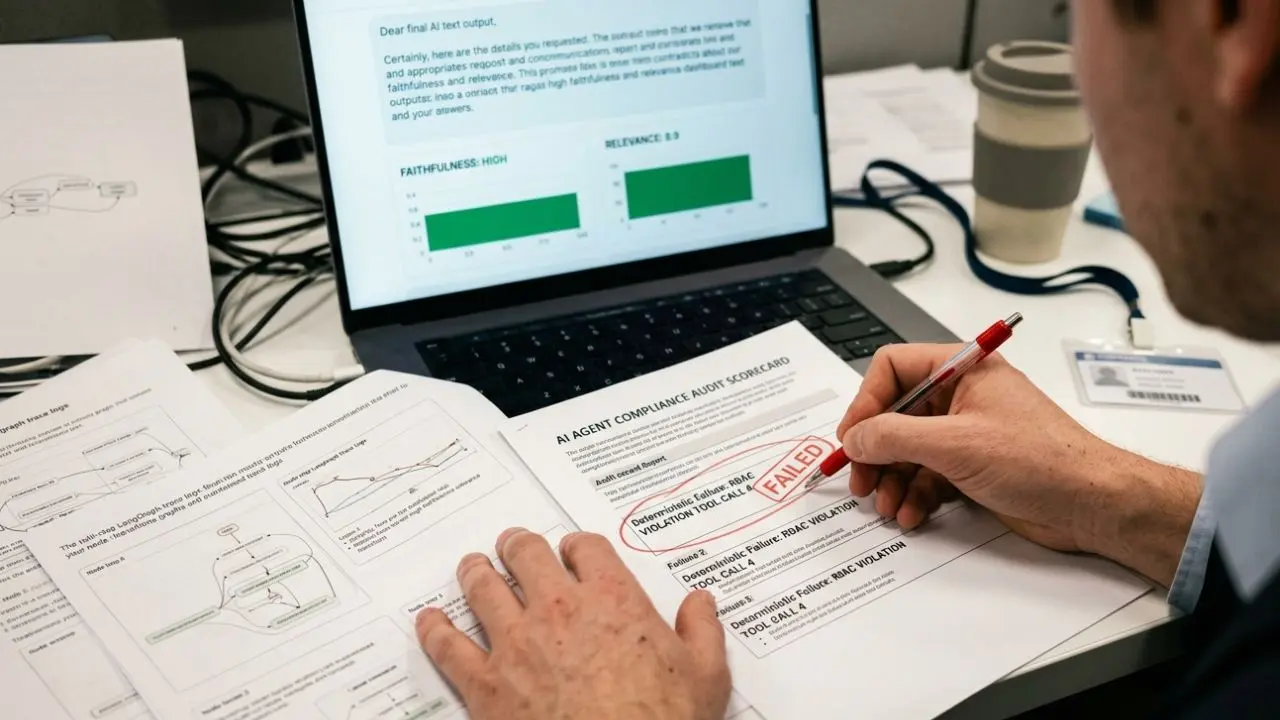
You have successfully implemented an evaluation framework, your dashboard shows high faithfulness scores, but the moment enterprise compliance teams review your AI agent, it fails the audit immediately.
The harsh reality of AI agent evaluation Ragas metrics enterprise adoption is that out-of-the-box defaults skip the critical operational metrics auditors demand. Your agent might be providing polite, relevant answers, but if it is silently hallucinating tool inputs or violating RBAC policies during multi-step reasoning, you are carrying massive unquantified risk.
As detailed in our AI agent observability playbook, measuring agent performance in production requires moving far beyond basic retrieval metrics. This deep dive exposes the exact enterprise scorecard you need to adopt before your next compliance review, ensuring your agentic workflows are actually deterministic, safe, and audit-ready.
The 4 Enterprise Metrics Ragas Defaults Skip
Standard RAG evaluation focuses heavily on whether an LLM answered a user's question accurately based on a static document. However, when you transition to autonomous agents, the definition of "success" changes fundamentally.
Enterprise compliance teams are not just looking at the final text output. They are deeply concerned with the "how" and the "why" of the agent's execution path. To truly secure your systems and go beyond RAG to agent evaluation, you must implement strict tracking for tool hallucination rates, state rollback integrity, and strict policy adherence.
Faithfulness vs. Answer Relevance in Agentic Contexts
Understanding what is faithfulness versus answer relevance in Ragas is your foundational starting point. Answer relevance simply measures if the final output addressed the user's prompt.
Faithfulness evaluates whether the generated answer can be directly inferred from the provided context without hallucination. In an agentic system, this "context" must dynamically include the exact JSON payloads returned by your external API tools, not just static vector database chunks.
If the tool returns an error, but the agent's answer relevance is high because it confidently lied, your basic eval suite just passed a critical failure.
Evaluating Multi-Step Tool Calls
A major blind spot for teams scaling AI is assuming single-turn evaluation frameworks work for multi-turn orchestration. If you are using frameworks like LangGraph, your agent is making autonomous routing decisions.
Can Ragas evaluate tool-call accuracy in a LangGraph agent? Out of the box, it struggles heavily. You must map custom evaluation metrics to every specific node transition in your graph.
This means breaking down the trace and evaluating the isolated inputs and outputs of every single tool execution.
LLM-as-a-Judge vs. Rule-Based Evaluation
A critical debate in enterprise architecture is whether you should use LLM-as-a-judge or rule-based eval for tool calls. The answer is a hybrid approach.
For deterministic tool executions—such as verifying if an API returned a 200 status code or if a JSON payload matches a Pydantic schema—you must use hard, rule-based code evaluations.
Reserve LLM-as-a-judge exclusively for qualitative assessments, such as evaluating the politeness of the final user response or summarizing complex reasoning traces.
Continuous Production Tracing and Golden Datasets
Passing an audit once in a staging environment means nothing if your model drifts in production a week later. Auditors want to know exactly how you track eval score drift over time and alert on regression.
This requires capturing 100% of your production traces and sampling them continuously against your evaluation pipeline. To scale this affordably, many teams are integrating specialized, smaller judge models.
For deeper insights on minimizing this operational overhead, review our analysis on Galileo Luna-2 cost-efficiency strategies.
Building a Golden Dataset
You cannot evaluate complex agent behaviors without a definitive baseline of truth. Learning how to build a golden dataset for multi-step agent evaluation is paramount.
This dataset should not be synthetically generated by the same LLM you are testing. Instead, it must be manually curated by domain experts, mapping exact user inputs to the explicitly expected chain of tool calls and the required final output.
This golden dataset becomes your immutable benchmark for every future deployment.

Frequently Asked Questions (FAQ)
What are the most important AI agent evaluation metrics in 2026?
The most critical metrics have shifted from basic RAG fluency to operational precision. In 2026, enterprise teams prioritize tool hallucination rate, routing decision accuracy, multi-step context retention, and strict adherence to structured output schemas.
How does Ragas compare to DeepEval and TruLens for agent eval?
While Ragas excels at standard retrieval-augmented generation metrics, DeepEval offers stronger native support for unit-testing LLM outputs. TruLens distinguishes itself with specialized feedback functions tailored for tracking application observability and mitigating specific LLM risks.
What is faithfulness versus answer relevance in Ragas?
Faithfulness strictly measures whether the final generated output can be logically inferred from the retrieved context without introducing hallucinations. Answer relevance independently measures how directly and effectively the final generated response addresses the user's original prompt.
How do I build a golden dataset for multi-step agent evaluation?
You must manually curate a diverse set of production user queries. For each query, explicitly define the expected sequence of autonomous tool calls, the expected intermediate API payloads, and the exact factual requirements for the final response.
Can Ragas evaluate tool-call accuracy in a LangGraph agent?
Out of the box, standard Ragas defaults struggle with autonomous multi-step routing. To evaluate a LangGraph agent effectively, you must write custom Ragas metric wrappers that isolate and assess the specific inputs and outputs of individual graph nodes.
How do I run Ragas evals continuously on production traces?
You achieve this by integrating Ragas into your observability pipeline. Configure your tracing backend (like AgentOps or Langfuse) to randomly sample a percentage of completed production runs, forwarding those trace contexts directly to an asynchronous Ragas evaluation worker.
What metrics do enterprise compliance teams require for AI agent audits?
Auditors demand provable determinism. They require detailed metrics on data privacy masking, strict adherence to Role-Based Access Control (RBAC) during tool execution, historical hallucination rates, and verifiable audit trails of every autonomous routing decision.
How do I measure agent hallucination rate in production?
You measure this by deploying a smaller, specialized LLM-as-a-judge model alongside your primary agent. This judge continuously scores the agent's final outputs directly against the raw data returned by its internal tool calls, flagging any unsupported claims.
Should I use LLM-as-a-judge or rule-based eval for tool calls?
You must use a hybrid strategy. Enforce strict, rule-based evaluations for deterministic tool outputs like schema validation and API status codes. Utilize LLM-as-a-judge only for qualitative assessments, such as evaluating conversational tone or complex reasoning.
How do I track eval score drift over time and alert on regression?
Push all of your continuous evaluation scores directly into a time-series monitoring tool like Datadog. Establish baseline thresholds for metrics like faithfulness, and configure automated PagerDuty alerts to trigger whenever the rolling average dips below your defined acceptable limits.