Your AI Agent Is Lying to You: The 2026 Observability Fix
- SDK Decision: Pick LangSmith for UX, Langfuse for self-hosted scale, and AgentOps for heterogeneous multi-framework setups.
- Standards First: Adopt OpenTelemetry GenAI semantic conventions now to guarantee vendor-neutral span schemas.
- Tracing Philosophy: Log 100% of errors but sample successes. Trace the handoffs, state mutations, and tool I/O, not just the LLM calls.
- Evaluation: Combine rule-based validation for tool outputs with small-model judges (like Luna-2) to enable 100% production coverage affordably.
- Stateful Rollbacks: Establish durable checkpoints so production failures are recoverable via a time-travel rewind, preventing catastrophic crashes.
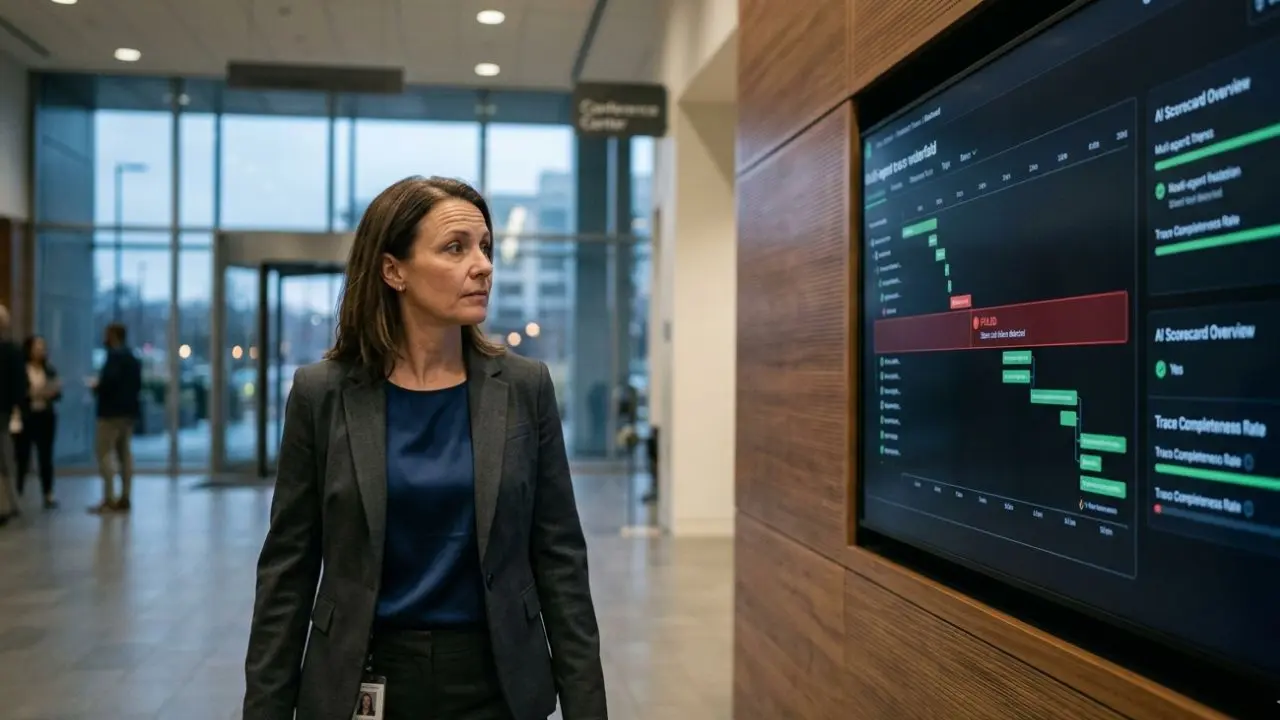
Your dashboard says the agent shipped a perfect answer. The user got nonsense. Three steps back, a tool returned an empty array, the next node confidently typed around the void, and your monitoring stack registered it all as a 200 OK.
This guide is the 2026 AI agent observability playbook that ends that pattern — the five-layer observability stack, the SDK and spec choices that matter, the cost math that breaks pilots, and the evaluation discipline auditors will demand by Q3.
Executive Summary
For Enterprise PMO Directors and Agile Leaders, here is what this guide will give you, in scannable form:
| Decision Layer | The 2026 Question | The Short Answer |
|---|---|---|
| SDK | Pay for LangSmith, self-host Langfuse, or instrument with AgentOps? | Depends on team size and trace volume — see Layer 1. |
| Standards | Adopt OpenTelemetry GenAI conventions now, or wait? | Adopt now. v1.30 attributes are stable and vendor-neutral. |
| Tracing | Span every node, every tool, every agent? | Yes — but with sampling. 100% on errors, ≤10% on success. |
| Evaluation | LLM-as-judge or rule-based scoring? | Hybrid. Rule-based for tool I/O, small-model judges (e.g., Luna-2) for semantics. |
| Cost & Ops | What does observability actually cost at scale? | $0.20–$1.40 per 1,000 traces depending on platform and retention. |
The five non-negotiable capabilities of a 2026 observability stack:
- End-to-end multi-agent trace propagation (not just per-LLM-call logging)
- Tool I/O capture with schema assertions, not just timing data
- A standards-based span schema (OpenTelemetry GenAI) for portability
- Continuous, sampled evaluation against a golden dataset
- A checkpoint and rollback mechanism so production failures are recoverable, not catastrophic
Why "AI Agent Observability" Is Not LLM Monitoring
The most expensive misconception in 2026 is treating an agent like a single LLM call with a wrapper. It isn't. A production agent is a distributed system that happens to think in natural language.
Tracing one prompt is not the same as tracing a 12-step graph with three sub-agents, four tool calls, and a checkpoint replay. LLM monitoring answers: "Did the model respond, and how fast?"
That mattered in 2023. Agent observability answers: "Did the right sequence happen, did each tool return valid output, did the planner make a defensible decision, did the cost stay inside its envelope, and would I be able to reproduce this trace next week?"
The questions are different, the data model is different, and the team that owns the answer is different. Confusing the two is how a CTO ends up with a Datadog dashboard that says everything is fine while the procurement assistant agent is quietly recommending suppliers that haven't existed for two years.
The "lying agent" problem is rarely the model hallucinating. It is the operational layer failing silently because no one instrumented the joints between steps.
Layer 1 — The SDK Decision: AgentOps, LangSmith, or Langfuse?
This is the first fork, and most teams pick wrong because they pick fast. Each of the three serious players in 2026 optimizes for a different audience.
AgentOps is the framework-agnostic instrumentation layer. Its core value is breadth — native support for CrewAI, LangChain, AutoGen, OpenAI Agents SDK, AG2, and CamelAI. If your stack is heterogeneous, AgentOps becomes the lingua franca that makes all your agents legible in a single trace store. Review how to set up AgentOps with CrewAI in 11 lines.
LangSmith is the developer-experience leader, with the most polished trace replay UI on the market. The cost is exactly that: a polished SaaS product with seat pricing that punishes growing teams. The $39-per-seat tier is fine for five engineers and a 5,000-trace cap.
It is not fine when you cross either threshold, and that pricing transition is where most pilots silently overspend. For the full side-by-side cost analysis, see our dedicated LangSmith vs Langfuse vs AgentOps: the 2026 cost truth comparison.
Langfuse is the open-source contender. Self-hostable, OpenTelemetry-friendly, and the only one of the three where your monthly cost can plausibly stay flat as trace volume climbs into the millions. The trade-off is operational ownership — Kubernetes, Postgres, Clickhouse, and a Helm chart you will read more carefully than you wanted to.
| Constraint | Pick |
|---|---|
| Heterogeneous agent frameworks, single pane of glass | AgentOps |
| Five engineers or fewer, premium DevEx, willing to pay | LangSmith Cloud |
| 50K+ traces per month, cost ceiling matters more than UX | Self-hosted Langfuse |
| Strict data residency or air-gapped environment | Self-hosted Langfuse |
| OpenTelemetry-first architecture, want vendor neutrality | Langfuse + OTel exporter |
Layer 2 — Standards: Why You Adopt OpenTelemetry GenAI Now, Not Later
The vendor-lock question used to be theoretical. In 2026 it is not. Every serious observability buyer has at least one boardroom story about migrating off an SDK that changed its pricing model or got acquired.
The answer is the same one cloud-native teams arrived at a decade ago: a vendor-neutral telemetry standard. OpenTelemetry's GenAI semantic conventions — the gen_ai.* attribute namespace — reached stable status in 2026 and now define the canonical span schema for LLM and agent operations.
The attributes you care about (gen_ai.system, gen_ai.request.model, gen_ai.response.id, gen_ai.usage.input_tokens, gen_ai.usage.output_tokens, and the still-being-finalized gen_ai.tool.* namespace for tool calls) are the same regardless of which backend ingests them.
Practically, this means three things:
- Your instrumentation code stops being tied to a vendor SDK. It produces standard spans.
- You can route those spans to Datadog, New Relic, Honeycomb, Langfuse, or a custom Clickhouse-backed pipeline, often simultaneously, without rewriting application code.
- Your spans are durable across platform migrations. If you outgrow LangSmith in year two, you keep your history.
The most common adoption objection is "the spec is still moving." In 2026 the request and response attributes are stable. The tool-call and multi-agent attributes are still evolving but already cover the 80% case. Waiting for 100% spec stability is a strategic error.
Layer 3 — Tracing Patterns: Capture the Joints, Not Just the Calls
The tracing rule that separates teams who debug from teams who guess: the most informative span is almost never the LLM call itself. It is the handoff between two nodes, the tool I/O, or the state mutation that occurred just before the model produced its confident wrong answer.
A production-grade trace schema captures, at minimum:
- The planner-to-worker handoff. Which sub-task was dispatched, with what context window, to which worker agent.
- The tool input and the tool output, in full. Not just timing. Not just status. The actual payloads, redacted for PII but otherwise complete.
- The state diff at each node. What changed in the agent's working memory between step N and step N+1.
- The decision rationale, where available. Many agent frameworks now emit a structured reasoning trace; capture it as a span attribute, not free text.
- The retry and fallback events. Every recovery action is a span, not a footnote.
The fifth bullet is the one most teams forget, and it is the one that prevents post-mortems from turning into archaeology. Ensure you are capturing the 5 spans 80% of teams forget.
The Silent Tool Failure Pattern
The most common failure mode in production agents is not the model getting confused. It is the tool returning an empty array, a malformed JSON, or a stale cache hit — and the next node treating that void as a successful response.
Your dashboard will show a green trace. Your user will see a sentence built on nothing. Defending against this requires three patterns, applied together. First, every tool node returns a typed result envelope — {success: bool, data: ..., error: ...} — never a bare payload.
Second, the consuming node asserts schema before acting; a Pydantic validation failure is a far better outcome than a confident hallucination. Third, your observability layer emits a span-level alert whenever a tool returns success: false or when the downstream LLM call doesn't reference the tool output in its response. Dive into the 4-check sequence for silent LangGraph failures for full implementation.
Sampling Without Losing Signal
Tracing everything is financially impossible above modest scale. Tracing only on errors is operationally impossible because most agent failures are silent, not error-coded.
The pattern that works in 2026 is stratified sampling:
- 100% of error spans, always
- 100% of spans with cost above the 95th percentile
- 100% of spans containing a regulated data type (financial, health, PII), for audit
- A tunable 5–10% of successful production traces, sampled deterministically by trace ID so you keep full multi-agent chains when you sample at all
This pattern keeps your ingestion bill flat while preserving the signal you actually need. Random per-span sampling breaks multi-agent traces in half and produces unusable replay artifacts.
Layer 4 — Evaluation: The Discipline Auditors Will Demand by Q3
Tracing tells you what happened. Evaluation tells you whether what happened was good. Most teams have the first and lack the second, and this is the gap that turns a successful pilot into a failed compliance review.
In 2026 the evaluation conversation has three serious patterns, used together, not as alternatives.
Rule-based evaluation for anything deterministic — tool-call argument schemas, output structure, regulated phrase blacklists, factuality against a known database. These are cheap, fast, and the foundation auditors will trust first.
Reference-based metrics for retrieval and reasoning quality — faithfulness, answer relevance, context precision, context recall. Frameworks like Ragas remain the open-source baseline, but you must know the 4 enterprise metrics Ragas defaults skip.
Small-model judges for semantic evaluation at production volume. Using GPT-class models as judges costs more per evaluation than the evaluated call itself, forcing teams to sample evals down to a statistically irrelevant slice. Purpose-built small judge models — Galileo's Luna-2 is the most-deployed 2026 example — bring per-evaluation cost low enough to run on 100% of traces in near-real time.
The discipline that pulls it together is the golden dataset — a curated, version-controlled set of representative inputs with known good outputs. Run it on every model change. Run it on every prompt change. Run it on every framework upgrade.
Information Gain: The Counter-Intuitive Eval Insight
Most teams treat evaluation as a CI gate — run the suite before deploy, block on regression, ship. This is necessary but insufficient. The actual production failure mode in 2026 is not a regression at deploy time; it is input drift at runtime.
Your user behavior changes, your tool ecosystem changes, your upstream data changes, and your previously-passing agent quietly degrades. The fix is to flip the evaluation timeline. Treat your golden dataset as a monitoring asset, not just a CI fixture.
Replay it nightly against the live production agent and alert on score drift, the same way you would alert on latency drift. The teams who build it themselves catch degradations weeks before users complain. The ones who don't, learn about it from a regulator.
Layer 5 — Cost and Operations: The FinOps Discipline Most AI Teams Skip
The conversation no one wants to have in the Q4 program review is the actual unit economics of observability. Tracing is not free; evaluation is not free; and the bill scales superlinearly with traffic when you pick wrong at Layer 1.
A realistic 2026 cost model breaks into three line items:
- Trace ingestion — typically $0.10 to $0.50 per 1,000 spans, depending on platform and retention class. Multiply by your average spans-per-agent-run to get your true per-run cost.
- Evaluation — 100% LLM-judge coverage with GPT-class models is roughly $0.05 to $0.20 per evaluated run. Small-judge models like Luna-2 drop this by 70–80%.
- Storage and retention — increasingly the third-largest line item. Most SaaS tiers give 30 days of retention as default; meaningful audit and drift-monitoring requires 90 to 365 days.
The discipline that prevents the surprise is exactly the same as cloud FinOps a decade ago — tag every trace by team, product, and environment; build a weekly cost-per-1,000-runs dashboard; set alerts at 80% of monthly budget. Learn how to trace this stack properly to avoid massive architectural blind spots.
Putting It Together: A 90-Day Adoption Roadmap
For an Enterprise PMO Director stepping into a portfolio of in-flight agent programs, the adoption sequence matters more than tool selection. Here is the roadmap that consistently lands well in 2026 governance reviews:
Days 0–30: Establish the trace. Pick an SDK at Layer 1, instrument one production agent end-to-end, capture tool I/O and state transitions, and verify trace completeness. Can a human follow the trace and explain what the agent did, without reading the application code? If not, your instrumentation is incomplete.
Days 31–60: Add the standard and the eval. Adopt OpenTelemetry GenAI conventions for all new instrumentation, build the first version of a golden dataset, and stand up at least one continuous evaluation against it.
Days 61–90: Operationalize. Layer in cost dashboards, alerting on drift, stratified sampling, and a rollback playbook for failing checkpoints. The deliverable that wins the executive review is the one-page incident report from a real production failure that was caught, traced, and remediated using the stack you built.
Frequently Asked Questions (FAQ)
What is AI agent observability and why does it matter in 2026?
AI agent observability is the practice of instrumenting, tracing, and evaluating multi-step agent workflows in production. It matters in 2026 because agents now make autonomous, cost-bearing decisions; silent tool failures and reasoning drift create real financial and regulatory exposure that traditional uptime monitoring cannot detect.
How is agent observability different from traditional LLM monitoring?
LLM monitoring tracks single-call latency and error rates. Agent observability tracks multi-step workflows: planner-worker handoffs, tool I/O, state mutations, decision rationale, and rollback events. The unit of observation is the full agent run, not the individual API call, and the failure modes are typically silent rather than error-coded.
What are the 5 layers of an AI agent observability stack?
The five layers are: Layer 1 SDK and instrumentation (AgentOps, LangSmith, Langfuse), Layer 2 standards and span schema (OpenTelemetry GenAI), Layer 3 tracing patterns and replay, Layer 4 evaluation and scoring (Ragas, LLM-as-judge, small-model judges), and Layer 5 cost and operations (FinOps discipline, sampling, retention).
Which open-source AgentOps tools work with LangGraph and CrewAI in production?
AgentOps SDK supports CrewAI and LangChain natively, and works with LangGraph through the LangChain callback handler. Langfuse provides framework-agnostic instrumentation through OpenTelemetry GenAI spans, which capture LangGraph node transitions cleanly. Both are open-source and production-deployable.
How do I detect a silent tool failure in a multi-step agent run?
Wrap every tool in a typed result envelope, assert output schema before downstream nodes consume the data, and emit a span-level alert when a tool returns a failed status or when the downstream LLM response fails to reference the tool output. Pair this with full tool I/O capture in your tracing layer for replay.
What is the OpenTelemetry GenAI semantic convention and is it stable yet?
OpenTelemetry GenAI conventions define standard span attributes (gen_ai.system, gen_ai.request.model, gen_ai.usage.*, and others) for LLM and agent operations. Request and response attributes are stable in 2026; tool-call and multi-agent attributes are still evolving but already cover the majority of practical instrumentation needs.
Should I self-host Langfuse or pay for LangSmith Cloud in 2026?
Pay for LangSmith Cloud if your team is under five engineers and your trace volume stays under the free or Plus tier limits; the developer experience is worth the seat fee. Self-host Langfuse when you exceed 50,000 traces per month, need strict data residency, or want a flat-cost trajectory at scale.
How much does it cost to trace 1 million agent steps per month?
Realistic 2026 ranges are $200 to $1,400 per month depending on platform, retention, and evaluation strategy. Trace ingestion runs $0.10 to $0.50 per 1,000 spans. Adding 100% LLM-judge evaluation with frontier models can multiply the bill by 5 to 10 times; small-judge models like Luna-2 cut that addition by 70 to 80 percent.
What metrics prove an AI agent is actually working in production?
The minimum production scorecard is: trace completeness percentage, tool-call success rate, eval score against the golden dataset, eval drift over time, cost per successful task, and end-user task-completion rate. Uptime and latency alone are insufficient — they miss silent failures entirely.
How do I roll back a failing agent checkpoint without losing user state?
Use a durable checkpointer (Postgres in production, Redis for low-latency cases), persist agent state at every node transition, and expose a rewind operation that restores the agent to the last-known-good checkpoint while preserving the user-facing session context. Test the rollback path in CI before relying on it in production.