Prompt Engineering is Dead: Rise of the "Agent Orchestrator"
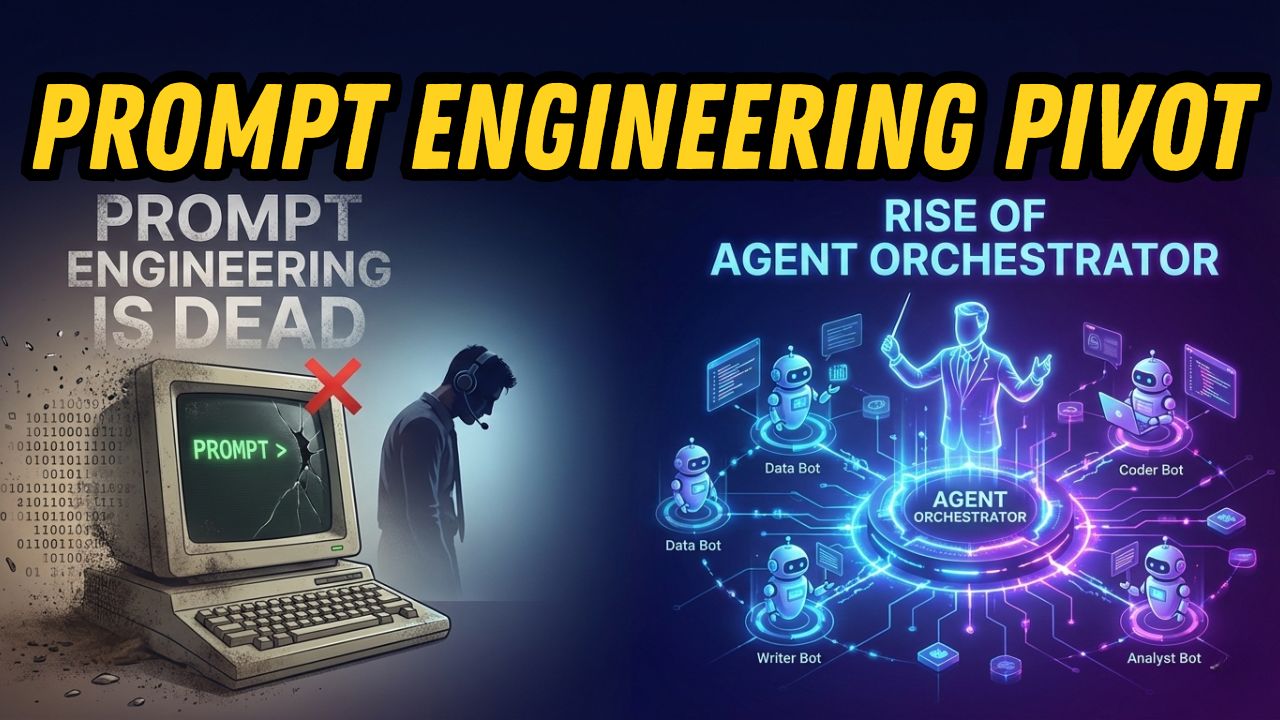
The Hard Truth: The "Chatbot" Era is Over
Remember 2023? Everyone was excited about "Prompt Engineering." We thought the future was typing clever sentences into ChatGPT to get a blog post or an email. But in 2026, typing into a chatbot is too slow.
Why prompt engineering is a dying career 2026: AI models have become smart. You don't need "magic words" anymore. They understand you perfectly. More importantly, businesses don't just want text, they want action.
They don't want an AI that writes an email. They want an AI that reads the email, checks the calendar, books the meeting, and updates the CRM, all without a human touching the keyboard. This shift has killed the "Prompt Engineer" and created a new, powerful role: The Agent Orchestrator.
Explore AI Career Training & Certifications Hub
What is an Agent Orchestrator?
Think of a music concert.
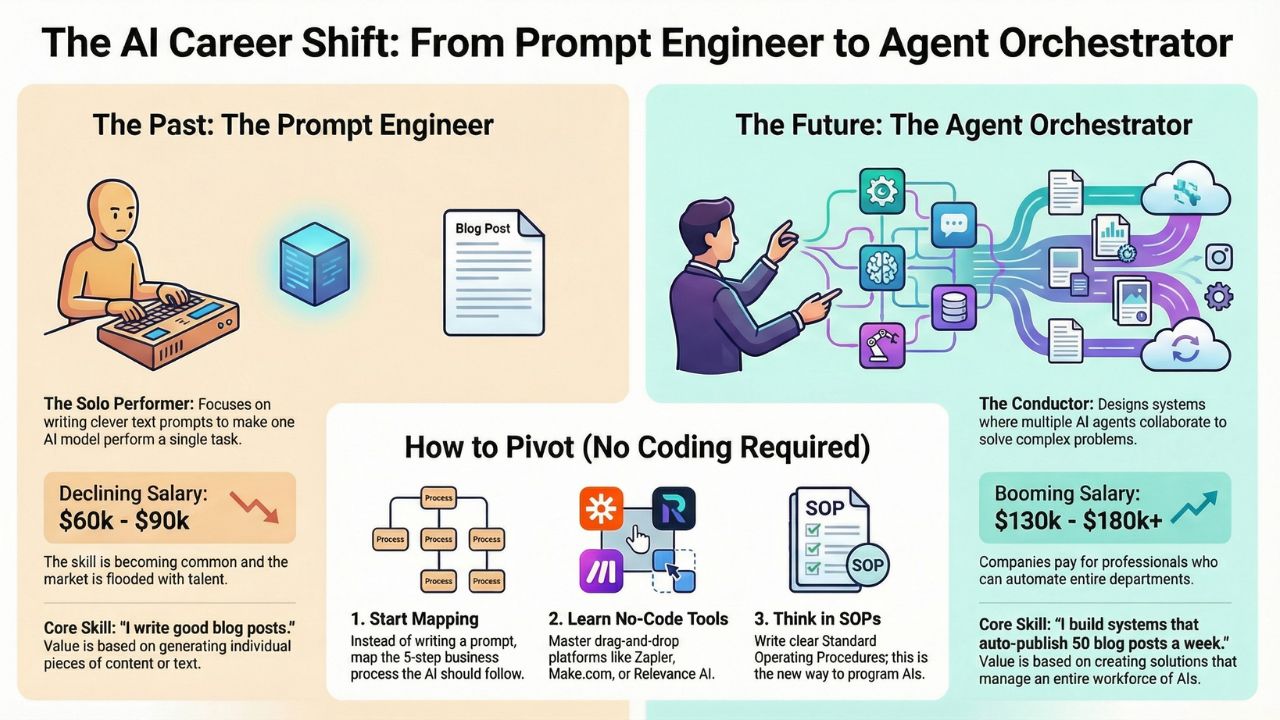
- Prompt Engineer: The person playing one violin. They focus on making one instrument sound good.
- Agent Orchestrator: The Conductor. They don't play the instruments. They direct the whole orchestra.
An Agent Orchestrator designs systems where multiple AI "Agents" talk to each other to solve big problems.
- Agent A (Researcher) finds data.
- Agent B (Analyst) crunches the numbers.
- Agent C (Writer) summarizes the report.
You, the Orchestrator, build the workflow that connects them.
Salary Wars: Prompt Engineer vs. Orchestrator
The money follows the value. Writing a prompt is a "task." Building a system is a "solution."
Salary of AI Agent Orchestrator vs Prompt Engineer:
- Prompt Engineer (Declining): $60,000 - $90,000. (The market is flooded, and the skill is becoming common).
- Agent Orchestrator (Booming): $130,000 - $180,000+. (Companies are desperate for people who can automate entire departments).
Job Description: What Does an Orchestrator Do?
If you look for a job description for multi-agent systems manager, you won't see "writing text" as the top skill. You will see:
- Workflow Mapping: Drawing diagrams of how a business task works step-by-step.
- Tool Connection: Connecting AI agents to real tools (Email, Excel, Slack).
- Testing: Watching two AI agents talk to each other and fixing it when they get confused.
- Governance: Making sure the agents don't hallucinate or leak private data.
How to Pivot: From Copywriter to Orchestrator (No Coding)
The best news? How to become an AI systems architect without coding is easier than you think. You don't need Python. You need logic.
Your Pivot Plan:
- Stop writing, start mapping: Don't just ask AI to write an article. Ask: "What are the 5 steps to create this article?"
- Learn "No-Code" Tools: Master tools like Zapier, Make.com, or Relevance AI. These let you drag-and-drop AI agents into a workflow.
- Think in "SOPs": Standard Operating Procedures (SOPs) are the code of the future. If you can write a clear instruction manual for a human, you can program an AI agent.
Career pivot from copywriter to AI orchestrator:
- Old Skill: "I write good blog posts."
- New Skill: "I build systems that generate, edit, and publish 50 blog posts a week automatically."
The Future is "Managerial"
The future of prompt engineering jobs in 2026 is not about talking to the machine. It is about managing the machine.
We are moving from "Artificial Intelligence" to "Agentic Workforces." The people who get the high paying ai roles that do not require coding will be the managers of this digital workforce. Don't be the person typing. Be the person conducting.
Frequently Asked Questions (FAQ)
Yes, as a standalone job title. As AI models get smarter, they need less "engineering" to understand instructions. The role is evolving into "AI Operations" or "Agent Orchestration," where the value lies in connecting workflows, not just writing text.
In 2026, Orchestrators significantly outearn Prompt Engineers. While Prompt Engineers average $60k-$90k, Agent Orchestrators often start at $130k+ because they solve expensive business problems (automation) rather than just content problems.
Absolutely. The rise of "No-Code" and "Low-Code" agent platforms means you can build complex multi-agent systems using logic and visual diagrams. Your ability to understand business logic is more important than your ability to write Python.
Beyond Orchestrators, look for roles like "AI Governance Officer," "Workflow Automation Strategist," and "Human-in-the-Loop Manager." These non-coding roles focus on the strategy, safety, and efficiency of AI systems.