The AI Career Roadmap in the Agentic Era
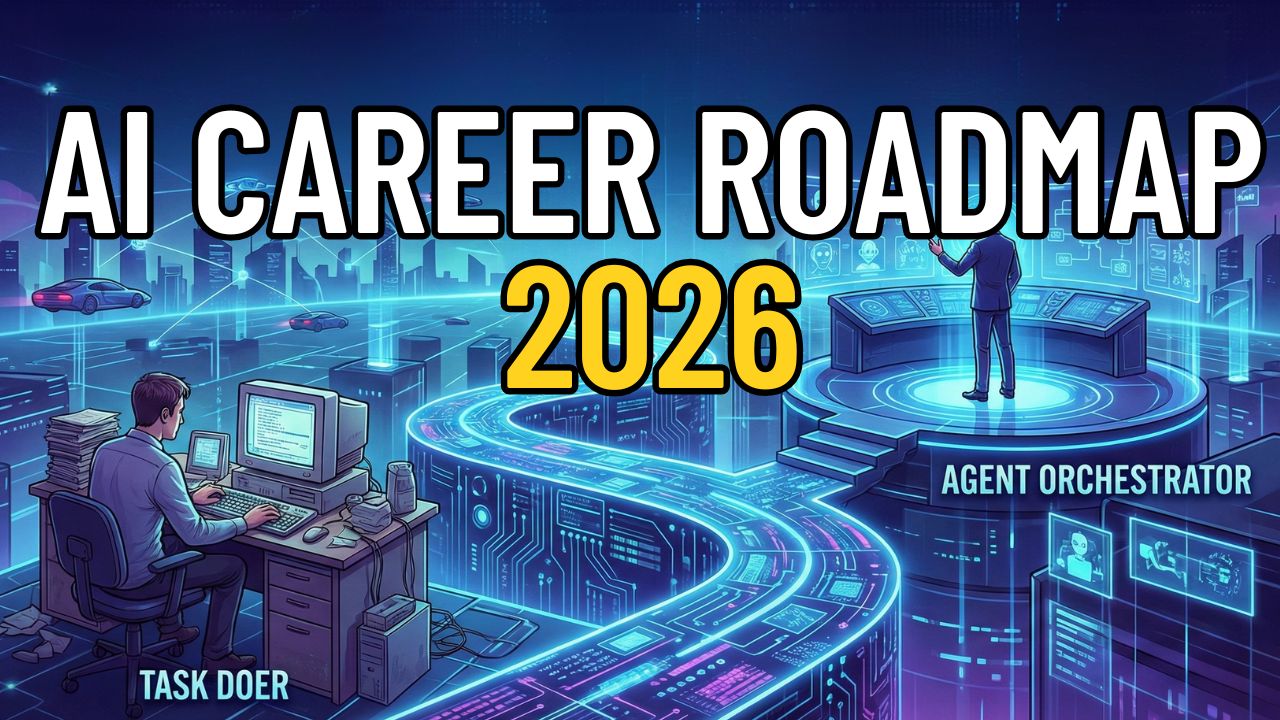
The job market isn't just changing, it is being rewritten. This is your survival guide to shifting from a "Task Doer" to an "Agent Orchestrator" in the economy of 2026.
The anxiety is real: "Will AI take my job?" The honest answer is yes, if your job is defined by tasks. However, if you redefine your career around roles and outcomes, the answer shifts dramatically.
We are entering the Agentic Era, a time when AI doesn't just generate text; it takes action. This guide acts as the central hub for surviving AI job displacement in the agentic era.
Below, we break down the critical pivots you must make, from choosing the right certifications to mastering the soft skills that algorithms cannot replicate.
The Core Concept: From "Doing" to "Orchestrating"
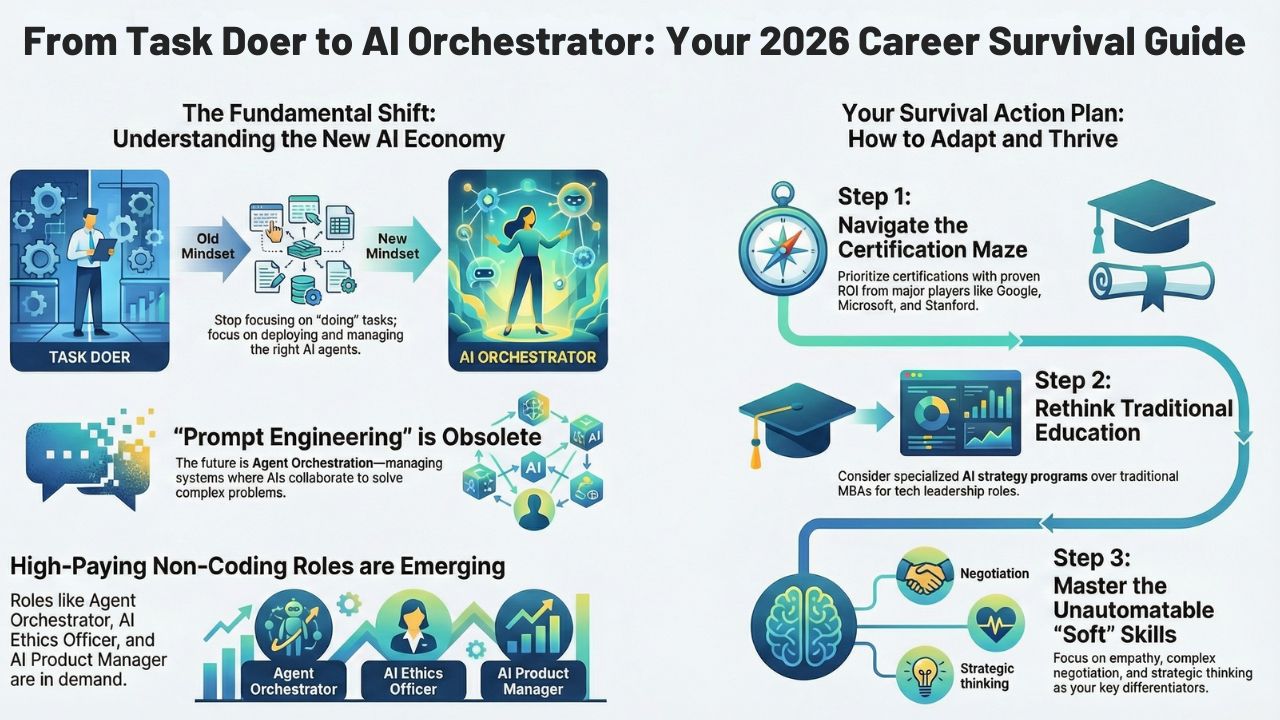
For the last decade, value was created by "doing" things: writing code, drafting emails, analyzing spreadsheets. In 2026, AI Agents will handle the "doing." Value will shift to Orchestration, the ability to design, manage, and verify the work of multiple AI agents.
The transition from task doer to AI orchestrator is the most critical career move you can make. It requires a fundamental shift in mindset:
- Old Mindset: "I need to learn Python to analyze this data."
- New Mindset: "I need to know which AI agent to deploy, how to verify its output, and how to integrate that insight into a business strategy."
This roadmap provides a step-by-step guide to AI career survival, helping you navigate the confusion of degrees, bootcamps, and changing job titles.
1. Credentials: Navigating the Certification Maze
Which piece of paper actually matters in 2026? With thousands of courses flooding the market, professionals are paralyzed by choice. Does a certificate from a tech giant carry more weight than a university specialization?
We have analyzed the cost vs. value of Coursera AI specializations and high-ticket bootcamps to determine what actually gets you hired.
- The Big Three: We compare the curricula of Google vs. Microsoft vs. Stanford to see which offers the best ROI.
- Non-Technical Paths: Identifying the best AI certifications for non-technical professionals who want to pivot without becoming data scientists.
Read the Full Review: Best AI Certifications 2026: Google vs. Microsoft vs. Stanford
2. The Education Pivot: Is the MBA Dead?
Rethinking the "Business Degree" for the AI Era. For decades, the MBA was the golden ticket to executive leadership. But does a traditional business curriculum hold up when algorithms can perform financial modeling better than a human associate?
We explore the impact of artificial intelligence on MBA ROI and ask the provocative question: Do you still need a business degree in 2026?
- The New Curriculum: What AI postgraduate programs for business leaders look like in 2026.
- Skills vs. Prestige: Why some leaders are skipping the degree entirely in favor of specialized "AI Strategy" executive education.
Deep Dive: The AI PG Program: Do You Still Need a Business Degree in 2026?
3. New Roles: Why Prompt Engineering is Dead
Stop memorizing prompts. Start building systems. A few years ago, "Prompt Engineering" was hailed as the job of the future. That future has already passed.
As models become smarter, they no longer need complex "spells" to function. The industry is moving toward Agent Orchestration, managing systems where AI agents talk to other AI agents to solve complex problems.
- The Salary Shift: We analyze the salary of AI agent orchestrator vs. prompt engineer roles.
- No Coding Required: Discover high-paying AI roles that do not require coding, specifically focusing on system architecture and workflow design.
Future-Proof Your Role: Prompt Engineering is Dead: Rise of Agent Orchestrator
4. Academic Tools: The 4.0 GPA Cheat Code
Ethical research in the age of automation. For students and researchers, the conversation has moved beyond "How do I use ChatGPT to write my essay?" (which is plagiarism) to "How do I use AI to analyze 500 papers in an hour?" (which is research).
We review best AI tools for writing master's thesis ethically, focusing on deep research tools like Consensus and Elicit.
- Literature Review: How to use Consensus AI for literature review to find citations instantly.
- Data Analysis: Automated data analysis tools for graduate students that turn raw data into insights.
Tools Guide: The 4.0 GPA Cheat Code: Best AI Tools for Thesis & Research
5. The Safety Net: Soft Skills
The only skills AI cannot automate. As technical barriers lower, the value of being "human" rises. Critical soft skills AI cannot replace in 2026, such as empathy, complex negotiation, and ethical judgment, are becoming the new differentiators for elite talent.
- Strategic Thinking: Why strategic thinking vs. algorithmic processing is the defining battle for leadership roles.
- Leadership: Developing leadership skills for managing AI agents and human-AI hybrid teams.
The Human Edge: 5 Soft Skills AI Cannot Replace (Yet)
Frequently Asked Questions (FAQ)
To build a viable roadmap, stop focusing on specific tools (which change monthly) and focus on workflows. Identify the repetitive "doing" tasks in your industry that will be automated, and upskill into the "orchestration" layer, managing the strategy and output of those tasks.
The most prominent non-coding role emerging is the Agent Orchestrator (or AI Systems Manager). Other high-value roles include AI Ethics Compliance Officer, AI Product Manager, and Workflow Automation Strategist. These require deep domain knowledge and system thinking rather than Python syntax.
Focus on "Compound Skills." Combine your domain expertise (e.g., Marketing, Law, Finance) with AI fluency. Do not try to become a generic "AI Expert." Instead, become the "AI-Enabled Lawyer" or the "AI-Driven Marketer." This hybrid approach is the most secure defense against displacement.
It depends on the curriculum. Traditional MBAs that focus heavily on quantitative analysis (financial modeling, basic accounting) are losing value as AI masters these tasks. Programs that focus on leadership, strategy, and managing AI agents are gaining value. Consider specialized AI PG programs if your goal is tech leadership.
Sources and References
- The agentic commerce opportunity: How AI agents are ushering in a new era for consumers and merchants
- Innovation at the core: How agentic AI will redefine business growth
- Coursera – 7 Popular Machine Learning Certifications: Your 2026 Guide
- Dataquest – Best AI Certifications to Boost Your Career in 2026
- BusinessBecause – How Will Artificial Intelligence Change MBA Jobs?
- Fortuna Admissions – Evolving MBA Job Market: How AI is Reshaping Career Paths
- Stackademic – Prompt Engineering Is Dead — Context Engineering Is Next
- Analytics India Magazine – Top 7 New Job Roles Created by AI in 2025
- Consensus (AI Search Engine for Research)
- Elicit (The AI Research Assistant)
- The Effortless Academic – Consensus AI Review for Researchers
- World Economic Forum – These are the skills you will need for the future of work