The Atlas-Hyundai Price No One on YouTube Is Telling You
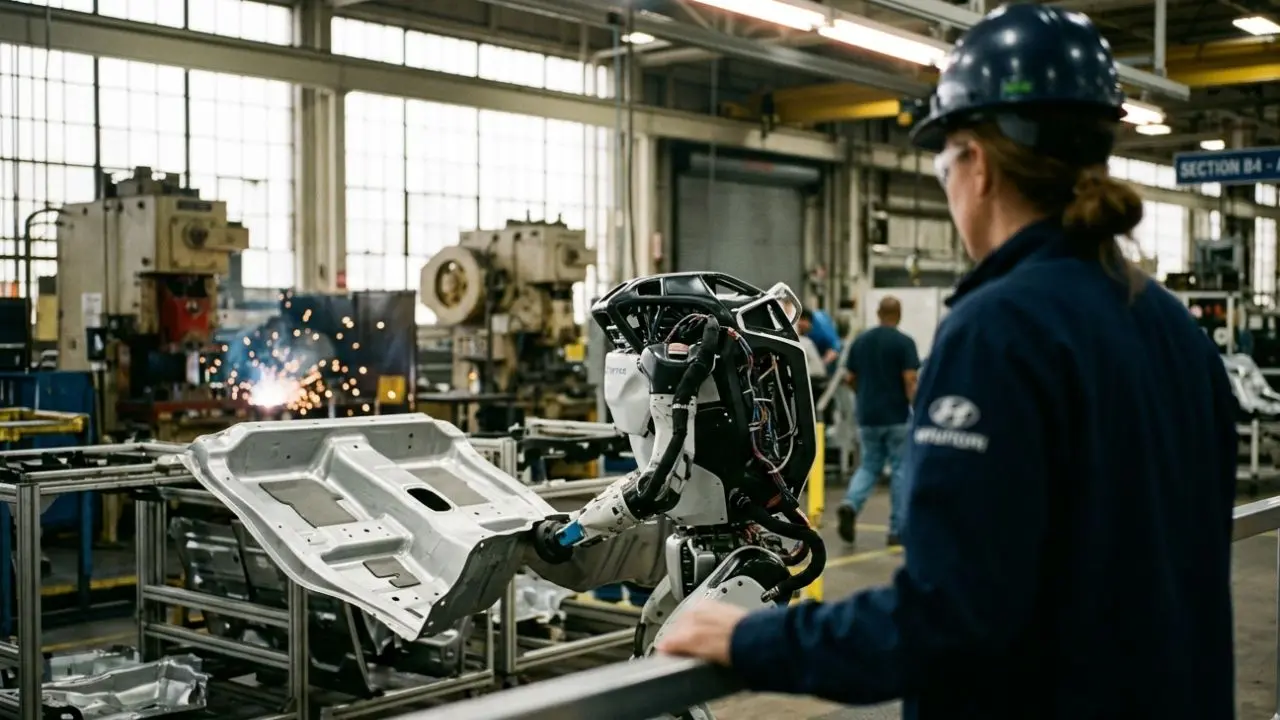
- Exclusive Factory Footprint: The advanced electric Atlas robot is actively deployed in a live Hyundai Georgia pilot program.
- Enterprise-Only Pricing: Boston Dynamics commercial pricing structures confirm the hardware requires massive industrial capital.
- The Electric Pivot: Transitioning from legacy hydraulics to a fully electric architecture drastically improves factory uptime and lowers maintenance overhead.
- Automotive Dominance: Hyundai's ownership of Boston Dynamics gives them exclusive first-access to this advanced atlas humanoid factory deployment.
Boston Dynamics Atlas is in a live Hyundai Georgia pilot — and the per-unit cost reveals why Atlas was never built for your home.
See the procurement file data that explains the massive capital requirements keeping this machine off the consumer market.
If you want to understand where this fits into the broader 2026 market landscape, you must review our overarching pillar page, The 2026 Humanoid Robot Audit.
The humanoid robot SERP in May 2026 is a tabloid-style attention war, with mainstream outlets constantly pushing a simplified Tesla narrative.
However, the reality of high-end enterprise robotics is quietly unfolding in the automotive sector.
Unpacking the Boston Dynamics Commercial Pricing
When evaluating the legacy data on the best humanoid robots, Boston Dynamics has always represented the pinnacle of agility.
But agility comes at an extreme premium.
YouTube tech influencers continually hype a future where an Atlas robot cooks your breakfast. This is financially impossible in 2026.
Procurement leaks indicate the per-unit cost of an enterprise-grade electric Atlas runs into the hundreds of thousands of dollars.
This completely shatters the sub-$30k consumer pricing model attempted by other manufacturers.
Atlas Humanoid Factory Deployment: The Georgia Pilot
The true value of this machine is being tested right now.
The electric Atlas robot is operational at the Hyundai Georgia facility.
Instead of general-purpose meandering, Atlas is executing highly specific, dynamic maneuvers that traditional bolted-down robotic arms cannot handle.
Its unique joint configuration allows it to lift heavy automotive components from odd angles, compensating for the chaotic reality of a live production line.
Atlas vs Figure 03 Unit Economics
To understand the broader automotive shift, we must look at the competition.
The comparison of Atlas vs Figure 03 highlights two radically different financial models.
Figure 03 utilizes a $25/hour Robot-as-a-Service (RaaS) operational expenditure model at BMW.
Conversely, the Hyundai-Atlas integration functions as a massive, in-house capital expenditure, utilizing Hyundai's direct ownership to absorb the staggering R&D and deployment costs.
The Shift: Hydraulic to Electric Atlas Robot
The most crucial upgrade for 2026 wasn't just software. Boston Dynamics retired the iconic hydraulic Atlas in favor of a fully electric system.
Hydraulic systems, while powerful, were prone to fluid leaks, required intense maintenance, and were simply too loud for safe, sustained human-robot collaboration on a modern factory floor.
The new electric Atlas robot delivers higher precision, vastly improved energy efficiency, and a broader range of motion, cementing its status as an elite, enterprise-only asset.
Optimize Your AI Workflow. Try Survey Monkey AI

We may earn a commission if you buy through this link. (This does not increase the price for you)
Frequently Asked Questions
1. How much does Boston Dynamics Atlas cost in 2026?
Boston Dynamics does not publish a public price list, but commercial procurement data suggests per-unit costs easily exceed $150,000 to $200,000 for enterprise buyers. This staggering upfront capital expenditure is strictly aligned with heavy industrial and automotive manufacturing budgets, not consumers.
2. Is the electric Atlas robot deployed at Hyundai Georgia?
Yes, the fully electric Atlas robot is currently undergoing a live, rigorous pilot program at the Hyundai Georgia manufacturing facility. This strategic deployment tests the robot’s advanced mobility and payload capabilities directly on a dynamic, high-volume automotive production line.
3. What does Atlas do at the Hyundai factory?
At the Hyundai facility, Atlas focuses on complex, ergonomically challenging tasks. It handles heavy, awkwardly shaped automotive components, leveraging its unique joint mobility to move parts from storage racks directly into the chaotic, tight spaces of an active assembly line.
4. Can a private company buy a Boston Dynamics Atlas?
Currently, Boston Dynamics heavily restricts Atlas procurement. Private companies cannot easily purchase units off the shelf. Deployment is strictly gated to highly vetted strategic partners, primarily focusing on maximizing ROI through bespoke, massive-scale industrial and logistical integration projects.
5. Is Atlas faster than Figure 03 or Optimus Gen 3?
Yes, in terms of dynamic mobility and rapid positional shifts, the electric Atlas robot significantly outperforms both Figure 03 and Optimus Gen 3. Its proprietary actuator design allows for faster recovery from physical disturbances and more explosive, varied movement patterns on factory floors.
6. How does Hyundai own Boston Dynamics?
Hyundai Motor Group acquired a controlling interest (80% stake) in Boston Dynamics from SoftBank in 2021. This strategic acquisition gives Hyundai preferential, early access to cutting-edge robotics hardware, allowing them to integrate advanced systems like Atlas directly into their own global supply chain.
7. What is the difference between hydraulic and electric Atlas?
The legacy hydraulic Atlas used pressurized fluid, making it incredibly strong but loud, heavy, and prone to maintenance leaks. The new 2026 electric Atlas robot uses custom electric motors, making it significantly quieter, more energy-efficient, broader in its range of motion, and factory-safe.
8. Has Atlas replaced any human workers at Hyundai?
Atlas is not replacing the general workforce; it is augmenting it. The Hyundai pilot targets specific, dangerous, and ergonomically punishing tasks—such as heavy lifting in awkward postures—aiming to reduce human worker injury rates and handle roles experiencing severe labor shortages.
9. Why is Atlas not sold to consumers?
The electric Atlas robot is far too expensive, powerful, and complex for safe household use. Its enterprise-grade hardware demands rigorous maintenance protocols and strict safety perimeters, making a direct-to-consumer rollout financially unviable and legally hazardous in the 2026 market.
10. What software runs on the new electric Atlas?
Atlas operates on a proprietary, highly advanced AI control system developed entirely by Boston Dynamics. It utilizes advanced machine learning for real-time physics adaptation, spatial computing, and computer vision, allowing it to autonomously navigate and manipulate objects within unstructured industrial environments.