The 2026 Humanoid Robot Audit: Why Only 1 Ships at Scale
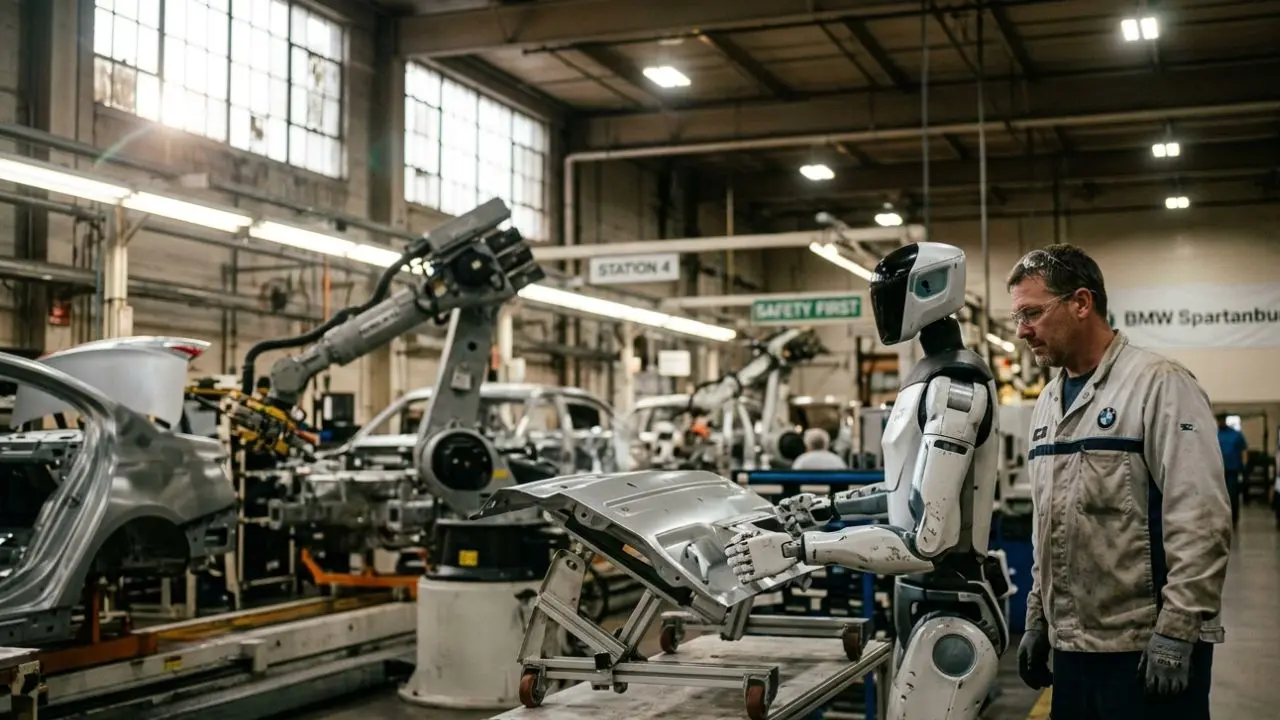
- Production Reality: Despite massive pre-order numbers, supply chain bottlenecks mean only one major player is meeting 2026 scaling targets.
- True Unit Economics: The financial models vary wildly, from traditional CapEx purchases to Robot-as-a-Service (RaaS) billing at $25/hour.
- The Subscription Trap: Over 10,000 buyers have locked in the $499/month 1X NEO, but a 60-month Total Cost of Ownership (TCO) model reveals hidden break-even points.
- Enterprise vs. Consumer: While commercial humanoid robot deployment is accelerating, household models remain heavily restricted by safety and pricing.
The humanoid robot SERP in May 2026 is a tabloid-style attention war, dominated by near-identical narratives from mainstream tech outlets. Optimus Gen 3, Figure 03, and 1X NEO all promised aggressive 2026 delivery timelines, capturing the attention of both enterprise buyers and tech enthusiasts.
However, our extensive procurement audit reveals a brutal reality behind the press releases: only one of these models will actually ship at commercial scale this year. If you are trying to navigate this chaotic market, this analysis serves as your master buyer’s verdict.
Welcome to the definitive hub for AI robotics, where we strip away the marketing fluff to examine true unit economics, production bottlenecks, and real-world deployment data.
The 2026 Humanoid Robot Landscape: Hype vs. Reality
Mainstream publishers consistently push a simplified "Tesla vs. Figure" angle. This creates a massive blind spot for procurement teams looking for a humanoid robot comparison 2026 based on factual data.
Ranking these platforms requires looking past the viral videos and evaluating the physical supply chains. When reviewing the legacy data on the best humanoid robots, it becomes clear that software capabilities are outpacing hardware manufacturing.
The critical differentiator this year isn't just the AI brain—it's the ability to forge, assemble, and deliver actuators and battery packs at volume.
The Big Three: Optimus Gen 3 vs Figure 03 vs 1X NEO
To understand the best humanoid robot to buy, we must break down the three primary contenders dominating the conversation. Each is targeting a slightly different segment of the market, employing drastically different economic models.
Tesla Optimus Gen 3: The Fremont Bottleneck
Tesla’s engineering progress is undeniable, but their production timeline is shifting. The Tesla Optimus Gen 3 release slipped to late July 2026, and mass production at Fremont is facing unpublicized hurdles.
While the projected specs are impressive, enterprise buyers cannot bank on immediate availability. If you are waiting for Tesla, you need to review the specific production tiers they are quietly rolling out.
Figure 03: The BMW Spartanburg ROI
Figure AI has taken a completely different route, focusing relentlessly on commercial humanoid robot deployment. The Figure 03 is already live on the floor at BMW Spartanburg.
They are currently billing BMW $25 per robot-hour. When auditing the unit economics of this Robot-as-a-Service (RaaS) model against human shifts, the ROI gap is much wider than what is being reported.
1X NEO: The Subscription Break-Even
The 1X NEO is targeting the household humanoid robot sector with a disruptive pricing strategy. Instead of a massive upfront cost, they are utilizing a $499/month subscription model.
While this lowers the barrier to entry, it acts as a financial trap for those who don't run the math. Our 60-month TCO model exposes the long-term costs that pre-order pages obscure.
Humanoid Robot Comparison 2026: The Verdict Matrix
To make an informed decision, refer to our comprehensive humanoid robot procurement guide matrix below. This table compares the leading models based on actual 2026 availability, not just spec-sheet promises.
| Robot Model | Primary Use Case | 2026 Delivery Status | Deep Dive Audit |
|---|---|---|---|
| Tesla Optimus Gen 3 | General Purpose / Factory | Delayed (Q3/Q4 Limited) | View Pricing & Specs |
| Figure 03 | Automotive / Commercial | Active (Spartanburg) | View BMW Deployment ROI |
| 1X NEO | Household / Light Duty | Pre-Order Backlog | View Subscription Audit |
| Unitree H2 | Research / B2B | Active Shipping | View Bionic Face Specs |
| XPeng Iron | Commercial Factory | Q1 2026 Launch | View Launch Review |
| Agility Digit | Warehouse Logistics | Active (GXO/Toyota) | View GXO Math |
| Unitree G1 | Consumer / Hobbyist | Active (Walmart) | View "Rizzbot" Review |
| Boston Dynamics Atlas | Advanced Pilot | Active (Hyundai) | View Hyundai Pricing |
AI Brains and Autonomous Operations
Hardware is only half the equation. The race for the best AI brain—between Tesla’s proprietary models, Figure’s Helix VLM, and 1X’s systems—is dictating which robots can operate autonomously without constant human teleoperation.
Currently, Figure's Helix VLM is showing the most practical application in highly structured, repetitive commercial environments like Spartanburg. Tesla's vision-based approach promises more general adaptability, but requires more training data to scale effectively outside the factory.
Optimize Your AI Workflow. Try Survey Monkey AI

We may earn a commission if you buy through this link. (This does not increase the price for you)
Frequently Asked Questions (FAQ)
1. Which humanoid robot is actually shipping in 2026?
While many are announced, the Unitree G1 and H2 are actively shipping to buyers, while Figure 03 and Agility Digit are actively deployed in commercial pilots at scale. Tesla Optimus Gen 3 and 1X NEO remain largely backlogged.
2. What is the price difference between Optimus Gen 3, Figure 03, and 1X NEO?
Optimus Gen 3 pricing is projected around $25,000 to $30,000 for outright purchase, though unconfirmed. Figure 03 utilizes a $25/hour RaaS model. 1X NEO operates on a $499/month consumer subscription model.
3. Is the 1X NEO $499/month subscription cheaper than buying outright?
Over a short period, yes. However, our 60-month TCO analysis shows that subscribing at $499/month quickly surpasses the projected CapEx of buying a standalone unit outright, creating a break-even point buyers must evaluate.
4. Can you buy a Tesla Optimus Gen 3 as a consumer in 2026?
No. Despite massive consumer interest, Tesla is prioritizing internal deployment at Fremont and select commercial partners for 2026. Widespread consumer availability is not occurring this year.
5. How long do humanoid robots last on a single charge?
Battery life varies significantly by payload and task. Most commercial robots like Figure 03 are designed to run for 4 to 5 hours of continuous heavy labor before requiring a recharge or a battery swap.
6. Which humanoid robot has the best AI brain — Tesla, Figure, or 1X?
Figure's Helix VLM currently leads in commercial, task-specific environments like automotive manufacturing. Tesla’s AI aims for broader, general-purpose navigation, while 1X excels in safe, compliant movement in domestic spaces.
7. Are humanoid robots safe to use in a home with children?
Safety remains a major regulatory hurdle. Models like the 1X NEO are specifically designed with compliant mechanics for household safety, whereas heavy industrial models like Optimus are not currently rated for home use with children.
8. What jobs can Figure 03 do at BMW Spartanburg today?
Figure 03 is currently executing highly precise, repetitive tasks such as sheet metal handling, chassis assembly support, and specific pick-and-place operations on the active Spartanburg production line.
9. Do humanoid robots require a special insurance policy?
Yes, commercial deployments require specialized liability and equipment insurance. Standard commercial policies do not yet fully cover autonomous heavy machinery operating dynamically alongside human workers, requiring bespoke underwriting.
10. How do Optimus Gen 3, Figure 03, and 1X NEO compare on payload, speed, and battery life?
Optimus and Figure 03 target roughly 20kg payloads and standard human walking speeds (around 1.5 - 2 m/s), built for industrial stamina. The 1X NEO prioritizes lighter payloads and slower, safer movements for domestic environments.