Optimus vs Figure 2026: The 3-Spec Verdict Reddit Got Wrong
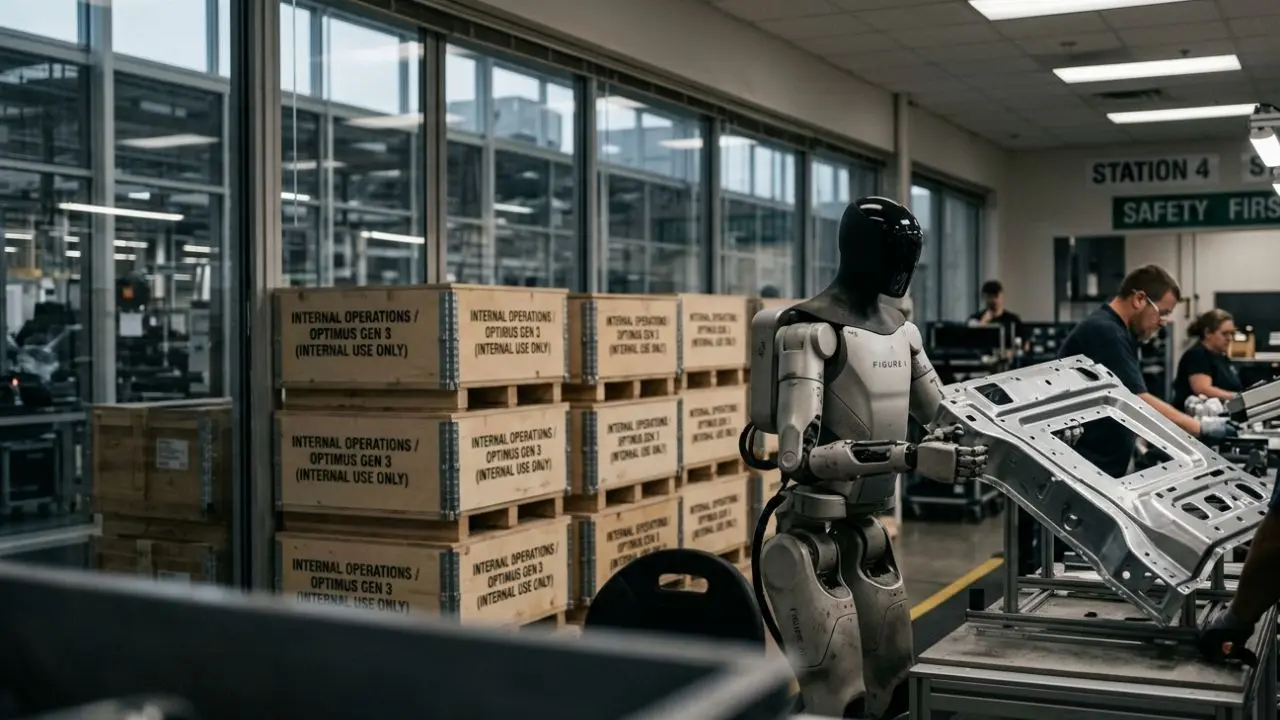
- The Reality Check: The optimus gen 3 vs figure 03 debate is not about physical strength; it is a software war between generalized world models and targeted visual language processing.
- Spec 1 (Autonomy): Figure’s Helix VLM dominates highly structured, predictable factory environments right now.
- Spec 2 (Scaling): Tesla’s vertical integration gives Optimus a massive long-term advantage in manufacturing volume.
- Spec 3 (Economics): The procurement math fundamentally changes when comparing Figure's Robot-as-a-Service (RaaS) model against Tesla's high-CapEx outright purchase.
Tesla Optimus vs Figure AI in 2026 isn't the duel Reddit thinks. Three specs flip the narrative — and one decides which robot you should actually back.
If you have already audited the broader robotics landscape in our master breakdown, you know the internet is obsessed with a fabricated hardware war. The mainstream humanoid robot face-off 2026 is dominated by viral videos and fanboy speculation, entirely missing the enterprise procurement reality.
When you strip away the Elon Musk hype and the Figure AI press releases, the decision for product managers and supply chain directors comes down to three deeply unglamorous technical specifications. This is the definitive tesla optimus vs figure ai comparison 2026 — built for buyers, not social media.
The Reddit Misconception: Why Spec Sheets Lie
Standard social media arguments focus entirely on maximum payload capacities, degrees of freedom in the hands, and walking speeds. These superficial figures mask the actual friction points encountered when integrating autonomous bipedal hardware into an active assembly line or warehouse ecosystem.
A robot that walks 20% faster but requires manual remote intervention every forty minutes will destroy an enterprise facility's net operational efficiency. True productivity metrics are derived directly from spatial reasoning loops, mean time between structural failures, and standardized unit procurement mechanics.
Spec 1: The Autonomy Framework (End-to-End vs. VLM)
The foundational division between these platforms lies entirely in their underlying computer vision and behavioral reasoning architectures. Tesla leverages an end-to-end deep learning neural network framework directly derived from its Full Self-Driving automotive infrastructure stack.
This model forces the robot to ingest raw video inputs and output direct actuator commands via unified networks, optimizing generalized environmental adaptions over time. Conversely, Figure AI utilizes a highly structured Vision-Language-Action system developed in close collaboration with OpenAI, known natively as Helix.
Helix processes tasks by converting visual inputs into explicit semantic instructions before executing specialized logic control. In highly predictable manufacturing cells, Figure's approach delivers superior precision for fast step-by-step pick and place routines, while Tesla's framework aims to conquer unstructured spatial variations globally.
Spec 2: Vertical Manufacturing and Scaling Infrastructure
Designing a high-fidelity prototype humanoid is an engineering triumph; scaling that machine to ten thousand operational units is a logistical nightmare. Tesla holds a structural manufacturing advantage due to its existing automotive gigafactory footprint and custom machine tooling experience.
Optimus utilizes completely custom-designed planetary and harmonic drive actuators manufactured entirely in-house. This vertical integration allows Tesla to iterate on alloy composition and motor winding efficiency weekly, shielding their production lines from external component supplier delays.
Figure AI relies on a premium, decentralized assembly methodology, selecting world-class industrial tier-1 suppliers for specialized sensor rigs and strain gauge elements. While this guarantees exceptional out-of-the-box accuracy for low-volume testing, it exposes Figure's long-term scale projections to international precision component bottlenecks.
Spec 3: Financial Procurement Mechanics (CapEx vs. RaaS)
The ultimate metric that dictates commercial adoption is the balance sheet impact. Tesla's primary strategic goal is a high-CapEx asset purchase strategy, positioning Optimus as a permanent factory tool with a target consumer deployment cost under twenty-five thousand dollars over time.
This requires substantial upfront corporate investment but eliminates recurring subscription vulnerabilities. Figure AI bypasses this initial capital block by championing an aggressive Robot-as-a-Service monthly subscription blueprint, minimizing the initial friction for manufacturing pilots.
For operations managers evaluating long-term financial risk, the decision hinges on whether your organization prefers predictable operational expenses (OpEx) with external software management or complete asset ownership with internal engineering maintenance obligations.
Optimize Your AI Workflow. Try Survey Monkey AI

We may earn a commission if you buy through this link. (This does not increase the price for you)
Frequently Asked Questions (FAQ)
What payload does each robot lift — Optimus vs Figure?
Both the Optimus Gen 3 and Figure 03 target a sustained industrial payload of approximately 20 kg (44 lbs). This capacity is specifically engineered to handle standard automotive parts and logistics totes without risking actuator failure during a shift.
Which has better battery life: Optimus Gen 3 or Figure 03?
Figure 03 relies on rapid battery-swapping protocols to maintain continuous factory uptime. Optimus Gen 3 houses a larger, integrated torso battery pack projected to last 4 to 5 hours, though real-world industrial endurance remains largely unverified by third parties.
Which humanoid robot has more real-world commercial deployments?
Figure AI leads significantly in third-party commercial deployments, primarily driven by its active integration at the BMW Spartanburg facility. Tesla is actively testing Optimus, but those deployments are heavily gated within their own automotive production lines.
Is the 1X NEO robot a direct competitor to Tesla Optimus?
The 1X NEO is uniquely optimized for low-force household environments and close-proximity human interactions. This positions it as a lighter, subscription-driven domestic complement rather than a direct structural competitor to heavy-industry bipedal models like the Tesla Optimus.