AI Living 2026: From Chatbots to Humanoids & Smart Cities

The Awakening: Welcome to 2026
Imagine waking up, but not to the jarring sound of a generic alarm clock. Instead, your bedroom blinds slowly tilt open to let in the exact amount of sunlight needed to wake you gently, based on your sleep cycle data from the night before.
You don't shout, "Alexa, turn on the coffee." You don't have to. Your kitchen already knows you're awake and has started brewing.
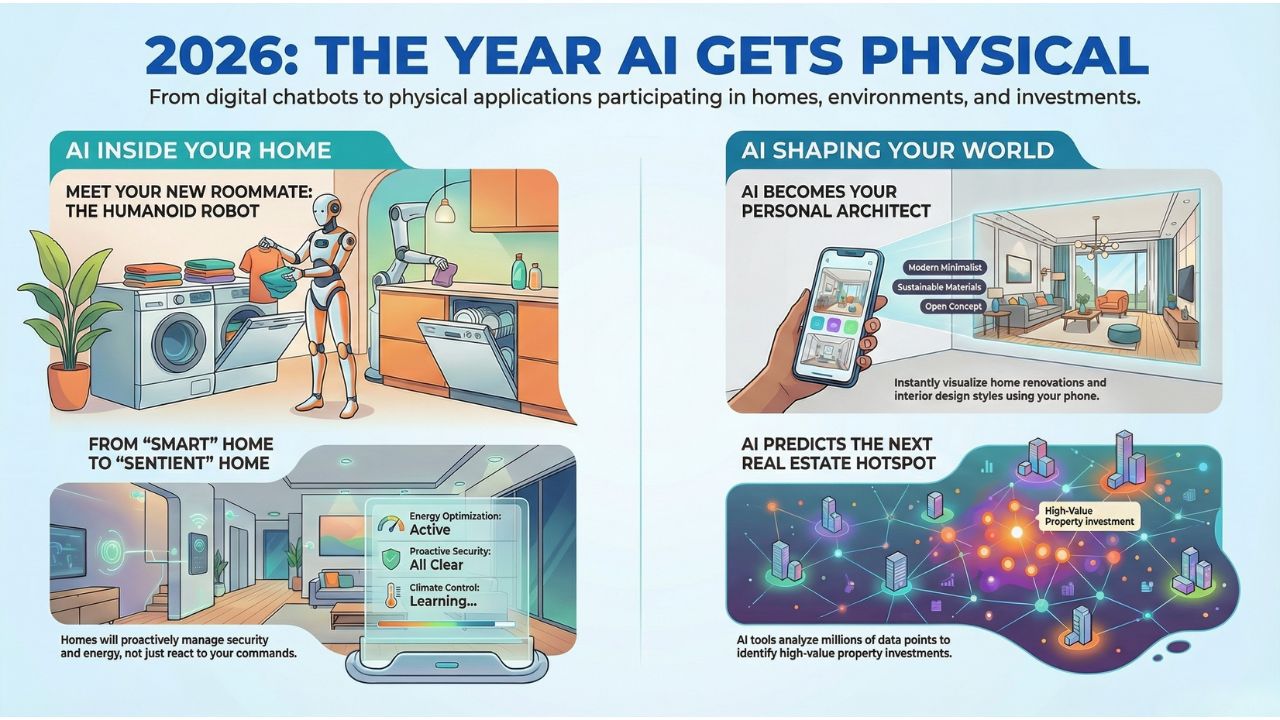
But here is the biggest change: when you walk into the kitchen, there isn’t just a voice in a speaker waiting for you. There is a figure standing there, a humanoid robot, unloading the dishwasher.
Welcome to the Physical AI Revolution.
For years, we lived in the era of "Chatbots", AI that lived on our screens and in our speakers. We asked ChatGPT to write emails; we asked Siri to check the weather. But 2026 marks a massive shift in the AI living roadmap.
This is the year AI leaves the screen and enters the physical world. We are witnessing the transition from chatbots to robots, where intelligence isn't just something you talk to; it's something that moves, works, and lives alongside you. This isn't science fiction anymore. It is the new reality of AI Living 2026.
1. The New Roommate: The Rise of Consumer Robotics
Remember when owning a smartphone was a luxury? In 2026, the domestic robots market forecast looks exactly like the smartphone market did in 2010. We are moving beyond the clumsy vacuum cleaners that bumped into walls.
We are entering the era of the "General Purpose Humanoid." These robots are not just programmed toys; they are powered by "Physical AI." They understand the physics of your home.
They can fold laundry without tearing it, hold an egg without crushing it, and understand that when you sigh heavily, you might need a cup of tea, not a weather report. The future of home robotics 2026 is about companionship and labor.
Whether it's the Tesla Optimus, the sleek Figure 01, or the agile 1X Neo, these machines are competing to become the "iPhone" of robots, the essential device you can't live without. They are redefining the impact of robotics on daily life, taking over the dangerous, repetitive, and boring chores so you can reclaim your time.
Deep Dive: Which robot is right for your home?
We’ve compared the top contenders on price, battery life, and "human-ness."
Read the Full Review: Best Home Robots 2026: Tesla Optimus vs. Figure vs. 1X
2. The Smart Investment: Real Estate in the AI Era
Finally, this physical revolution is changing the value of the land itself. We are seeing a divergence between Smart Cities Vs Sentient Cities.
Investors are no longer just looking for "location, location, location." They are looking for "data, connectivity, and automation." AI tools can now analyze millions of data points, from local crime rates to future zoning changes, to predict property value appreciation with frightening accuracy.
For the savvy investor, AI provides a crystal ball. It can spot undervalued properties that the human eye misses and predict which neighborhoods will boom next year. Understanding these tools is crucial for anyone looking to build wealth in 2026.
Deep Dive: How do you find the next boomtown? Use the tools the pros use.
Read the Guide: AI for Real Estate: The New Rules of Property Investment
3. From Smart Homes to Sentient Homes
For the last decade, we’ve had "Smart Homes." But let's be honest, they weren't that smart. You still had to command them. If you didn't tell the lights to turn off, they stayed on.
In 2026, we are upgrading to Sentient Home Technology. A sentient home doesn't wait for commands; it anticipates needs. It is proactive. Using advanced sensors and local AI agents, your home "feels" the environment.
- Security: It doesn't just record a burglar; it recognizes a face that doesn't belong and locks the doors before they even reach the porch.
- Energy: It doesn't just run the AC; it knows you won't be home until 6 PM and manages the solar panels to sell excess energy back to the grid during peak hours, effectively lowering your electricity bill with zero effort.
This is one of the most practical smart home automation ideas 2026, a home that acts as a guardian and an accountant.
Deep Dive: Want to turn your house into a thinking machine that saves you money?
Read the Guide: The Sentient Home: AI Security, Energy & Insurance
4. Redesigning Your World: AI as Your Architect
The Physical AI Trends aren't just about robots; they are about how we shape the physical spaces we live in. In the past, renovating a home meant hiring expensive architects, waiting weeks for blueprints, and hoping you liked the result.
Now, generative AI has democratized design. You can stand in your living room, point your phone camera, and say, "Show me this room in a Mid-Century Modern style with a touch of Japanese minimalism."
Instantly, the AI re-renders your reality on the screen. It tells you exactly which furniture fits, where to buy it, and how the light will hit the sofa at 4 PM. This toolset empowers homeowners to visualize how AI is changing home living before spending a single dollar on paint or lumber.
Deep Dive: Don't hire an architect until you try these tools.
We reviewed the best apps to redesign your home instantly.
Read the Review: Best AI Interior Design Tools 2026: Renovate Without an Architect

Conclusion: The Future is Physical
The year 2026 is not just another year of faster phones and better apps. It is the year digital intelligence grows hands, feet, and eyes.
From the robots that clean our floors to the sentient walls that protect us, the Physical AI Revolution is here to make our lives safer, easier, and more human. Are you ready to live in the future?
Frequently Asked Questions (FAQ)
A Smart Home (like one using Alexa or Google Home) is reactive, it waits for your command to turn on lights or play music. A Sentient Home is proactive; it uses local AI agents and sensors to understand context. It knows you are sleeping and adjusts the temperature automatically, or recognizes a stranger at the door and locks it without you asking.
Yes, 2026 marks the shift from industrial pilots to consumer availability. Companies like 1X, Tesla, and Figure are releasing "general-purpose" humanoids designed to safely navigate living rooms, fold laundry, and provide companionship, similar to how early smartphones entered the market.
AI removes the guesswork from investing. Instead of relying on intuition, AI tools analyze millions of data points, from zoning changes to crime rates and migration patterns, to predict which neighborhoods will appreciate in value before they become popular.
Absolutely. Generative AI tools (like Midjourney or specialized interior design apps) allow you to upload a photo of your room and instantly render it in different styles (e.g., "Modern minimalist" or "Scandinavian"). It helps you visualize renovations and furniture placement instantly.