Sovereign AI Cloud Infrastructure for Indian GCC: Why the Public Cloud is a Security Risk
Quick Summary: Key Takeaways
- Public clouds expose your proprietary enterprise AI models to unacceptable vulnerabilities.
- Sovereign AI cloud infrastructure Indian GCC is becoming the non-negotiable standard for secure operations.
- Private LLM deployments guarantee strict compliance with regional data laws.
- Air-gapping your AI models is absolutely critical for financial and healthcare offshore operations.
- Deploying models locally dramatically slashes runaway 2026 API costs.
- Secure your data with sovereign AI cloud infrastructure for Indian GCC.
You can no longer rely on shared public servers when handling sensitive, proprietary algorithms and customer intelligence.
This deep dive is part of our extensive guide on AI-Native Global Capability Center Operating Model.
To survive the agentic era, you must control your infrastructure from the silicon up.
Let's explore exactly why public environments are failing and how to secure your offshore data.
The Public Cloud is a Major Security Risk
Public clouds present massive security risks for proprietary AI models.
Sharing compute resources means you do not have absolute control over where your enterprise data lives.
With autonomous agents processing terabytes of sensitive data, the attack surface expands exponentially.
You cannot afford to leak trade secrets into public foundational models.
Global capability centers need localized, highly secure environments. The only viable solution is bringing the processing power directly in-house.
Navigating the DPDP Act
India's data residency laws are becoming stricter. You must understand the impact of DPDP Act on GCC cloud strategy.
You simply cannot send sensitive Indian citizen data to offshore cloud servers without risking massive non-compliance penalties.
For a complete look at maintaining regulatory safety, read our guide on the Generative AI Governance Framework for GCC Compliance.
Building the Sovereign AI Stack
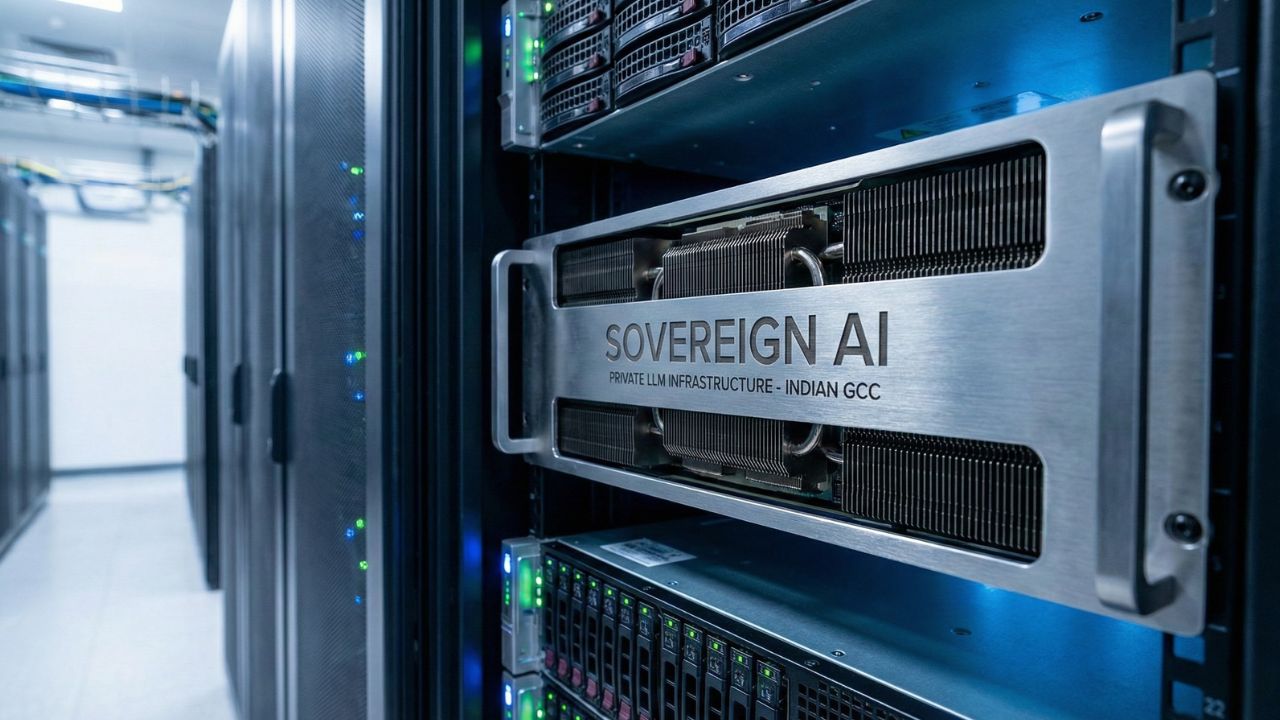
Building a secure center starts with hardware. You need on-premise AI compute for GCCs.
This means investing in localized infrastructure rather than renting it. You must integrate sovereign silicon into existing GCC stacks.
Can GCCs use NVIDIA H100s locally in India? Absolutely. Localizing advanced GPU clusters guarantees unmatched processing speeds.
The Power of Private LLM Deployment
You must prioritize private LLM deployment for enterprises. Running models internally protects your IP and prevents external data leakage.
Furthermore, local LLM deployment is often cheaper than massive API usage at scale.
It ensures compliance and slashes 2026 API costs.
Air-Gapping for High-Stakes Operations
If you run a financial center, standard firewalls are not enough.
You must know how to air-gap AI models for financial GCCs.
Air-gapping physically isolates your AI compute from the public internet.
This creates an impenetrable fortress for your most sensitive autonomous workflows.
To fund this robust infrastructure, many centers are changing how they bill.
Learn more in our breakdown of Outcome-Based Billing Models for AI Agent Workforce.
Conclusion
In the intelligence era, whoever controls the compute controls the future.
Investing in sovereign AI cloud infrastructure Indian GCC guarantees your operations remain secure, compliant, and highly resilient against external security threats.

Frequently Asked Questions (FAQ)
It is a localized, fully controlled data and compute environment. It relies on sovereign silicon and on-premise hardware to ensure that artificial intelligence models and enterprise data never leave the host country or facility.
Private clouds eliminate the severe security risks associated with shared public servers. They ensure absolute control over proprietary enterprise data, preventing IP leakage and unauthorized model training.
Compliance requires hosting all data processing and storage locally. To comply with local laws and ensure security, centers must adopt sovereign AI cloud infrastructure.
Yes, at enterprise scale. While upfront hardware costs are high, private LLM deployment ensures compliance and slashes 2026 API costs by eliminating unpredictable, volume-based third-party API fees.
You must upgrade power and cooling systems to handle advanced GPU clusters. It also requires deploying on-premise AI compute and establishing rigorous localized security perimeters.
Sources & References
- AI-Native Global Capability Center Operating Model
- Generative AI Governance Framework for GCC Compliance
- Outcome-Based Billing Models for AI Agent Workforce
- Ministry of Electronics and Information Technology (MeitY): Digital Personal Data Protection (DPDP) Act
- Data Security Council of India (DSCI): Cloud Security and Data Localization Frameworks
- NVIDIA: Architecting Sovereign AI Infrastructure for Enterprises
Internal Links:
External Industry Context: