Deepfake Insurance 2026: Protecting Your Digital Identity in the Age of AI
It starts with a phone call. It’s your father's voice. He sounds panicked, breathless.
He says he’s at the police station, he’s been in an accident, and he needs ₹50,000 transferred to a lawyer right now.
You panic. You transfer the money.
Five minutes later, you call your father. He is sitting at home, drinking tea. He never called you.
You have just been hit by the "Voice Clone Scam," the most terrifying financial threat of 2026. In the last year alone, deepfake fraud has moved from high-tech corporate espionage to a household danger, affecting families across India.
The bad news: Antivirus cannot stop this.
The good news: You can now insure against it.
Welcome to the 2026 Buyer’s Guide for Deepfake Insurance. We are moving beyond standard health and life insurance.
In the age of AI, your most valuable asset isn't your car, it’s your digital identity. Here is how to protect it.
Explore AI Wealth & Business Automation Hub
The New Threat Landscape: Why You Need "Identity Covers"
In 2024, cyber insurance was a niche product for IT professionals. By 2026, it is as essential as medical insurance.
Why? Because the attack surface has changed.
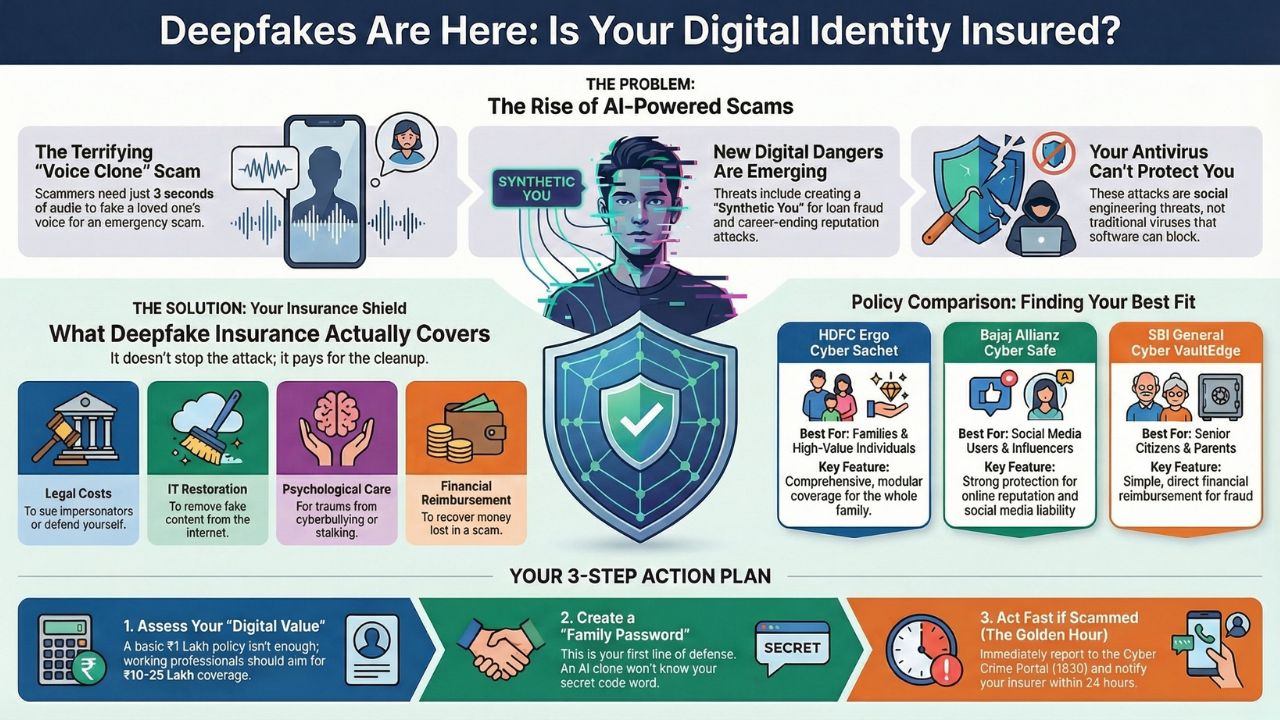
- The "Digital Arrest" & Voice Clones: Scammers use AI to clone voices from 3-second Instagram Reels to orchestrate fake kidnappings or arrests.
- Synthetic Identity Theft: Fraudsters don't just steal your credit card; they create a "Synthetic You" using deepfakes to pass Video KYC for loans in your name.
- Reputation Assassination: A deepfake video of you saying something offensive can go viral, destroying your career in hours.
Standard cyber policies used to cover only "Theft of Funds." The new wave of deepfake insurance India policies covers Theft of Reputation and Legal Defense against these AI crimes.
Comparative Review: Best Cyber Insurance for Individuals (2026)
We analyzed the top policies available in India to see which ones actually protect against modern AI threats.
1. HDFC Ergo Cyber Sachet (The Comprehensive Shield)
Best For: Families and High Net-Worth Individuals (HNIs).
HDFC Ergo has aggressively updated its HDFC Ergo cyber insurance review to tackle 2026 threats. It is structured as a "sachet," allowing you to pick and choose specific covers.
- Deepfake Coverage: It explicitly covers "Identity Theft" and "Loss of Reputation." If a deepfake damages your standing, the policy pays for IT Consultants to remove the content and Psychological Counseling for the trauma.
- Financial Shield: Covers financial losses from unauthorized digital transactions, including those triggered by phishing or voice spoofing.
- Cost: Extremely affordable, starting at ~₹2/day for basic coverage.
Verdict: The most modular plan. You can insure your entire family (including children) under one policy.
2. Bajaj Allianz Individual Cyber Safe (The Social Media Defender)
Best For: Influencers, Content Creators, and Active Social Media Users.
If your life is on Instagram or LinkedIn, this is your policy. Bajaj Allianz focuses heavily on "Social Media Liability."
- Deepfake Coverage: Strong protection against Cyber Stalking and Identity Theft. If a hacker uses a deepfake to impersonate you on social media, the policy covers the legal costs to prosecute them.
- Unique Feature: It offers specific coverage for "Media Liability", protecting you if your account is hacked and used to post defamatory content about others.
- Cost: Plans range from ₹1 Lakh to ₹1 Crore coverage.
Verdict: Essential for anyone whose income depends on their digital reputation.
3. SBI General Cyber VaultEdge (The Pure Financial Cover)
Best For: Senior Citizens and Parents.
SBI’s policy is straightforward and focused on financial fraud. It is less about reputation management and more about getting your money back.
- Deepfake Coverage: Covers "Theft of Funds" resulting from unauthorized transactions (like the "Emergency Call" scam).
- Simplicity: No deductibles. If you lose money, you get the full claim amount up to the sum insured.
Verdict: The best "set it and forget it" policy for parents vulnerable to voice cloning scams.
What Does "Deepfake Insurance" Actually Cover?
Many people misunderstand this product. It does not stop the deepfake from being made. It pays for the cleanup. When looking to protect against AI voice scams, here is what the fine print really gives you:
| Coverage Component | What it Means in 2026 |
|---|---|
| Legal Costs | Pays for lawyers to file cases against impersonators or to defend you if a deepfake makes you look like a criminal. |
| IT Restoration | Pays for forensic experts to prove a video is fake and to scrub it from the internet. |
| Psychological Care | Pays for therapy sessions if you or your child face trauma from cyberbullying or stalking. |
| Financial Reimbursement | Refunds money transferred during a scam, provided you file an FIR within the stipulated time (usually 24-48 hours). |
2026 Action Plan: How to Buy & Claim
Step 1: Assess Your "Digital Value"
Do not under-insure. If a deepfake gets you fired, what is your loss? A ₹1 Lakh policy is useless. Aim for a cover of at least ₹10 Lakh to ₹25 Lakh if you are a working professional.
Step 2: The "Family Password" Protocol
Insurance is the backup. Your first line of defense is the "Family Password." Agree on a secret code word with your parents today. If you get a "distress call" from their voice, ask for the code. An AI voice clone cannot know it.
Step 3: Filing a Claim
If you are hit by identity theft insurance India 2026:
- Golden Hour: Report to the National Cyber Crime Portal (1930) immediately. Insurance will reject claims without an official complaint number.
- Preserve Evidence: Do not delete the fake messages or call logs. Take screenshots.
- Intimate Insurer: Contact HDFC/Bajaj within 24 hours. Delaying notification is the #1 reason for claim rejection.
Frequently Asked Questions (FAQs)
Yes, most comprehensive policies (like HDFC Ergo Cyber Sachet and Bajaj Allianz Cyber Safe) cover "Theft of Funds" resulting from social engineering and phishing, which includes the "Digital Arrest" modus operandi, provided an FIR is filed.
It is surprisingly cheap. Basic plans for individuals start as low as ₹1,000 to ₹3,000 per year for a ₹5 Lakh cover. High-value covers (₹1 Crore+) for HNIs can cost around ₹15,000 - ₹25,000 annually.
Yes. Policies often allow you to include family members (spouse and dependent parents/children) under a single "Floater Sum Insured" plan, protecting the entire household from voice clone scams.
Sources and References
- NeGD: "Deepfakes in India: Legal Landscape and Judicial Responses"
- ET CISO: "Preparing for the next wave of deepfake fraud in 2026"
- HDFC Bank: "Cyber Insurance | HDFC Bank - HDFC ERGO E@Secure"
- HDFC Ergo: "Cyber Sachet Insurance - Plan Details"
- Bajaj Allianz: "Individual Cyber Safe Insurance Policy Brochure"
- Vikaspedia: "Deepfakes and Digital Safety: A Citizen’s Guide to AI Scams"