AI Wealth & Business Automation Hub 2026: The Indian Guide to Financial Freedom
It is January 2026. You wake up in Gurugram, not to the sound of a jarring alarm, but to a soft notification from your "Digital CFO."
While you slept, your personalized AI agent optimized your portfolio based on the overnight US market shifts, filed a rectification request for a minor tax mismatch from three years ago, and negotiated a better premium for your family’s cyber insurance policy.
Welcome to the era of AI wealth management India 2026.
The days of passive investing and manual business grunt work are dead. In 2026, wealth isn't just about earning money; it's about automating its growth and protection. The gap between the wealthy and the aspiring class in India is no longer just capital, it’s compute.
Those who wield AI agents effectively are building "Fortress Balances," while those relying on legacy methods are fighting a losing battle against inflation and algorithmic markets.
This hub is your command center. We have spent the last year testing, breaking, and verifying the tools that claim to build financial freedom. We have divided this new world into four critical "spokes" of wealth: Taxation, Protection, Business Growth, and Trading.
Here is how you will survive and thrive in the Indian financial landscape of 2026.
Phase 1: The AI Tax Shield
Surviving the "Algorithmic Audit"
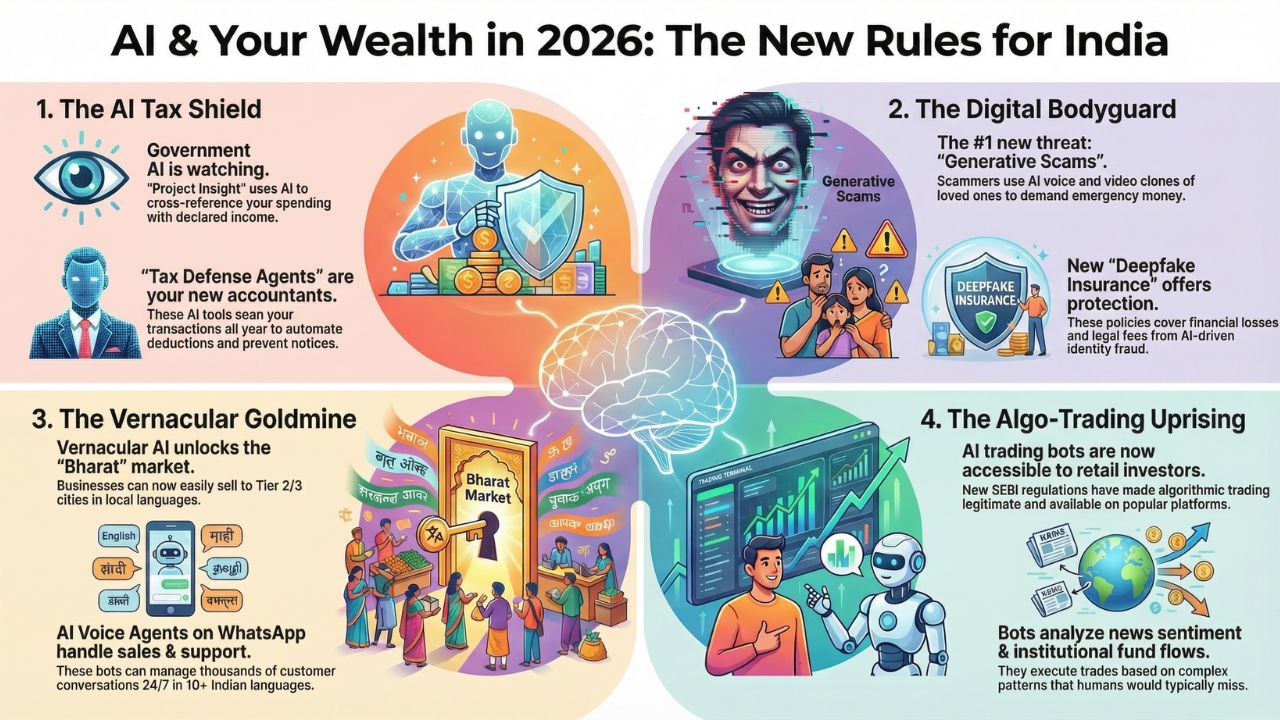
In 2025, the Income Tax Department collected over ₹11,000 crores in additional revenue purely through AI-driven mismatch detection. By 2026, the scrutiny has only intensified. The government’s "Project Insight" is no longer just watching high-value transactions; it is cross-referencing your Swiggy orders with your declared income.
For the salaried employee, the old way of "scrambling in March" is dangerous. The best AI tools for tax saving 2026 are not just calculators; they are defensive agents.
Imagine an AI that lives on your phone. Throughout the year, it scans your UPI transactions. When you pay a medical bill for your parents, it auto-tags it for Section 80D. When you pay rent, it verifies if your HRA exemption is optimized against your basic salary. By the time filing season arrives, your ITR-1 or ITR-2 is 99% ready, requiring only a biometric approval.
We have moved beyond simple e-filing. We are seeing the rise of "Tax Defense Agents" that can predict a potential notice before it is even issued. Tools like TaxBuddy and ClearTax have evolved, using AI to cross-verify your Annual Information Statement (AIS) against your bank statements in seconds, ensuring you never face a mismatch notice.
But which agent is safe? Which one actually saves money rather than just filing forms?
Deep Dive: The Tax Automation Guide
Don't let the March rush destroy your wealth. We reviewed the top agents specifically for Indian employees.
Read More: AI for ITR 2026: Best Tax-Saving Agents for Indian Salaried Employees
Phase 2: The Digital Bodyguard
Insuring Your Identity in the Deepfake Era
If 2025 was the year of Generative AI, 2026 is unfortunately the year of the "Generative Scam." The risk landscape for AI for Indian finance has shifted from credit card theft to Identity Hijacking.
In mid-2025, we saw the first wave of "CEO Voice Clones", scams where employees received calls from their "boss" demanding urgent transfers. Now, that technology has trickled down to target regular families. Your parents might receive a video call that looks and sounds exactly like you, claiming you are in an emergency and need cash immediately.
This has birthed a massive new industry: Deepfake & Cyber Insurance. Insurers like HDFC Ergo and ICICI Lombard have begun rolling out "Digital Identity Covers." These aren't your standard cyber policies.
They cover the legal costs of reclaiming a stolen digital identity, the financial loss from voice-cloned frauds, and even reputation management if a deepfake video of you destroys your professional standing. The "Make Money" mindset is useless if you lose it all to a 30-second AI clip. You need a shield.
Deep Dive: The 2026 Insurance Buyer's Guide
Are you covered against voice cloning? We compare the premiums and fine print of the new "Cyber Covers."
Read More: Deepfake Insurance & Cyber Covers: The 2026 Buyer’s Guide for India
Phase 3: The Vernacular Goldmine
Automated Business Tools for Solopreneurs
While the media focuses on high-tech startups in Bengaluru, the real money in 2026 is being made in "Bharat", Tier 2 and Tier 3 cities. The barrier to entry for selling to this massive demographic has collapsed, thanks to Vernacular AI.
You no longer need a call center of 50 people to sell products in Tamil, Telugu, or Hindi. You need one solid AI Voice Agent.
Companies like Sarvam AI and Krutrim have revolutionized this space. Their "Samvaad" agents can live inside WhatsApp, handling sales inquiries, booking appointments, and solving customer complaints in 10+ Indian languages with native fluency.
This is the golden era of automated business tools for solopreneurs. A single person sitting in Pune can run a D2C brand selling Ayurvedic products to customers in rural Bihar, with AI handling every conversation in Bhojpuri or Hindi. These agents don't sleep, they don't ask for raises, and they can scale from 10 calls to 10,000 calls a day instantly.
If you are trying to build a side hustle or a full-time business in 2026 without using these agents, you are voluntarily operating with one hand tied behind your back.
Deep Dive: Selling to Bharat
Learn how to deploy Sarvam and Krutrim agents to unlock the trillion-dollar vernacular economy.
Read More: Vernacular AI Marketing: Selling to 'Bharat' Using Voice Agents
Phase 4: The Algo-Trading Uprising
Can Retail Investors Beat the Sensex?
Finally, we arrive at the most dangerous and lucrative frontier: The Market. The search for an AI money making guide eventually leads everyone here.
In 2026, the Nifty 50 is a battlefield of algorithms. Institutional investors have used "Black Box" models for decades. But recently, SEBI's new regulations have standardized the playing field, mandating unique Algo IDs and stricter testing for retail bots.
This regulation ironically legitimized the industry. Now, retail traders are using algorithmic trading for beginners India platforms that plug directly into Zerodha or Upstox. These bots don't just "guess" stock prices. They analyze sentiment from thousands of news articles, track FII (Foreign Institutional Investor) flows in real-time, and execute trades based on volatility patterns that a human eye would miss.
But the question remains: Can a ₹5,000/month subscription bot actually beat the Sensex? Or is it just a faster way to lose capital? We tested the top platforms to find out if "Robo-Alpha" is real or a myth.
Deep Dive: The Nifty Prediction Experiment
We put real money into India's top AI trading bots. Here is what happened to our portfolio.
Read More: Nifty Prediction 2026: Can AI Trading Bots Beat the Sensex?
Your Roadmap to 2027
The tools listed in this hub, Tax Agents, Cyber Insurance, Voice Bots, and Trading Algos, are the four pillars of the modern Indian wealth stack. This is not science fiction. This is the baseline for 2026. The AI wealth management India 2026 landscape rewards the curious and punishes the complacent.
Explore the spokes. Download the tools. Secure your digital identity. And most importantly, stop working for money, and start engineering systems that generate it for you.
Frequently Asked Questions (FAQs)
Yes, but it is highly regulated. SEBI requires all algo strategies to be approved by the exchange. Retail investors must use brokers who provide "White Box" or approved algos with unique Algo IDs to ensure transparency and safety.
AI cannot change tax laws, but it can prevent leakage. AI tools detect missed 80C investments, optimize HRA/LTA claims based on actual spending patterns, and prevent notices by matching your ITR data perfectly with your AIS (Annual Information Statement).
It is a specialized cyber insurance add-on. As of 2026, it covers financial losses from voice-cloning fraud, legal fees for identity theft, and counseling services for victims of digital harassment. Insurers like HDFC Ergo and Bajaj Allianz have started offering these specific covers.
Sarvam AI is a leading contender for 2026, specifically for its "Samvaad" agents that integrate into WhatsApp and support 10+ Indian languages like Hindi, Tamil, and Telugu, making it ideal for reaching Tier-2/3 customers.