The AI Detector Crisis: Why Free & Paid Tools Fail in 2026
What's New in This Update
- Added Q2 2026 TextShift benchmark data revealing a catastrophic drop in accuracy on "humanized" text (down to 3.1% - 7.8% for industry leaders).
- Updated Turnitin's false-positive parameters, including the structural admission of missing up to 15% of AI text deliberately to preserve their 1% false positive threshold.
- Expanded the analysis on AI detector bias against ESL and non-native English writers, referencing the severe 2026 ROC/AUC score disparities.
TL;DR: Key Takeaways
- The 99% accuracy claim is a myth: When tested against humanized or lightly edited text, top detectors like Turnitin and GPTZero drop to single-digit accuracy.
- Severe systemic bias exists: Non-native English speakers face false positive rates up to 35% higher than native speakers due to flawed "perplexity" scoring models.
- Evasion is trivial: AI humanizer tools and newer reasoning models bypass detection software with over a 90% success rate.
- Never rely on a single tool: Institutions should treat AI checkers as preliminary signals, not conclusive evidence, to prevent false academic accusations.
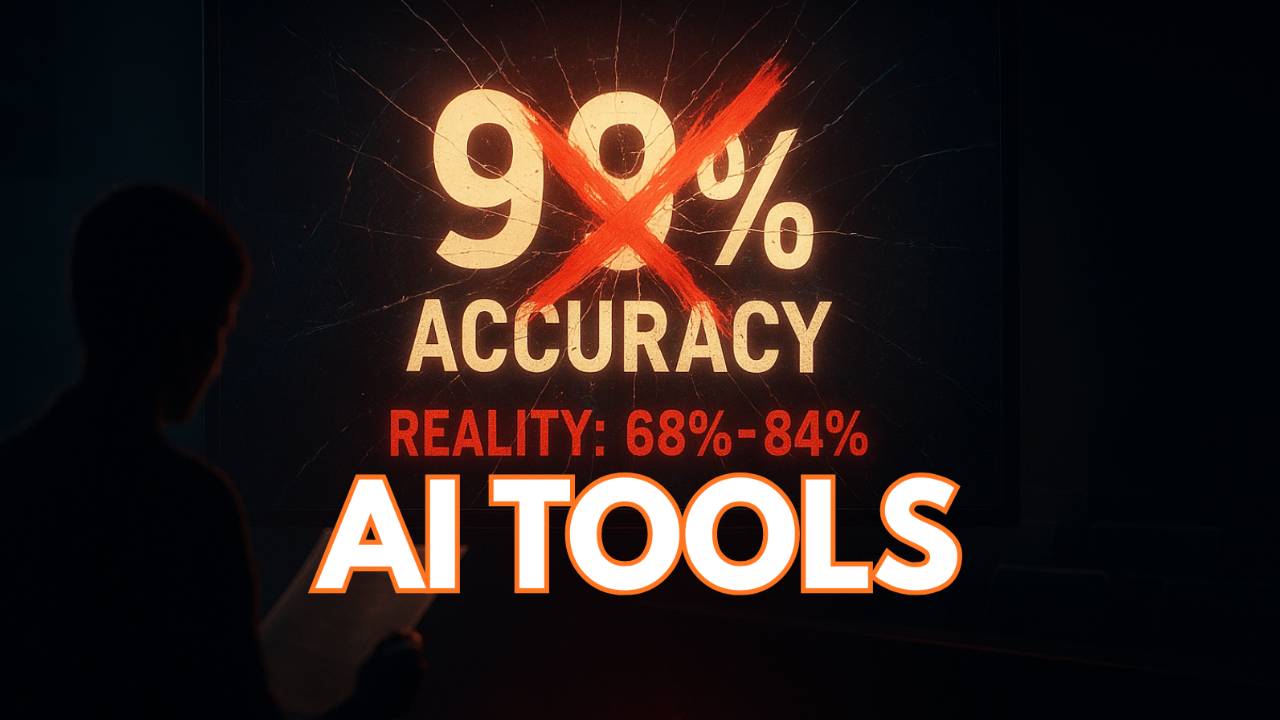
AI detection tools relentlessly market themselves with claims of 99% accuracy, promising educational institutions and publishers a silver bullet for the explosion of machine-generated content. However, exhaustive independent testing in 2026 reveals a starkly different and highly problematic reality. The real-world accuracy rates of these tools range from a mere 68% to 84% on standard checks, and they completely collapse when evaluating lightly edited drafts.
This massive gap between marketing promise and technical performance creates a severe crisis. Students face false accusations, professional writers lose contracts, and enterprise compliance teams make high-stakes decisions based on fundamentally flawed algorithmic outputs. The widespread integration of the AI detector into the modern workflow was meant to preserve content authenticity. Instead, the current generation of tools has introduced a chaotic new layer of technical debt and liability.
The core architectural issue is straightforward: while the reliance on an AI checker is soaring, its capabilities lag dangerously behind the sophistication of modern reasoning models like Claude 3.5 Sonnet, Gemini 1.5 Pro, and DeepSeek R1.
The 99% Myth: Deconstructing AI Detector Accuracy Claims
Claims of near-perfect accuracy from AI detection companies crumble under independent scrutiny. Multiple studies and deep-dive tests reveal a technology struggling to keep pace, with performance that is inconsistent at best and dangerously biased at worst. Relying on these top-line benchmark claims without understanding their testing parameters often mirrors the AI data contaminationscandal currently plaguing model evaluation.
- The Humanized Text Collapse: According to the Q2 2026 TextShift benchmark, the accuracy of top-tier detectors drops catastrophically when analyzing text that has been edited or "humanized." Originality.ai dropped from 96.2% accuracy on raw AI output to just 7.8% on humanized text. Copyleaks plummeted to 6.2%, and Turnitin hit a mere 5.1% detection rate. These 2026 metrics prove that the tools fail the moment a user revises a draft.
- Widespread Underperformance: A comprehensive deep test found that 15 of the most popular free AI detection tools achieved accuracy rates between only 68% and 84%. The gap between a marketing claim of 99% and a reality of 68% represents a massive vulnerability for enterprise publishers.
- Struggling with Modern AI: Detection accuracy plummets when faced with text from frontier AI models. The average detection rate for content generated directly by GPT-4o is only 68%, highlighting a critical failure to keep up with advancing underlying technology.
The Mechanics of Failure: Perplexity and Burstiness Explained
To understand why these tools fail so spectacularly, you must understand how they operate. An AI detector does not definitively "know" if a machine wrote a document. It calculates a statistical probability based on two primary metrics: perplexity and burstiness.
Perplexity measures how predictable the vocabulary is. If the word choices are highly probable based on the preceding text, the perplexity is low, and the system assumes an AI wrote it. Burstiness measures the variation in sentence structure and length. Human writers naturally mix short, punchy sentences with long, complex ones (high burstiness). Early AI models produced sentences of uniform length (low burstiness).
The problem? Human writing is not uniformly bursty or perplexing. Technical documentation, academic research, and clear business communication require rigid structure and precise, predictable terminology. When a human writes clearly and concisely, they artificially lower their perplexity and burstiness, triggering false flags from the detector.
The Human Cost of Algorithmic Errors: A False Positives Crisis
Beyond statistical noise, the catastrophic failure of AI detectors is measured in ruined careers and derailed academic futures. The technology's most damaging flaw is the false positive—when authentic, human-written work is incorrectly flagged as synthetic.
While industry giant Turnitin publicly claims a false positive rate of less than 1%, their Chief Product Officer, Annie Chechitelli, has acknowledged a deliberate architectural trade-off: the system is configured to intentionally miss up to 15% of AI-written text just to keep false positives mathematically low. Even with these internal governors, independent studies routinely produce staggering false positive rates.
Systemic Bias: Why AI Detectors Penalize Non-Native Speakers
Evidence from multiple controlled tests shows that AI detectors do not provide a level playing field. They heavily penalize individuals from marginalized and non-traditional groups because their authentic writing mirrors the exact statistical patterns detectors use to identify machines.
- Non-Native English Speakers (ESL): This demographic bears the brunt of algorithmic failure. The landmark 2023 Stanford study reported a 61.3% average false positive rate for TOEFL essays written by non-native speakers. In 2026, the gap remains severe; recent ROC curve analyses show area-under-the-curve (AUC) scores plummeting from 0.89 for native writers down to 0.72 for non-native writers (Hastewire 2025 Study). Non-native writers naturally utilize simpler syntax and fewer colloquialisms, resulting in low perplexity—the exact trigger for an AI flag.
- Neurodiverse Students: Writers with ADHD experience an estimated 12% false positive rate. Unconventional organizational patterns, pacing, and stylistic choices common in their writing are routinely misinterpreted by algorithms as AI hallucination behaviors.
- Racial Bias: A report from Common Sense Media revealed a 20% false positive rate for Black students, a significantly higher error threshold than the 7% recorded for White students.
These algorithmic biases cause tangible harm. From a university professor threatening to fail an entire class based on a flawed scan to freelance copywriters losing long-term clients, the collateral damage of deploying immature detection tools is unacceptable.
Why Most AI Checker Tools Fail: Technical Flaws and Evasion
The unreliability of AI checkers isn't a mystery; it is a predictable outcome of a technology caught in a losing arms race against its own rapidly evolving source material.
- Outdated Training Data: Most legacy detectors were trained on older AI models like GPT-3. They struggle to identify the nuanced, highly variable text produced by frontier models. An Originality.ai internal report noted a 12% decline in its own tool's accuracy over just six months as LLMs advanced.
- Advanced Evasion Techniques: A massive cottage industry of AI "humanizer" tools now exists specifically to rewrite machine-generated content and inject artificial burstiness. Using a humanizer in tandem with an LLM bypasses 95% of detectors, rendering legacy scanners useless.
- Reasoning Models Break the Mold: When analyzing DeepSeek V3 and R1 against free AI detectors, researchers found that models utilizing "Chain of Thought" reasoning natively produce text with higher burstiness. This creates a massive blind spot where reasoning-heavy essays bypasseven the most expensive enterprise checking software.
- Code is Undetectable: While platforms excel at identifying prose, relying on them for programming tasks is deeply flawed; engineering teams instead use generative AI tools for automated code reviewsto evaluate logic and security vulnerabilities rather than authorship.

2026 Independent Testing: A Review of Popular Free AI Tools
The wild variance in reported accuracy for the same tools across different independent tests underscores the technology's inherent volatility. A tool that performs well in one analysis may fail spectacularly in another, making a single 'best' recommendation impossible. The following data, synthesized from two major 2026 benchmarking studies, reveals a landscape of deep inconsistency.
| Tool Name | Scribbr Test Accuracy | TextShift Benchmark (2026) | Key Findings & Limitations |
|---|---|---|---|
| Scribbr (free) | 78% | 65% | Fast and user-friendly for basic checks but doesn't highlight suspect text, making appeals impossible. |
| QuillBot | 78% | 67% | Notably weak against its own paraphrasing tool's outputs, representing a potential conflict of interest. |
| GPTZero | 52% | 84.7% (Raw) / 4.3% (Edited) | Shows strong performance on pure academic writing. Struggles significantly with GPT-4o content and fails entirely on humanized drafts. |
| ZeroGPT | 64% | 59% (Raw) / 3.1% (Edited) | Prone to extreme reliability issues and has been frequently observed flagging entirely original, human writing as synthetic. |
| Copyleaks (Free Tier) | - | 93.4% (Raw) / 6.2% (Edited) | Highly capable on raw LLM output across multiple languages, but drops to near-zero accuracy if the user edits the document. |
Best Practices: Navigating the AI Detection Minefield
Given their massive limitations, AI detection tools must be used with extreme caution. Relying on them as the sole arbiter of authenticity is an operational failure. Instead, a more nuanced, human-centric approach is required to protect organizational integrity.
- Treat Results as Advisory, Not Definitive: Detector scores should be treated as a preliminary indicator, not as conclusive proof. A 70% AI score is an invitation to review version history, not an excuse to issue a failing grade or terminate a contract.
- Employ a Multi-Tool Consensus Approach: To increase reliability, use 2-3 different detectors on the same text and look for consensus. A 2026 analysis found this method can increase raw accuracy and dramatically reduce the false positive risk.
- Always Combine with Human Judgment: An AI checker cannot understand nuance, cultural references, humor, or unique brand voice. A final human review is essential to assess the actual value and authenticity of the deliverable.
- Establish Clear Appeals Processes: Institutions and organizations must create transparent policies and provide a clear, fair process for individuals to appeal a finding from an AI tool using document version histories (like Google Docs edit tracking).
Beyond Detection: A Call for Digital Literacy
The evidence is unequivocal: the current generation of AI detection technology is fundamentally broken. It fails to deliver on its promises of accuracy, is riddled with systemic biases that actively harm vulnerable linguistic groups, and is easily bypassed by trivial evasion techniques. The severe human cost of these algorithmic errors demands an immediate, structural shift in strategy.
The path forward is not holding out hope for better detection algorithms, but enforcing better education and more resilient internal policies. Instead of chasing algorithmic perfection and policing drafts, institutions must focus on fostering a culture of digital literacy that empowers teachers and students through adaptive learning. The objective must immediately shift from catching cheaters to building analytical critical thinkers capable of using AI as a tool rather than a crutch.
Related Deep-Dives for Content Integrity
Continue your audit of AI detection and content authenticity:
Frequently Asked Questions (FAQs)
Are AI detectors biased against certain types of writing?
Yes, empirical testing demonstrates severe bias. Non-native English speakers, neurodiverse writers (such as those with ADHD), and authors of formal academic or technical documentation face significantly higher false positive rates. Their authentic writing naturally features lower "perplexity" and less vocabulary variation, which algorithms incorrectly classify as machine-generated text.
Can paraphrasing or humanizer tools bypass AI detection?
Yes, evasion is highly effective in 2026. AI "humanizer" services like StealthWriter specifically inject statistical burstiness into synthetic text, allowing AI-generated content to bypass legacy detection platforms with over a 90% success rate.
What is the most reliable way to use an AI checker if they are so inaccurate?
The most responsible method is to never treat a single algorithmic output as conclusive proof. Organizations should use 2-3 different detectors to check for consensus, combine those findings with human review and document version histories, and treat the final score strictly as a preliminary signal for further discussion.

Sources and References:
- AI Detector Accuracy Comparison 2026: Unbiased Review (TextShift Benchmark)
- AI Detection Accuracy Studies — Meta-Analysis of 14 Studies
- What Turnitin Can and Can't Detect in 2026: A Full Breakdown
- Study Reveals AI Detectors' False Positives on Non-Native Writers
- Best AI Detector | Free & Premium Tools Compared
- Best AI Detector Similar to Turnitin for Students
- Best Practices for Integrating AI into Existing Workflows
Explore More AI Resources
Continue your deep dive into AI performance, development, and strategic tools by exploring our full content hub.
Read the Full Guide to AI Detector & Checker Tools