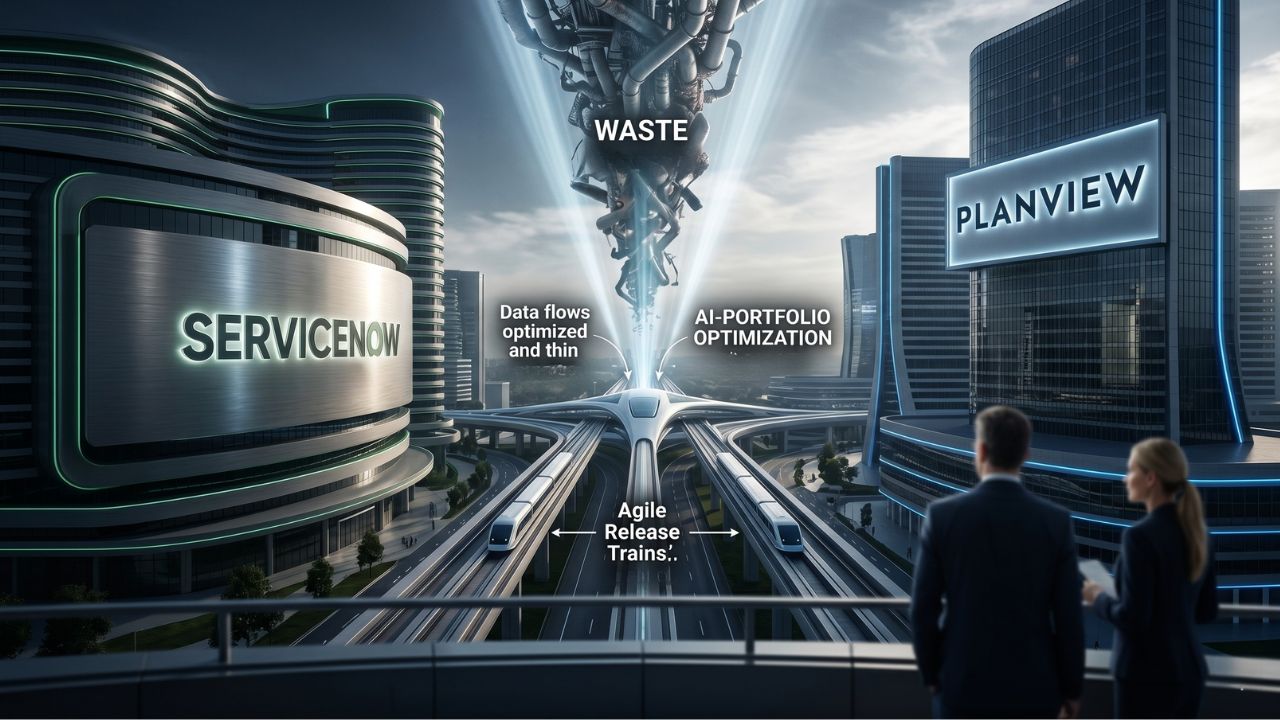
ServiceNow vs Planview for AI PMO Workflows: The Cost Trap
What's New in This Update
- Added quantitative breakdown of hidden API compute fees disguised as premium platform usage.
- Updated analysis on Planview Copilot's Q2 2026 dependency mapping capabilities.
- Included new enterprise frameworks for evaluating cross-team capacity forecasting limits in ServiceNow SPM.
Executive Summary
- The Hidden Cost Trap: AI features in enterprise PMO tools run on Large Language Models (LLMs). Unmonitored token consumption by these embedded agents creates massive, unpredictable API bills.
- ServiceNow SPM AI: Best for organizations where Agile development is tightly coupled with IT Service Management (ITSM). Operates strictly within a closed, proprietary LLM ecosystem.
- Planview Copilot: Superior for top-down Lean Portfolio Management and complex capacity forecasting, but migrating deep historical Jira data requires aggressive sanitization to prevent hallucinations.
- Governance Failure: Neither platform provides out-of-the-box, zero-trust bounded autonomy. Enterprises must engineer custom circuit breakers to prevent rogue AI agents from altering portfolio financial data.
Evaluating ServiceNow vs Planview for your Project Management Office (PMO) in 2026 is no longer a simple debate over Gantt charts and capacity planning features. The introduction of autonomous agents and generative AI has fundamentally altered the procurement landscape.
Vendors heavily market these embedded AI capabilities as the ultimate solution for Agile portfolio management. They promise automated status reports, predictive risk analysis, and instantaneous epic generation. However, they frequently obscure the massive backend LLM token fees and the critical security vulnerabilities introduced by handing non-deterministic software the keys to your enterprise data.
Before you commit your PMO to a multi-year contract, you must uncover the hidden AI cost traps and understand why implementing rigid enterprise AI governance frameworksis the only way to survive the transition to agentic workflows.
The Promise (and Peril) of AI in the PMO
Modern PMOs are shifting from administrative oversight to strategic enablement. AI tools accelerate this transition by parsing unstructured data—such as hundreds of Jira tickets, Slack conversations, and PR reviews—into coherent executive summaries. For directors figuring out how to use AI for agile portfolio management, these capabilities seem like a silver bullet to cut PMO waste by 40 percent.
The peril lies in the architecture. When an AI agent autonomously processes a massive backlog, it consumes API tokens for every word it reads and generates. If an agent enters an infinite execution loop while attempting to map dependencies across a 50-team Agile Release Train, it can burn through tens of thousands of dollars in compute fees in a matter of hours.
ServiceNow SPM AI: The Walled Garden Approach
ServiceNow Strategic Portfolio Management (SPM) has deeply integrated generative AI via its Now Assist framework. Because ServiceNow often serves as the central nervous system for enterprise IT, its AI capabilities shine when bridging the gap between portfolio planning and IT Service Management (ITSM).
Strengths of ServiceNow SPM AI
- Seamless ITSM Integration: Now Assist can instantly analyze incident trends from the IT service desk and correlate them with technical debt dragging down Agile sprint velocity.
- Automated Translation: The platform excels at translating highly technical backlog items into business-value summaries for executive stakeholder reporting.
- Proprietary Security: ServiceNow utilizes its own domain-specific LLMs within a closed ecosystem, ensuring your proprietary Agile data is not used to train public models.
The Downside: Routing Restrictions
The closed ecosystem is a double-edged sword. ServiceNow actively restricts deep custom LLM routing. You cannot easily hot-swap their proprietary model for a cheaper, open-source foundational model to handle basic administrative tasks. This lack of flexibility forces enterprises to pay a premium for every AI interaction, driving up total cost of ownership.
Planview Copilot: The Lean Portfolio Engine
Planview has positioned its Planview Copilot as the premier AI engine for top-down Lean Portfolio Management (LPM) and enterprise-wide Agile planning. It is designed to sit above the team-level execution tools (like Jira) and provide strategic orchestration.
Strengths of Planview Copilot
- Cross-Team Capacity Forecasting: Planview Copilot leverages machine learning to predict resource bottlenecks across multiple Agile Release Trains before they impact delivery timelines.
- Deep Data Queries: The conversational interface allows portfolio managers to query complex financial data and dependency maps using natural language.
- Strategic Alignment: The AI excels at identifying misalignments between team-level execution (epics and features) and top-level strategic themes.
The Downside: The Jira Migration Trap
Planview’s AI relies entirely on the quality of the data ingested from execution tools. While native API connectors easily move basic issue data from Jira, migrating the nuanced, historical context required for accurate AI dependency mapping is extraordinarily complex. If you feed the Copilot unsanitized, garbage data, the AI will confidently hallucinate strategic recommendations.
The Hidden LLM Token Cost Trap
This is the metric vendors refuse to highlight in their pitch decks. Both ServiceNow and Planview operate on business models that eventually pass the underlying cloud compute costs back to the customer.
Whether packaged as a premium per-user add-on or a consumption-based credit system, you are paying for LLM tokens. Heavy reliance on features like automated backlog grooming or complex portfolio scenario planning requires massive context windows. Passing thousands of epics into an LLM to generate a single dependency report consumes immense compute power.
If you fail to implement token monitoring, your PMO software bill will rapidly eclipse the human labor savings the AI was supposed to generate.
Why Bounded Autonomy is Mandatory
Neither ServiceNow nor Planview provides true, zero-trust bounded autonomy out of the box. Both platforms assume implicit trust within their own authenticated environments.
This is unacceptable for enterprise security. If an embedded AI agent hallucinating a strategic pivot decides to autonomously rewrite the funding allocations for a Q3 initiative, it must be stopped before the database commits the change. PMOs managing AI agents in agile release trainsmust engineer custom, middleware-level circuit breakers.
You must establish a Human-in-the-Loop (HITL) validation gate. The AI should only ever draft the change; a human Release Train Engineer or Portfolio Manager must explicitly approve it. Furthermore, if you are attempting SAFe Agile framework AI integration, you must implement strict semantic firewalls to prevent prompt injections from poisoning the portfolio data.
Calculating True ROI: The PMO Formula
To accurately compare ServiceNow and Planview, you must abandon traditional software ROI calculations. Use this framework instead:
- Calculate Human Time Saved: Estimate the hours saved per month on manual status reporting, dependency tracking, and backlog grooming.
- Add Licensing and Token Fees: Combine the base platform license with the projected premium AI add-on costs and the estimated LLM token expenditure based on API call volume.
- Add Security Engineering Costs: Factor in the engineering hours required to build custom circuit breakers and bounded autonomy middleware outside of the SaaS platform.
- Subtract TCO from Human Savings: If the total cost of ownership (TCO) exceeds the human labor savings, the AI implementation is a financial liability.
For organizations looking to scale agentic AI across agile teams, relying solely on native SaaS governance is a recipe for budget overruns and compliance failures.
The Verdict
ServiceNow is the clear winner if your Agile organization is heavily focused on ITSM and requires strict data residency within a closed ecosystem. Planview is superior if your primary objective is top-down Lean Portfolio Management and predictive capacity forecasting across disparate execution tools.
However, the software you choose matters less than the governance framework you wrap around it. Both platforms contain hidden AI cost traps. The most successful PMOs in 2026 treat these vendors as execution engines, while maintaining absolute control over the security middleware and token consumption metrics internally.
Frequently Asked Questions (FAQ)
Which is better for AI Agile workflows: ServiceNow or Planview?ServiceNow excels when Agile workflows are deeply intertwined with IT Service Management (ITSM) and incident resolution. Planview is superior for top-down Lean Portfolio Management and complex, cross-team capacity forecasting. Both require strict external token monitoring to prevent budget overruns.
How does ServiceNow SPM integrate generative AI?ServiceNow integrates generative AI via its Now Assist framework, automating epic generation, summarizing sprint bottlenecks, and translating technical backlog items into executive-friendly status reports. However, it operates as a closed system, limiting custom LLM routing flexibility for advanced enterprise architects.
What is Planview Copilot's pricing for enterprise PMOs?Planview Copilot typically utilizes a premium per-user add-on model layered over their standard enterprise tiers. PMOs must strictly audit usage, as heavy reliance on complex dependency mapping and deep-data queries can rapidly escalate hidden LLM token consumption costs.
Can ServiceNow AI predict Agile project failure?It can highlight early risk indicators by analyzing historical sprint velocity drops and unaddressed technical debt. However, its probabilistic predictions must be rigorously validated by a human Release Train Engineer before any funding cuts or strategic pivots are executed.
What are the hidden token costs in enterprise PMO software?Hidden token costs occur when embedded AI agents autonomously process massive, unstructured backlogs or enter infinite execution loops. Because vendors obscure the raw prompt lengths, enterprises end up paying exorbitant backend API compute fees disguised as premium platform usage.
Which tool offers better bounded autonomy for AI agents?Neither tool offers true, zero-trust bounded autonomy out of the box. Both assume implicit trust within their own ecosystems. Enterprises must engineer custom, middleware-level circuit breakers outside of these platforms to instantly sever database access during an AI hallucination.
How hard is it to migrate Jira data to Planview AI?Migrating basic issue data is straightforward via native API connectors. However, importing nuanced, historical Jira context required for Planview's AI to accurately map cross-team dependencies is highly complex, often requiring aggressive data sanitization to prevent LLM hallucination upon deployment.
Does ServiceNow support custom LLM routing for PMOs?ServiceNow restricts deep custom LLM routing, preferring enterprises utilize their proprietary, domain-specific models inside the Now Platform. This walled-garden approach increases security but actively prevents PMOs from hot-swapping to cheaper, open-source foundational models for basic administrative tasks.
What are the best alternatives to ServiceNow for AI PMO?Top alternatives include Planview for pure portfolio management, Atlassian Jira Align for native Jira ecosystems, and Targetprocess. However, the most secure enterprises are bypassing SaaS AI entirely, building bespoke multi-agent architectures governed by strict semantic firewalls and hard-coded kill switches.
How to calculate ROI for AI portfolio management tools?Calculate ROI by measuring the reduction in manual administrative hours against the platform's licensing fees plus estimated LLM token expenditure. You must factor in the cost of engineering custom security middleware, as relying solely on native SaaS governance is a liability.