Fine-Tune a Small Language Model: Start Here First (June 2026)
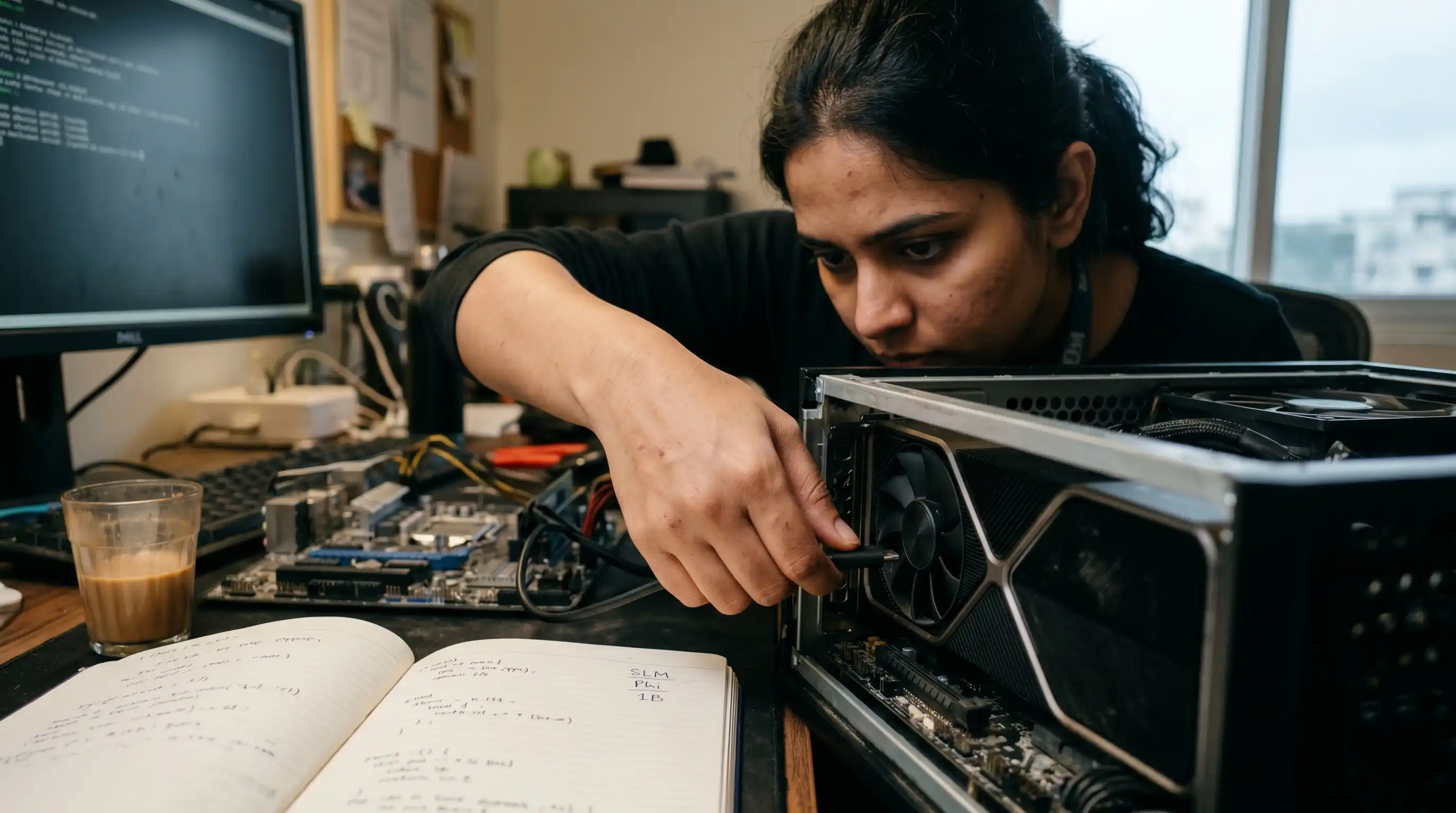
- Compute Accessibility: Small language models (SLMs) drop the hardware barrier completely, enabling full adaptation cycles on accessible developer nodes.
- Task Specialization: A properly customized SLM can cleanly match or outperform massive models on tight, domain-specific tasks.
- Data Efficiency: Lightweight architectures converge quickly, needing only a fraction of the data files required by large frontier models.
- Reduced Latency: Fine-tuning an SLM delivers fast on-prem execution speeds and slashes inference token overhead for production deployments.
Fine-tune a small language model and skip the GPU farm entirely. See which SLM and method to start with before you burn a weekend on the wrong one.
Diving straight into heavy parameter-count models for an initial validation test is a recipe for budget exhaustion and configuration complexity.
Before setting up your localized environments or downloading model files, it is vital to map out where lightweight custom models fit into your workflow by reviewing our structural foundation guide on Fine-Tuning LLMs 2026.
Focusing your initial training operations on highly compact, specialized model weights dramatically accelerates validation speed while keeping hardware barriers to a minimum.
Why Target Small Language Models (SLMs) for Your First Build?
Enterprise engineering teams frequently make the mistake of reaching for the highest parameter count available when launching a custom model initiative.
Shifting Away From Massive Compute Budgets
Large models demand expansive distributed clusters, complex tensor parallel configurations, and premium multi-node orchestration tools.
Choosing a small language model changes this entirely. By targeting models that sit within a 1B to 8B parameter envelope, you shift your development pipeline from high-cost cloud computing into an active local prototyping ecosystem.
Achieving Domain-Specific Mastery At Scale
An SLM functions like an elite specialist when optimized correctly.
While it loses broad general trivia knowledge during custom optimization, its parametric capacity adjusts cleanly to rigid internal rules.
If your production goal is to classify legal text, parse strict medical schemas, or translate unique internal database scripts, a tuned small model easily carries the load.
For a comparative overview of how low-rank optimizations maintain behavioral alignment across compact architectures, check our technical breakdown of LoRA vs QLoRA fine-tuning.
Selecting Your Starter Architecture: Phi, Gemma, Qwen, vs. Llama 3.2
Your selection of a base small model dictates your token processing efficiency and downstream inference footprint.
| Model Family | Parameter Envelope | Primary Core Strength |
|---|---|---|
| Microsoft Phi | 1.5B to 3.8B | Deep logical and code-oriented text |
| Google Gemma | 2B to 9B | High cognitive capabilities and math |
| Alibaba Qwen | 0.5B to 7B | Multi-lingual precision and tools |
| Meta Llama 3.2 | 1B to 3B | Massive edge deployment ecosystem |
The Beginner Efficiency Spectrum
For entry-level workflows, architectures like Llama 3.2 or Qwen provide accessible entry points.
Their base attention mechanisms are highly forgiving of slight optimization variations, and they enjoy deep integration across standard open-source library toolkits.
If your target use case centers around strict formatting structures, prioritize base models that feature strong pre-trained instruction following, as this foundation accelerates downstream conversion.
Architectural Orientation: Designing Data Requirements and Methods
Fine-tuning a small model requires a structured layout for data ingestion and a clear selection of your underlying training framework.
Quantifying the Fine-Tuning Corpus Size
Because SLM architectures contain fewer internal parameter matrices, they require significantly fewer training examples to establish behavioral alignment than their larger counterparts.
A highly curated dataset containing 1,000 to 5,000 clean, validated instruction-response samples is typically sufficient to lock in a new corporate voice or structural layout.
For a detailed breakdown of the infrastructure and operational capital required to support these data pipelines, read our analysis of fine-tuning cost multipliers.
Streamlining Local Implementations
To convert your data into updated model weights without encountering processing delays, avoid complex raw training code.
Leverage memory-optimized wrappers like Unsloth or structured configuration engines like Axolotl.
These toolkits allow you to execute local 4-bit configurations seamlessly, enabling developers to complete complex training runs inside standard terminal layers.
To review a step-by-step local configuration blueprint for scaling these local implementations safely, check out the specialized guide on how to fine-tune Llama 4 locally.
Steering Clear of Common Beginner Pitfalls
When managing your first optimization loop, apply defensive parameters to prevent common failure modes.
- Prevent Overfitting: Because SLM parameters are sensitive, running too many training iterations on a small dataset will cause the model to memorize samples verbatim, destroying its ability to generalize.
- Enforce Precise Tokenization: Always use the exact tokenizer configuration shipped by the base model provider; dropping special tokens will result in broken, repetitive outputs.
- Clamp Your Learning Rates: Keep your learning rates conservative (e.g.,
2e-4or lower) when using low-rank adapters to avoid wiping out the foundational knowledge baked into the base model.
Conclusion & CTA
Fine-tuning a small language model provides an accessible, high-velocity path to mastering model customization without the burden of enterprise compute costs.
By picking a robust base architecture, curating a tight dataset, and deploying optimized QLoRA scripts, you can build a high-performance custom asset in a single afternoon.
Ready to initiate your first optimization run? Begin by auditing your local hardware profile, structuring your initial instructional text corpus into clean data files, and running a baseline validation loop before scaling your customized specialized models into production frameworks.

Frequently Asked Questions (FAQ)
The Meta Llama 3.2 and Alibaba Qwen model families are widely regarded as the most accessible starter models for fine-tuning due to their massive open-source ecosystem support, predictable memory scaling metrics, and native compatibility with popular training scripts.
Fine-tuning an SLM sharply cuts your infrastructure costs, eliminates the need for premium multi-node GPU systems, speeds up training cycles, and yields a highly efficient, fast model that can be deployed cheaply in production.
For general instruction-following and formatting adjustments, Llama 3.2 (1B or 3B) represents an excellent starting point. If your target task involves heavy programming logic or mathematical datasets, the Microsoft Phi series provides strong native capabilities.
Yes, a dedicated graphics processor is still required to handle backpropagation math efficiently. However, because SLMs are highly compact, you do not need expensive cloud clusters; an accessible 16GB or 24GB consumer GPU is perfectly capable of handling the workload.
Because small architectures adjust to formatting constraints rapidly, you can often achieve strong behavioral alignment using a highly clean, curated dataset containing between 1,000 and 5,000 high-fidelity instruction-response pairs.
The most streamlined path is utilizing 4-bit Quantized Low-Rank Adaptation (QLoRA) via automated optimization engines like Unsloth or Axolotl. This framework minimizes memory overhead while allowing you to control parameters via simple, declarative script layouts.
Yes. While a larger model retains superior general knowledge across varied fields, a small language model optimized on a clean, domain-specific dataset can cleanly match or outpace frontier systems on tight classification or formatting tasks.
Using a single modern consumer-grade GPU and a standard optimization dataset of a few thousand items, a highly optimized QLoRA training run can comfortably finish within 1 to 3 hours.
The most frequent missteps include deploying poorly formatted data, applying excessively high learning rates that corrupt base weights, and running too many training iterations, which causes severe model overfitting.
Choose RAG if your primary goal is to inject dynamic, changing corporate knowledge or source documents. Choose fine-tuning if you must enforce strict output syntax, specialized formatting rules, or strict tone constraints.