AI-driven productivity metrics for offshore centers: The 10x Developer Illusion Exposed
Executive Snapshot: The Bottom Line
- Lines of Code (LOC) is a vanity metric: AI assistants inflate LOC effortlessly; track cycle time reduction instead.
- Quality must throttle velocity: High code generation speeds mean nothing if your mean time to recovery (MTTR) spikes.
- Security mapping is mandatory: You must align your metrics with the NIST AI Risk Management Framework (AI RMF) 1.0.
- This framework specifically addresses the risks of relying on AI-generated code by mapping productivity metrics to secure and reliable GenAI usage.
Buying AI tokens for your offshore teams is the easy part.
The illusion of the "10x developer" often masks rising technical debt and poor code quality generated by unmonitored AI coding assistants.
To cut through the vendor hype, leaders must implement true AI-driven productivity metrics for offshore centers to measure real developer velocity.
Mastering this is a non-negotiable step in tracking your broader GCC performance KPIs.
If you fail to measure AI correctly, you risk turning a potential innovation engine back into a massive cost sink.
Moving Beyond the Hype: Integrating AI with DORA Metrics
You cannot rely on vendor dashboards to tell you how productive your offshore engineers are.
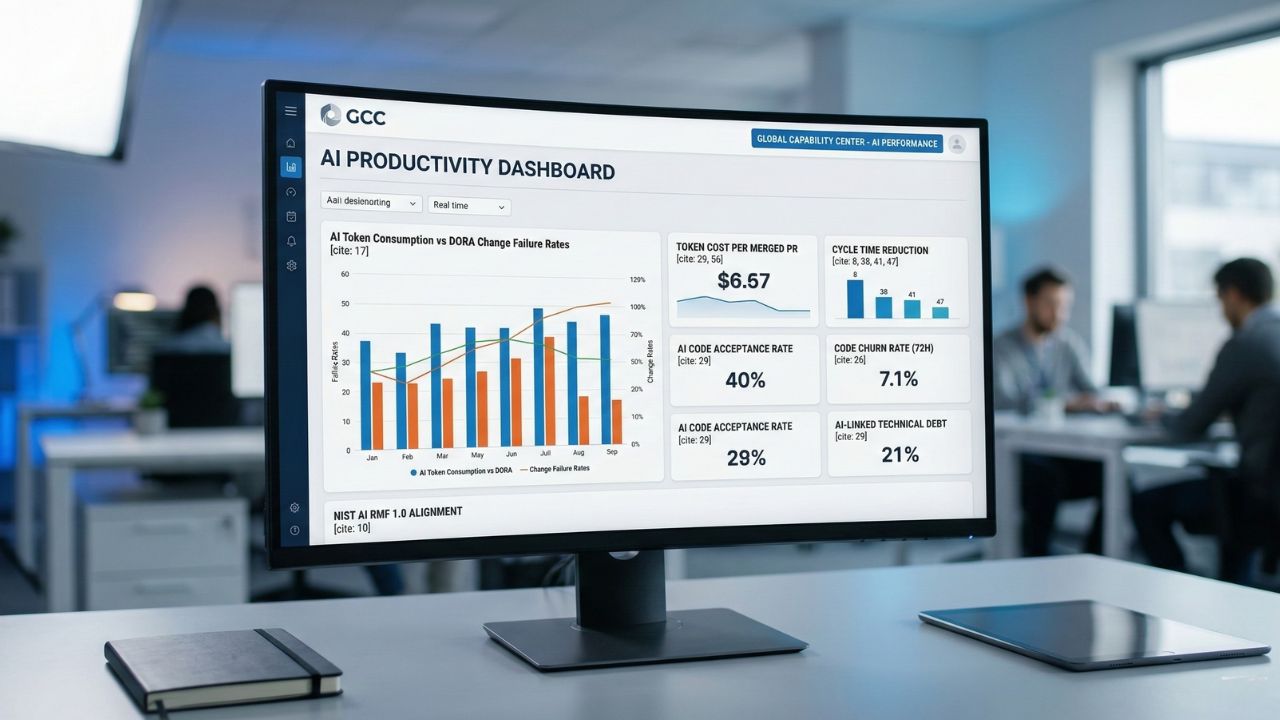
To measure the true ROI of GitHub Copilot or similar tools in a GCC, you must overlay AI usage data onto established DevOps Research and Assessment (DORA) metrics.
When evaluating GenAI ROI in GCCs, raw speed is dangerous without guardrails.
If your deployment frequency increases but your change failure rate skyrockets, the AI is not making your team faster, it is just breaking things more efficiently.
You must actively track token usage costs vs productivity gains.
If your monthly API costs for AI agents exceed the labor savings gained through faster cycle times, your capability center ROI is upside down.
To present this clearly to your board, integrate these specific data points into a Global Capability Center key metrics dashboard template.
What Most Teams Get Wrong about AI-driven productivity metrics
The most dangerous trap executives fall into is equating AI-assisted code generation with finalized value creation.
Are AI coding assistants actually increasing offshore velocity? Yes, but they frequently increase technical debt at the exact same time if code review processes are not upgraded.
The "10x developer" illusion occurs when a junior offshore developer uses GenAI to write complex architectures they do not fully understand.
Pro-Tip: The Code Churn Metric
To track the quality of AI-generated code in offshore hubs, monitor the "Code Churn Rate" within 72 hours of a pull request.
If code written with AI assistants is frequently rewritten or heavily modified by senior engineers shortly after submission, your "productivity gain" is a mirage.
Traditional vs. AI-Driven Productivity Metrics
| Measurement Target | Obsolete Traditional Metric | True AI-Driven Metric | What it Actually Tells You |
|---|---|---|---|
| Code Output | Lines of Code (LOC) | AI Code Acceptance Rate | How much of the AI's suggestion is actually usable in production. |
| Speed | Time to Complete Task | AI-Assisted Cycle Time | The true reduction in cycle time due to AI tools. |
| Cost Efficiency | Cost per FTE | Token Cost per Merged PR | Whether the GenAI software overhead is yielding a positive financial ROI. |
| Quality | Number of Bugs Found | AI-Linked Technical Debt | Identifies if AI speed is creating long-term structural codebase liabilities. |
To know if your metrics are actually competitive, you must commit to benchmarking GCC performance against global standards.
Conclusion: Stop Guessing, Start Measuring
The "10x developer" is a dangerous myth if your offshore center is bleeding value through hidden technical debt, high code churn, and unchecked API token costs.
AI is a powerful accelerator for your global teams, but only if you have the precise telemetry required to steer it safely.
You can no longer rely on vanity metrics like raw lines of code or vendor-supplied dashboards to justify your global capability center investments.
True velocity requires a balanced approach where speed is directly throttled by quality and security.
Ready to prove your true AI return on investment? Stop wasting hours building static presentations and guessing your offshore developer velocity.
Download our Global Capability Center key metrics dashboard template right now to instantly track cycle time reductions, token efficiency, and enterprise value creation in real-time.
Streamline your AI Feedback loops. Try HeyGen AI
We may earn a commission if you buy through this link. (This does not increase the price for you)
Frequently Asked Questions (FAQ)
The best metrics include the reduction in total cycle time, the ratio of token costs to successfully deployed features, and the defect leakage rate specifically tied to AI-assisted code commits.
You measure ROI by comparing the fully loaded cost of the Copilot licenses and API tokens against the quantifiable dollar value of the development hours saved and the acceleration of feature delivery.
They increase the speed of initial code drafting, but overall velocity only improves if the offshore team has strong code review processes to catch the inevitable AI-generated logic errors and bloated syntax.
You integrate them by overlaying your AI adoption rates (like percentage of code generated by Copilot) onto your standard DORA metrics, specifically monitoring if change failure rates increase as deployment frequency spikes.
Track the average time spent in the "coding" and "review" phases of your Agile sprints before AI implementation, and compare those baselines to the phase durations after full AI adoption.
Quality is demonstrated by tracking code churn (how often recently written code is modified), the volume of security vulnerabilities flagged by static analysis tools, and the rate of code rollbacks.
Prevent technical debt by enforcing strict human-in-the-loop peer reviews, capping the amount of AI code accepted per commit, and routinely refactoring repositories heavily reliant on generated output.
Key KPIs include the percentage of level-one tickets deflected by AI agents, the reduction in mean time to resolution (MTTR) for complex issues, and the corresponding internal customer satisfaction (CSAT) scores.
Use dedicated API management dashboards to track monthly token expenditures, and correlate those exact costs against the number of completed story points or successful product deployments in Jira.
Benchmark performance by testing your team against industry standards for first-time-right code delivery, and tracking how quickly they can prompt, generate, and successfully test complex enterprise applications.
Sources & References
- NIST AI Risk Management Framework (AI RMF 1.0)
- DORA (DevOps Research and Assessment)
- ISO 31000 (Risk Management)
- GCC performance KPIs: The $100M Mistake Sinking Offshore Value in 2026
- Benchmarking GCC Performance Against Global Standards 2026
- Global Capability Center key metrics dashboard template
External Industry Standards:
Internal Deep Dives: