Generative AI prompts for sprint retrospectives: Stop Wasting 2 Hours on Action Items
Quick Answer: Key Takeaways
- Turn messy feedback into prioritized backlog items instantly.
- Generate NIST-compliant action plans from your team's raw data.
- Automatically identify sentiment and measure team morale.
- Learn to avoid bias in your AI retrospective summaries.
- Use specific prompts to automate root cause analysis.
Are you tired of spending your entire Monday morning organizing sticky notes and whiteboard scribbles? You can use these elite Generative AI prompts for sprint retrospectives to turn messy feedback into prioritized backlog items and NIST-compliant action plans.
This deep dive is part of our extensive guide on Generative AI for Scrum Master. Stop managing lagging indicators and start building an autonomous execution engine.
The Core Problem with Traditional Retros
Retrospectives are where high-performance teams are born, yet most are forgotten by Monday morning. Facilitators waste hours manually categorizing feedback instead of actually coaching the team.
The solution is leveraging AI to do the heavy administrative lifting. By utilizing targeted prompts, you can extract actionable insights in seconds.
Extracting "Start, Stop, Continue" Insights
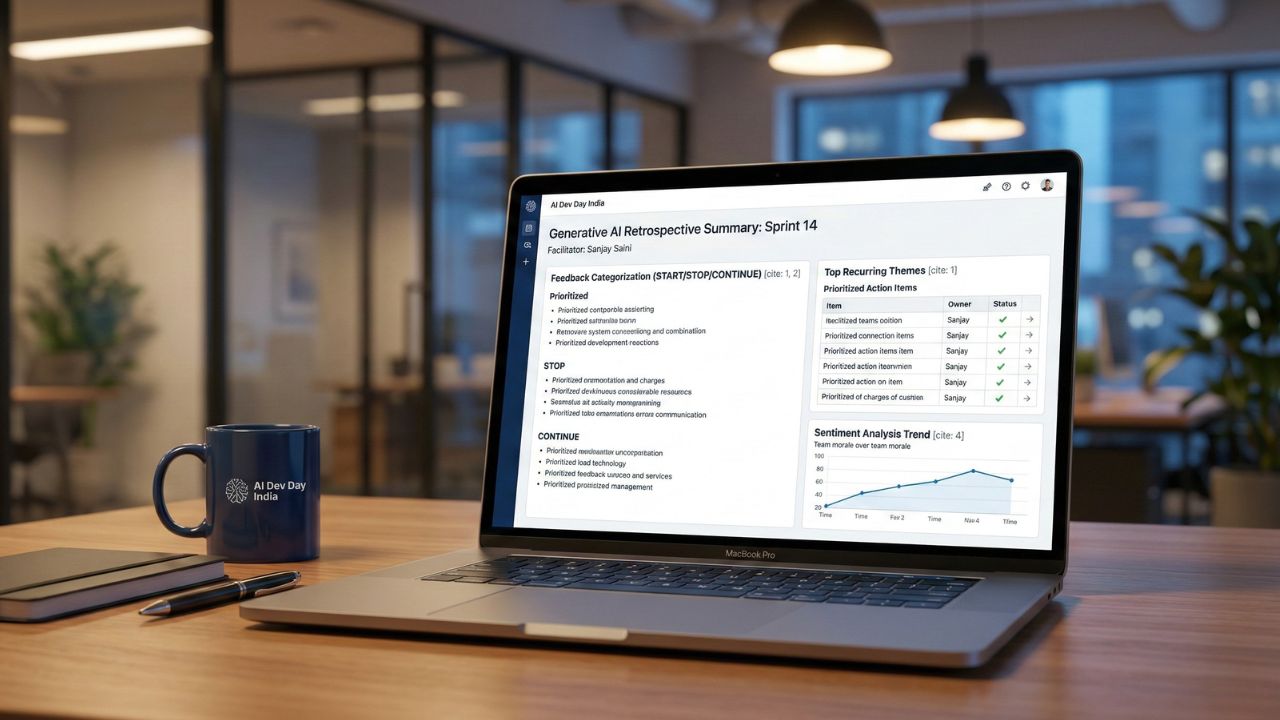
A standard format like "Start, Stop, Continue" is perfect for AI parsing. You can instruct the AI to categorize raw transcript data into these three distinct buckets automatically.
Once categorized, the AI agent can highlight recurring themes. This ensures that critical team sentiments are not buried under louder, more dominant voices during the meeting.
Advanced Prompting Techniques
Automating Root Cause Analysis
Don't just list the problems; find the source. You can use prompts to ask the AI to run a 5 Whys analysis on the top three blockers identified during the sprint.
If these blockers require new features or bug fixes, you can easily transition them into your backlog. In fact, pairing this workflow with the best AI tools for automated user story generation creates a seamless, end-to-end process.
Sentiment Tracking and Bias Mitigation
Emotional context matters just as much as functional blockers. You can use targeted prompts to help the AI identify sentiment in team feedback to gauge overall morale.
However, it is vital to proactively avoid bias in AI retrospective summaries. Use specific prompt constraints aligned with the NIST AI RMF (Govern Function) to ensure your analysis remains objective.
From Feedback to Execution
The ultimate goal is to create actionable outcomes, not just a neat summary. What is a prompt to turn retro issues into user stories? Instruct the AI to convert blockers directly into tickets.
You can also ask the AI to suggest resource reallocation based on the sprint's bottlenecks. For forward-looking resource balancing, check out how to use Claude AI for agile capacity planning.
Conclusion
The era of manual sticky-note sorting is completely over. By integrating these Generative AI prompts for sprint retrospectives, you transform idle feedback into immediate, trackable momentum.
Stop wasting hours on administration and start driving real agile transformation today.
Scale Securely with Proven Tools. Try Fireflies AI

We may earn a commission if you buy through this link. (This does not increase the price for you)
Frequently Asked Questions (FAQ)
The best prompts focus on categorizing raw feedback into actionable frameworks, running root cause analyses, and extracting measurable action items for the next sprint.
Feed your raw meeting transcript or digital whiteboard notes into the AI and prompt it to generate a prioritized, bulleted list of the core themes.
Yes, you can instruct the AI to analyze the emotional tone of the feedback notes to track changes in team morale over time.
Ask the AI to evaluate your sprint issues and identify the vital 20% of blockers that caused 80% of the team's delays.
Use a prompt like: "Convert the following sprint blockers into standard Agile user stories, complete with acceptance criteria, for our backlog."
Provide the AI with strict system instructions to remain objective, rely only on provided data, and adhere to NIST AI RMF guidelines.
Yes, you can prompt the AI to generate a daily checklist based on retro action items to be reviewed during your upcoming daily standups.
Integrate AI bots directly into your Slack or Teams channels to gather asynchronous feedback before the retrospective meeting officially begins.
Absolutely. By analyzing the sprint's data and chat logs, the AI can auto-populate "Start, Stop, Continue" categories for the team to review and refine.
Prompt the AI to apply frameworks like the "5 Whys" or Ishikawa diagrams to the most severe bottlenecks identified in the retrospective.