The impact of agentic AI on the Scrum Master role: 70% of Your Tasks Are Now Dead
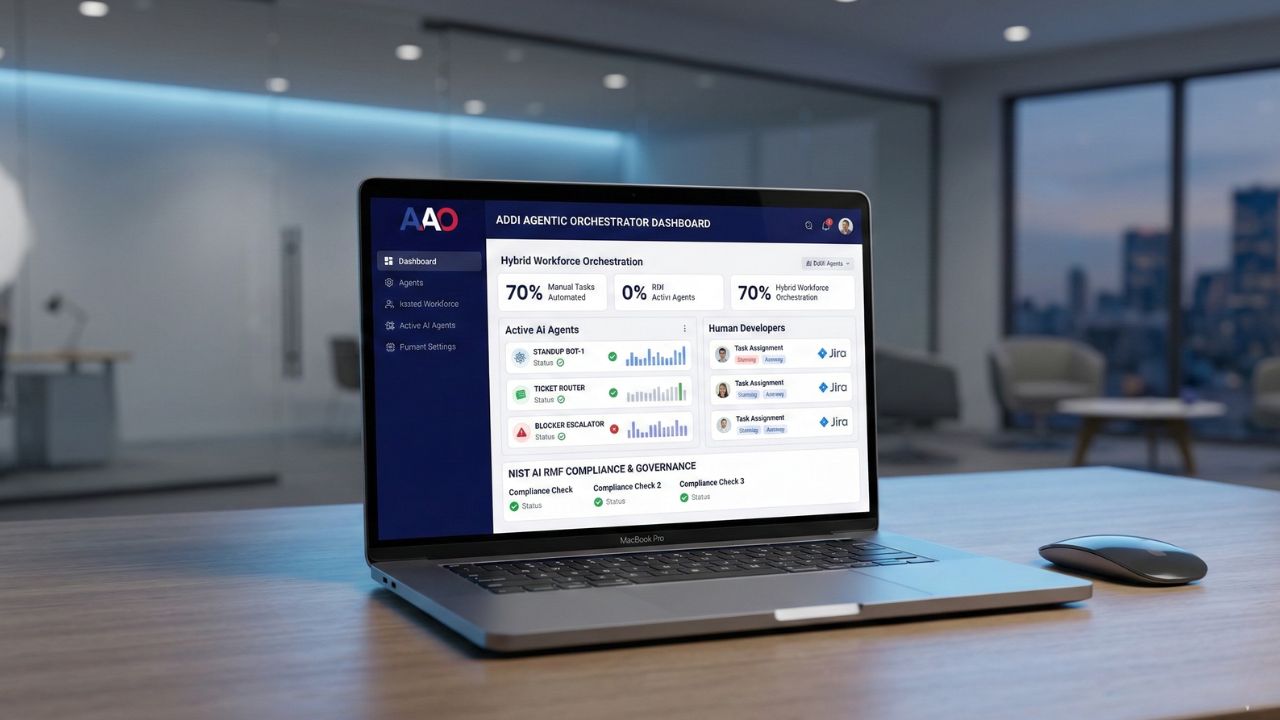
Quick Answer: Key Takeaways
- Understand why 70% of manual Agile facilitation tasks are now fully automated by AI.
- Learn to govern a hybrid workforce of human developers and autonomous digital employees.
- Discover how to transition from an administrative facilitator to a high-value Agent Orchestrator.
- Master the NIST AI RMF to securely deploy autonomous sprint planning.
Introduction
We are rapidly moving from AI as a passive assistant to AI as an autonomous, decision-making teammate. If you are not actively preparing to govern a digital workforce, the impact of agentic AI on the Scrum Master role will render your current skill set obsolete.
This deep dive is part of our extensive guide on Generative AI for Scrum Master.
It is time to shift your career from basic, task-based leadership to strategic agent orchestration under the strict guidelines of the NIST AI RMF framework.
The Rise of the Agent Orchestrator
There is a massive functional difference between generative and agentic artificial intelligence. Generative AI can write a user story, but agentic AI can independently move that story through a workflow.
These "digital employees" do not just wait for human prompts. They monitor the sprint board, identify bottlenecks, and take proactive steps to resolve dependency conflicts in real time.
Because these agents handle the administrative heavy lifting, the Scrum Master must evolve. Your new role is the "Agent Orchestrator," responsible for configuring, monitoring, and coaching these AI entities.
Automating the Daily Standup
The traditional daily standup is officially dead. Autonomous AI agents now ping developers directly via Slack or Microsoft Teams to gather asynchronous updates.
The agent automatically compiles these updates, updates Jira tickets, and highlights critical blockers. It completely eliminates the need for a 15-minute, manual round-robin meeting.
This autonomous execution allows human developers to stay deeply focused on coding. Meanwhile, the orchestrator only steps in to handle complex, high-level organizational blockers.
Governing the Hybrid Workforce
Integrating autonomous agents introduces significant compliance and operational risks. If an AI agent incorrectly reassigns a critical task, who is held accountable?
This is why mastering the NIST AI RMF (Manage Function) is absolutely non-negotiable for modern Scrum Masters. You must establish strict boundaries and fallback protocols for your digital workers.
If you need a reliable framework for managing your team's workload alongside these tools, explore our comprehensive guide on how to use Claude AI for agile capacity planning.
Redefining Agile Ceremonies
Agentic AI does not just facilitate sprints; it can actually reason and adapt. If a developer calls in sick, the AI can automatically recalculate the sprint's predictive trajectory.
It instantly reassigns tickets based on remaining team capacity and historical velocity data.
To see how these tools independently structure requirements, check out the best AI tools for automated user story generation.
Conclusion
The future of agile project management relies on autonomous digital workers. Embracing the impact of agentic AI on the Scrum Master role is the only way to survive the massive transition coming in 2026.
Stop managing spreadsheets and start leading the hybrid human-AI workforce today.
Scale Securely with Proven Tools. Try Fireflies

We may earn a commission if you buy through this link. (This does not increase the price for you)
Frequently Asked Questions (FAQ)
Generative AI creates content, like summarizing meeting notes or writing code snippets. Agentic AI acts autonomously, executing multi-step workflows, assigning tickets, and resolving sprint blockers without requiring constant human prompting.
No, they will not replace the role, but they will drastically transform it. AI handles the administrative and repetitive tasks, forcing the Scrum Master to evolve into a strategic, high-level systems orchestrator.
An Agent Orchestrator is the modernized version of a Scrum Master. This leader focuses on configuring AI agents, ensuring algorithmic compliance, and seamlessly integrating digital employees with human developers.
They participate asynchronously by querying team members in their native chat tools. The agents then update issue trackers, log cycle times, and instantly escalate severe blockers to the Agent Orchestrator.
Yes. Advanced agentic models can analyze an entire product backlog, identify logical dependencies, and autonomously propose optimized sprint plans based on predictive capacity and resource availability.
By eliminating manual administrative overhead, automating handoffs, and resolving minor dependencies instantly, agentic AI drastically reduces cycle times and significantly accelerates overall team velocity.
Major risks include agents making poor prioritization decisions, hallucinating requirements, or acting without proper human oversight, which can lead to compliance violations and derailed sprints.
Governance requires strict adherence to frameworks like the NIST AI RMF. You must establish clear auditing trails, human-in-the-loop approval thresholds, and continuous monitoring of the AI's autonomous decisions.
A digital employee is an advanced AI agent given specific system permissions to autonomously manage tasks, update documentation, and communicate with human developers to drive project momentum.
By 2030, the role will be completely unrecognizable from its 2010 origins. Scrum Masters will function as hybrid project managers and AI compliance officers, focusing entirely on optimizing human-agent collaboration.