1X NEO vs Figure 03: The 30kg Gap That Matters
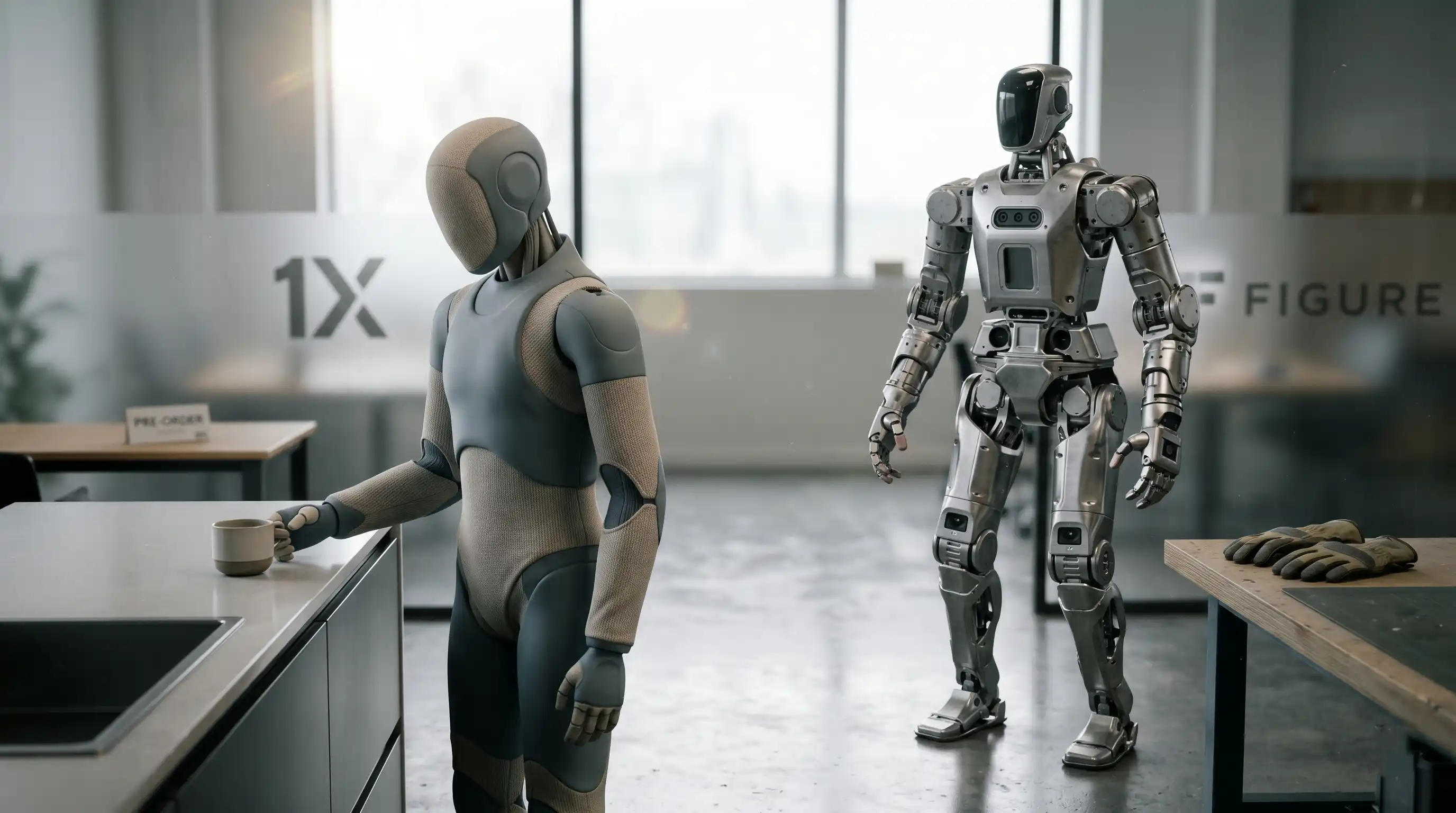
- The Mass Disparity: The 1X NEO weighs a nimble ~30 kg, whereas the Figure 03 lands at an industrial ~60 kg.
- Market Availability: 1X NEO is actively taking consumer pre-orders for 2026 delivery, while Figure 03 remains gated for commercial partners.
- Safety Profiles: NEO's soft, tendon-driven build minimizes physical kinetic risk around children and pets.
- Sensory Frameworks: Figure 03 leads in tactile mechanics, featuring advanced 3-gram touch-sensing hands and integrated palm cameras.
Two bleeding-edge AI companies are racing to put a general-purpose humanoid butler in your kitchen. Both sport an estimated $20,000 price tag, but they are built on fundamentally opposing design philosophies.
If you are trying to decide whether to invest in early adoption or simply track the technology, you must read our foundational report, Home Humanoid Robots 2026: Buy Now or Wait?
That overarching analysis sets the stage for the deep hardware divergence we are parsing today. The choice between these two platforms isn't just about software capabilities.
It comes down to a physical layout metric: a massive weight disparity that dictates exactly how safe, quiet, and practical these units will be inside a real family home.
The Core Spec Gap: 30kg and the Philosophy of Home Design
1X NEO: Lightweight Tendons and Quiet Compliance
The 1X NEO is engineered from the ground up to be home-first. Standing at 5'6", its physical hallmark is its ~30 kg weight and soft-body polymer exterior.
Instead of heavy rigid metal gears, it utilizes a highly compliant, tendon-driven motor system. This ensures that the robot operates at a near-silent 22 dB level.
It can move seamlessly around a household without generating distracting mechanical noise. Furthermore, a lighter mass means lower kinetic energy.
If a system malfunction occurs, a 30 kg soft robot causes exponentially less damage than an industrial-weight machine.
Figure 03: Industrial Mass and Precision Force
In contrast, the Figure 03 reflects an engineering ethos rooted in raw capability and structural rigidity. Weighing in at roughly 60 kg, it possesses double the physical mass of the NEO.
This extra weight accommodates a robust metallic structure and an incredibly dense array of sensors. Its hands feature integrated palm cameras and unmatched 3-gram tactile force sensors.
This allows the Figure 03 to manipulate objects as delicate as a paperclip with absolute precision.
However, managing a 60 kg metallic frame requires significant power and stiffer actuators, altering its safety footprint in a domestic environment.
Autonomy vs. Teleoperation: Where the Intelligence Diverges
NEO’s World Model and the "Expert Mode" Reality
The software backing these platforms represents two distinct approaches to AI deployment. The 1X NEO utilizes a custom world model backed by intensive investments from OpenAI.
Currently, its out-of-the-box autonomy handles roughly 60-70% of daily chores. When it encounters an unfamiliar obstacle or a complex task, it flags a remote operator.
This human-in-the-loop mechanism is called Expert Mode. A remote specialist logs in securely, sees through the robot’s cameras, and guides it through the chore.
The onboard system records the session, using it as training data to improve future autonomous performance.
Helix AI and Figure’s Gated Autonomy Approach
Figure 03 bypasses the heavy reliance on immediate consumer teleoperation by keeping its home deployments strictly controlled. It is powered by Helix AI, a proprietary neural framework designed for high-level reasoning and native spatial awareness.
Figure's strategy is to avoid releasing hardware to the general public until near-full, self-directed autonomy is achieved.
While this prevents the privacy friction associated with remote human operators viewing your living space, it significantly delays consumer access.
They are prioritizing a turnkey, fully autonomous butler over an iterative, community-trained beta model.
Availability and Pre-order Timelines: Shipped vs. Promised
1X Factory Production and Active Shipments
When it comes to putting boots on the ground, 1X holds a substantial first-mover advantage. The company has opened a fully operational, vertically integrated manufacturing plant in Hayward, California.
They are actively processing consumer pre-orders. If you want a humanoid robot operating in your home this year, the NEO is effectively your only viable commercial option.
Before committing capital to a deposit, reviewing a comprehensive pricing and contract framework is vital.
Figure 03 Corporate Partners and Consumer Roadmaps
Figure is commanding a massive $39 billion corporate valuation, but its production volume is currently funneled elsewhere. Their primary focus remains on commercial testing, illustrated by their high-profile industrial deployments with partners like BMW.
Their residential strategy for late 2026 is limited strictly to gated, partner-only pilot programs.
As a standard retail consumer, you cannot visit their website, place a deposit, or secure a guaranteed delivery window for a Figure 03 this year. It remains a masterfully executed tech showcase that is not yet scalable for the consumer market.
Conclusion
The battle between the 1X NEO and the Figure 03 highlights a fascinating fork in the road for consumer robotics.
1X gives you an accessible, ultra-lightweight frame today by leveraging remote human operators to bridge the AI capability gap.
Figure promises an incredibly precise, self-sufficient mechanical marvel, but keeps the purchase doors firmly shut until the software catches up.
For deeper analysis on evolving home automation standards, safety regulations, and the long-term societal impacts of consumer-facing AI, you can continuously monitor our core AI Living, Smart Homes & Robots hub.

Frequently Asked Questions (FAQ)
The primary difference lies in their physical construction and target audience. The 1X NEO is a lightweight, 30 kg soft-body robot optimized specifically for home safety and immediate consumer pre-order. The Figure 03 is a heavier, 60 kg metal humanoid boasting precise 3-gram touch-sensing hands powered by Helix AI, but it is currently restricted to commercial pilots.
For immediate real-world use, the 1X NEO wins by default because it is built home-first and can actually be ordered. Its quiet 22 dB operation and compliant tendon system make it inherently safer around children and pets compared to the heavier industrial frame of the Figure 03.
Both companies are targeting an introductory price floor of roughly $20,000. However, because the Figure 03 is not yet available for direct public purchase, its final residential hardware and subscription pricing structures remain unconfirmed, while NEO offers a concrete $499/month path.
No, the Figure 03 is not available for retail purchase or consumer pre-order in 2026. Figure is focusing its current production allocation on industrial manufacturing partners and limited, closed-loop residential testing groups later in the year.