Home Humanoid Robots 2026: Buy Now or Wait? (June 2026)
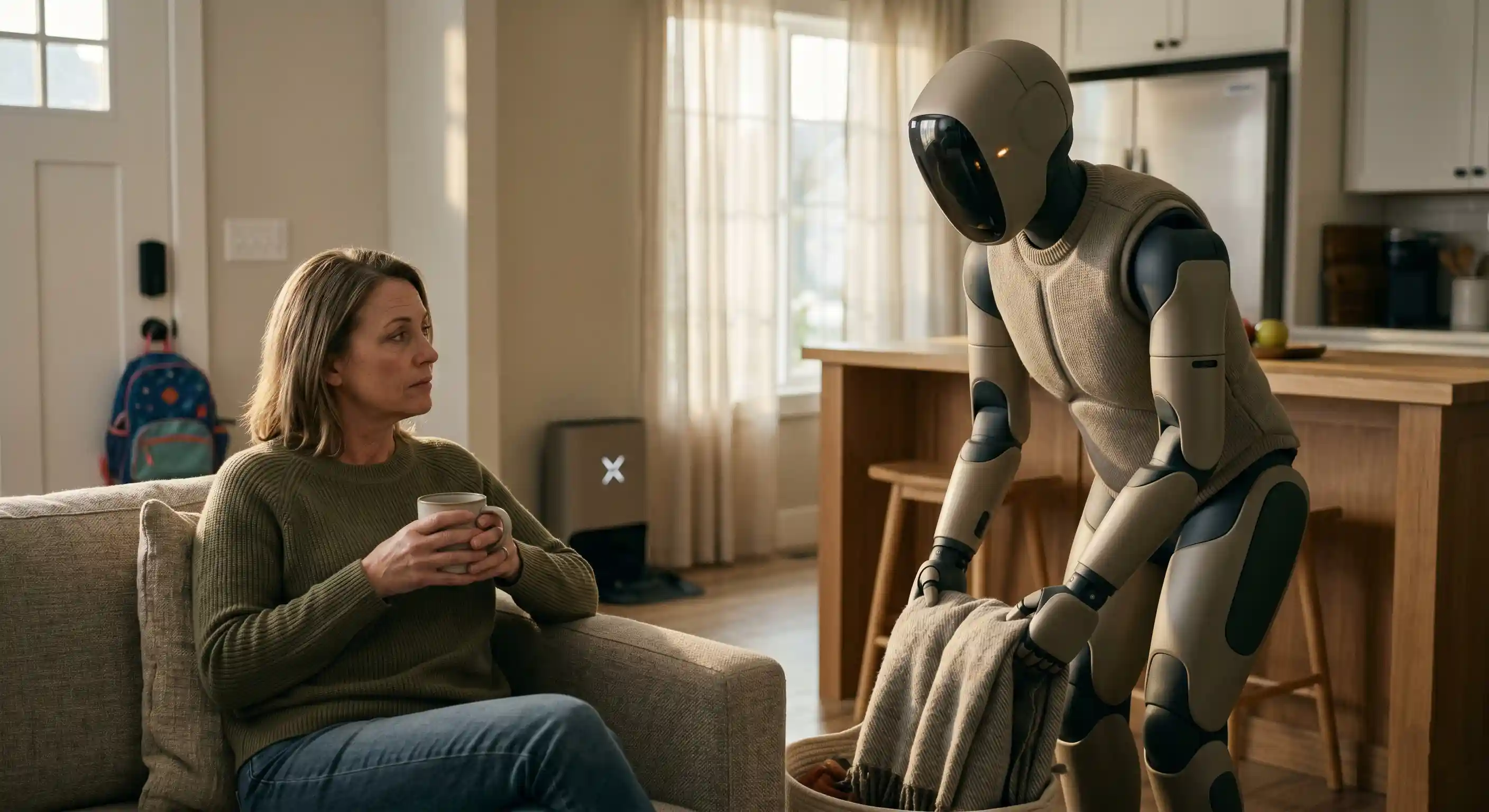
- Buy now only if you're a hands-on early adopter who accepts beta reliability and 60–70% autonomy.
- Wait if you want a turnkey assistant — autonomy and price both improve sharply through 2027–2028.
- Budget ~$20,000 to own, or ~$499/month to subscribe (with a refundable deposit).
- Check privacy first: set no-go zones and review teleoperation before the robot enters your home.
- Only one consumer-ready humanoid (1X NEO) is actively taking consumer pre-orders for 2026 home delivery.
A $20,000 robot that folds your laundry sounds like the future finally arriving on your doorstep. But behind the cinematic demo reels, today's home humanoids are part-autonomous, part-teleoperated machines.
One default setting can quietly let a vetted stranger see inside your house — and the "cheaper" subscription can cost more than buying outright.
This definitive guide cuts through the hype with verified specs, real costs, the privacy fine print, and a clear framework for the only question that matters: should you buy now, or wait?
The home robot conversation flipped from science fiction to a purchasing decision faster than almost anyone predicted. In April 2026, 1X opened full-scale production at its Hayward, California factory.
Pre-orders are live, deposits are being taken, and shipping dates are real. It's no longer "will home robots happen?" It's "should I be one of the first to live with one?"
01 — What a Home Humanoid Robot Actually Does in 2026
A home humanoid robot is a bipedal, human-sized machine designed to operate in spaces built for people — navigating doorways, stairs and furniture rather than a factory floor.
The reality in 2026 is narrower than the marketing. Out of the box, today's leading home humanoid handles foundational tasks: opening doors, fetching items, turning off lights, and basic tidying on a schedule.
From Demo Reel to Daily Chore
Treat polished launch videos as a target state, not a current one. Independent reviews put the 1X NEO's real-world autonomy at roughly 60–70% of tasks today.
The rest is filled by remote human assistance. Complex or novel chores — the ones you most want automated — are exactly the ones that still need help. The machines are capable and improving monthly, but not yet the self-directed butler the keynotes imply.
Autonomy vs. Teleoperation: The Detail Most Buyers Miss
When the robot can't do something autonomously, a remote human operator can take over and guide it — 1X calls this "Expert Mode." The robot learns from those sessions, so autonomy rises over time.
You're not just buying a robot; you're buying into a hybrid human-AI service. We unpack the head-to-head implications in our dedicated comparison of the two flagships.
When a vendor says "fully autonomous in 2026," read it as a roadmap, not a feature. The most credible CEOs in this space describe full home autonomy as a 2027–2028 target. Buying in 2026 means buying the journey, not the destination.
02 — Who's Actually Shipping to Homes
Dozens of companies demo humanoids. Almost none will put one in your living room this year. Here's who matters for a household buyer.
1X NEO — The Only One Taking Consumer Pre-Orders
NEO is the practical answer to "what can I buy?" It's a soft, tendon-driven robot weighing about 30 kg, standing 5'6", with 22-degree-of-freedom hands and a near-silent 22 dB operation.
Crucially, it was engineered home-first: lightweight for safety, quiet enough to live with, and designed to blend into a living space rather than dominate it.
Figure 03 — The Best-Funded Bet (Not Yet for Sale)
Figure 03 is the technologist's favorite. It carries a more advanced sensory suite — palm cameras and fingertip sensors that detect roughly three grams of force.
But you can't buy one. Figure targets limited, partner-only home deployments late in 2026, gating consumer availability behind near-full autonomy. It's the one to watch, not order.
Tesla Optimus & the Rest of the Field
Tesla's Optimus is going to factories first; Musk's own consumer pricing targets roughly 2027. Unitree's developer-grade G1 sells near $16,000 but is a platform for tinkerers.
| Robot | Price | Weight | Home availability | Buyer verdict |
|---|---|---|---|---|
| 1X NEO | $20,000 or $499/mo | ~30 kg | Consumer pre-orders; ships 2026 | Buy if early adopter |
| Figure 03 | ~$20,000 (target) | ~60 kg | Partner-only, limited, late 2026 | Watch, can't buy |
| Tesla Optimus | ~$20,000–$30,000 | ~57 kg | Factories first; consumer ~2027 | Wait |
Ignore robots without a published consumer price and a shipping date. In 2026, a humanoid that has both — and only NEO truly does for homes — is in a different category from one with a viral demo.
03 — What a Home Humanoid Robot Really Costs
The headline is simple: about $20,000 to own, or about $499 per month to subscribe, secured by a refundable deposit. The honest cost is more nuanced.
The $20,000 Sticker — and the Deposit
A one-time purchase makes you an owner with priority delivery. Early-access ownership ties you to the current hardware generation, and capabilities still arrive via software you don't control.
We break down every line item — deposit, delivery timing, and what's bundled — in our full pricing and pre-order analysis.
Buy vs. Subscribe: The $499/Month Math
At $499 per month, you reach the $20,000 purchase price in roughly 40 months. Keep the robot longer than that and ownership wins outright.
Expect to upgrade within three years? The subscription may be the smarter hedge against hardware obsolescence.
A subscription is a leash. If you stop paying, you typically stop owning the capability. Confirm what happens to the hardware and your data the day your subscription lapses before you sign.
04 — The Privacy Question No Keynote Answers
Here's the misconception worth correcting: people assume a home humanoid is a self-contained AI appliance, like a smart speaker with legs. It isn't.
Because today's robots lean on Expert Mode teleoperation, a vetted human operator can see through the robot's cameras and drive it through your home. Your "robot" is, at times, a remote person.
Teleoperation Means a Human May Be in the Loop
1X states its operators pass background checks, which matters. But the structural fact remains: the capability to view inside your home exists by design. This is a different privacy posture entirely.
No-Go Zones, Face-Blur, and Where Your Data Lives
Vendors are building real controls: user-defined no-go zones, time windows, face-blurring, audio masking, and the ability to opt out of data sharing.
We map the full teleoperation data flow and exact settings in our deep-dive on NEO's privacy model.
Configure privacy before the robot's first task. Define no-go zones for bedrooms and bathrooms, enable face-blurring, and review data-sharing defaults at setup.
05 — Are Home Humanoids Safe Around Families?
Safety splits into two categories buyers routinely conflate: physical and digital. Both deserve intense scrutiny.
Physical Safety
NEO's design choices are reassuring: a soft 3D-lattice polymer body, low ~30 kg mass, and quiet operation reduce both injury risk and the "uncanny" factor.
Still, any humanoid that walks and lifts can fall or misjudge a path. Around toddlers and pets, supervise until you've seen reliable behavior over weeks.
Cyber & Data Safety
A connected, camera-equipped robot is a mobile sensor platform on your home network. Strong passwords, two-factor authentication, and prompt firmware updates are not optional.
Home robotics regulation is forming, and rules differ sharply by region. Don't assume a robot sold in one market meets your local data or safety norms. Verify regional compliance before purchase.
06 — Buy Now or Wait? A Practical Framework
Strip away the spectacle and the decision comes down to your appetite for being early. Use this simple framework.
Buy Now If…
You're genuinely excited to pioneer the technology, you can absorb a $20,000 outlay without strain, you enjoy tinkering, and you'll actively use the privacy controls.
Wait If…
You want a dependable assistant that "just works." Autonomy is projected to climb from today's 60–70% toward 90%+ by 2028. Waiting buys you a more capable, cheaper machine.
For the bigger picture on companionship and eldercare, see our AI Living, Smart Homes & Robots hub.

Frequently Asked Questions (FAQ)
For most households, not yet. In 2026 they're early-adopter hardware: expensive ($20,000+), partly teleoperated, and limited to simple chores. They're worth it if you value pioneering the technology and accept beta-grade reliability. Mainstream buyers are better served waiting for higher autonomy and lower prices.
The 1X NEO, mainly because it's the only one families can actually order in 2026. Its lightweight (~30 kg) soft-body design prioritizes safety around children and pets. Figure 03 looks more advanced but isn't on sale. For real households today, NEO wins by default — with privacy caveats.
Expect around $20,000 to buy outright, or roughly $499 per month to subscribe, plus a refundable deposit (about $200 for NEO). Cheaper developer units such as the Unitree G1 start near $16,000, but they aren't designed as turnkey, ready-to-use home assistants.
Yes. Home humanoids carry multiple cameras and microphones, and models like NEO use remote human "experts" who can view and operate the robot for complex tasks. Vendors offer no-go zones, face-blurring and data opt-outs, but the underlying capability to see inside your home exists by design.
Both. In 2026, NEO runs an estimated 60–70% of tasks autonomously and relies on remote human teleoperation ("Expert Mode") for the rest. Full home autonomy is a 2027–2028 goal. Treat any "fully autonomous in 2026" marketing claim with healthy skepticism this year.
For buying today, yes — NEO ships to consumers in 2026 and is lighter and home-first. Figure 03 has more advanced sensing and AI but targets limited, partner-only home deployments late in 2026. NEO is the practical pick; Figure is the one to watch closely.
Reasonably, by design. NEO's ~30 kg soft, tendon-driven body and low operating noise reduce injury risk, and vendors add no-go zones. But a moving, lifting machine still poses physical and data-security risks. Supervise closely around toddlers and pets until reliability is proven over time.
You can pre-order now. 1X NEO consumer shipments are slated to begin in 2026 (US first, other markets from 2027). Figure 03 targets limited home deployments late in 2026, and Tesla Optimus likely won't reach ordinary consumers until around 2027.
Either. NEO offers a one-time ~$20,000 purchase or a ~$499/month subscription. Subscriptions lower the upfront cost and may bundle updates and support, but cross roughly 40 months and you'll pay more than buying. Choose based on how long you realistically plan to keep it.
Real-world 2026 tasks are basic: tidying, fetching items, opening doors, turning lights on and off, and simple loading or organizing. Conversational control works via onboard language models. Complex or novel chores still need teleoperator help, so set expectations well below the polished demo videos.
Sources & data anchors: 1X Technologies (NEO product pages, Hayward factory announcement, Apr 30 2026) · The Robot Report · Figure AI / The Robot Report · independent NEO and Figure 03 reviews · Motley Fool & InvestorPlace (market sizing). Pricing, weights and availability are fast-moving; verify on the manufacturer's site before purchase. This article is informational and not financial or purchasing advice.