AI Career Roadmap 2026: Shift From Coder to Agent Orchestrator
- Updated compensation data reflecting Q2 2026 hiring trends across major Indian Global Capability Centers (GCCs).
- Added a deep-dive architectural breakdown of stateful memory handling in LangGraph.
- Included a new Portfolio section emphasizing verifiable API integration projects over static repositories.
- Detailed the exact shift from stateless prompt engineering to stateful Agentic Workflow design.
- Added a new 12-month actionable transition timeline for software developers.
Key Takeaways for 2026
- The traditional "Junior Developer" role is rapidly declining. Service companies bill for automated outcomes, not raw coding hours.
- Orchestration replaces typing. Engineers who design loops where AI writes, tests, and deploys code command a significant salary premium.
- The required skill stack has shifted from pure web frameworks (like MERN) to API integration, vector databases, and stateful agents using Python.
- A modern tech portfolio must demonstrate autonomy. Recruiters look for live, agent-driven workflows rather than static to-do list applications.
The "Syntactical" Crisis in Modern Software Engineering
If you are a Computer Science student or a junior developer in India right now, you have likely felt the panic. You watch sophisticated models like Gemini Code Assist and GitHub Copilot Workspace draft boilerplate functions and execute multi-file refactors faster than humanly possible. You hear the whispers in placement cells and office cafeterias echoing a singular fear: "Is coding dead?"
Let’s be blunt: Manual coding—the repetitive act of memorizing syntax to write standard CRUD (Create, Read, Update, Delete) operations—is dying. However, software engineering remains highly resilient. It simply evolved.
The future of software engineering in India relies not on typing public static void main, but on becoming an "Agent Architect." The market actively hires professionals who design robust systems where AI safely generates the code, rather than hiring the code writers themselves. This roadmap serves as your survival guide, providing the exact skills required to transition from the anxiety of replacement to the confidence of orchestration. For a broader perspective on the academic landscape, review our comprehensive Indian student's guide to AI tools and careersto align your long-term study strategy.
1. The Death of the "Junior Dev": Why Entry-Level is Vanishing
In the traditional service-based IT model—which dominates tech hubs like Bangalore, Pune, and Hyderabad—the "Junior Dev" role operated on a simple loop: take a small Jira ticket, write a script, test it, and push it to a repository. Today, an autonomous AI agent executes that exact loop in seconds, operating continuously at a fraction of the human cost.
The Reality Check: Major IT service companies no longer bill clients strictly for "hours of coding." They bill for automated, verified outcomes. As we documented in our analysis of how India's IT giants are training the AI agent workforce, when an AI model generates the outcome reliably, the entry-level billing hour immediately evaporates.
The Trap: If your resume currently highlights only "Java Basics" or "HTML/CSS proficiency," you are operating in the high-risk zone.
The Opportunity: Software complexity hasn't disappeared; it shifted up the stack. Companies desperately need system designers, code reviewers, and risk managers who can validate AI outputs and manage API constraints.
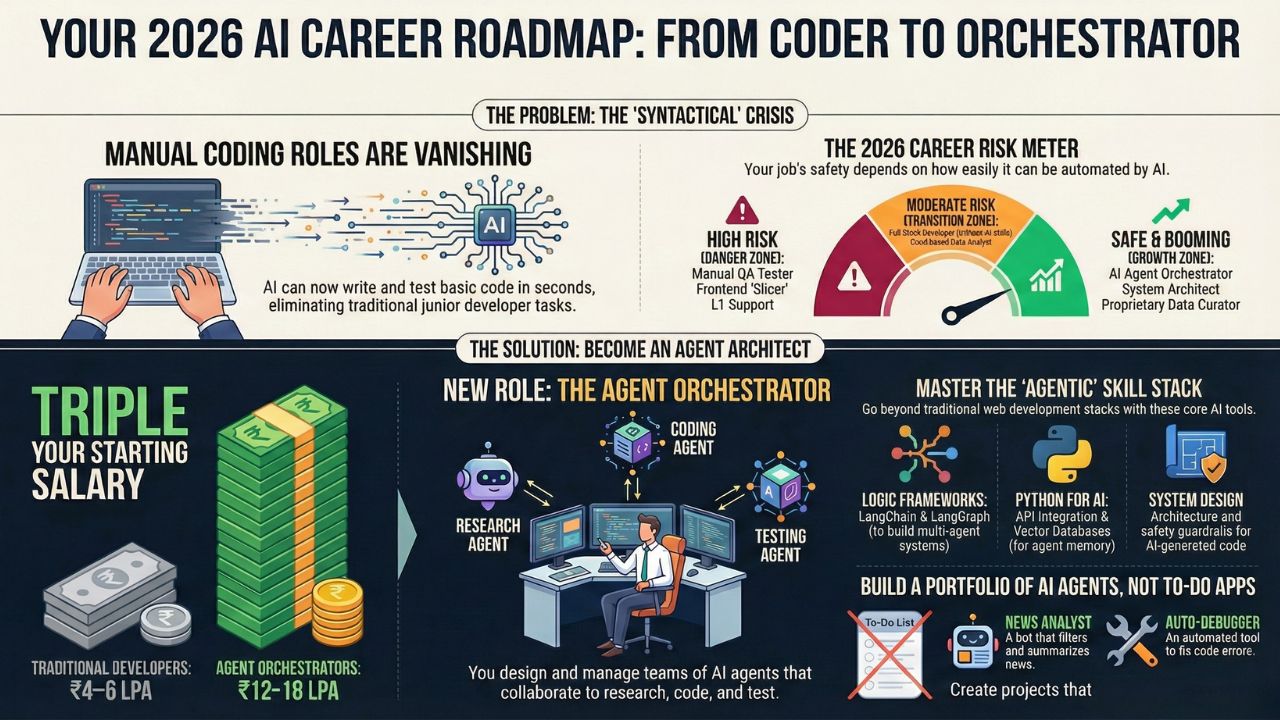
The 2026 Career Risk Meter
- Manual QA Tester (writing step-by-step test cases)
- Frontend "Slicer" (Figma to static HTML/CSS)
- L1 Support / Basic Ticket Resolution
- Junior Content Writer / Boilerplate Copywriter
- Full Stack Developer (relying solely on manual CRUD frameworks)
- Data Analyst (operating strictly in Excel/Basic SQL)
- Traditional SEO Executive
- AI Agent Orchestrator
- System Architect & API Integrator
- Proprietary Data Curator / RAG Specialist
- Hardware/Edge AI Engineer
2. The New Role: What Exactly is an "Agent Orchestrator"?
You hear this term constantly in tech circles. But what defines it technically? Understanding the stark difference between prompt engineering vs agent design marks the dividing line between a temporary gig and a sustainable career trajectory.
Prompt Engineering involves asking a single chatbot a static question, such as, "Write a Python script for a snake game." It relies entirely on the model getting it right on the first try. It is fundamentally stateless.
Agent Design involves building an autonomous system where multiple specialized bots collaborate, correct each other, and execute tasks. A typical orchestration loop looks like this:
- Agent A (The Researcher): Browses trusted documentation and identifies the optimal libraries for the required task.
- Agent B (The Coder): Drafts the initial code based strictly on Agent A's findings.
- Agent C (The Critic): Reviews the draft against enterprise security guidelines and identifies logical bugs.
- Agent D (The Executor): Attempts to compile or run the code in a sandbox, captures any error logs, and feeds those logs directly back to Agent B for revision.
As an Agent Orchestrator, you manage this digital team. You define the "Tools" (API access) the agents can use, establish the "Guardrails" (ethics, safety, and token spend limits), and architect the "Loop" (how the agents communicate to reach the final verified state). If you want to understand the exact mechanics behind these autonomous builds, read our deep dive into what agentic coding actually entails.
The Financial Upside: Early Q2 2026 data confirms the AI agent orchestrator salary in India yields an exceptionally high ROI. While traditional entry-level developer roles stagnate between ₹3.5–6 LPA, freshers equipped with verifiable "Agentic Workflow" portfolios command starting packages of ₹12–18 LPA. Enterprises gladly pay this premium because one competent orchestrator delivers the operational output of a five-person manual team.
3. The 2026 Agentic Skill Stack: Moving Beyond MERN
Relying exclusively on the MERN (MongoDB, Express, React, Node) stack restricts your marketability. To thrive, you must urgently adopt the "Agentic Stack." Understanding the underlying systems is paramount; we outline the core competencies needed in our Systems Architect roadmap.
A. Logic Frameworks: LangChain & LangGraph
Chaining static prompts together manually fails at enterprise scale. Frameworks like LangGraph solve this by allowing developers to build "stateful" agents. A stateful agent remembers its previous actions, accesses episodic memory, and loops back to correct its own errors without requiring human intervention. To implement this correctly in production environments, consult our technical blueprint on deploying LangGraph at scale.
B. Python for AI (The Universal Integration Glue)
Python acts as the primary interface for AI development. You no longer need to write complex sorting algorithms from scratch; instead, you require robust "Glue Python" skills:
- API Integration: Securely connecting an AI agent to external systems. The defining standard for 2026 is the Model Context Protocol server stack, which allows agents to securely read and write data across enterprise silos.
- Vector Databases: Configuring tools like Pinecone or ChromaDB to grant your agents "Long Term Memory," enabling them to recall previous user interactions or search proprietary company documents instantly.
C. System Evaluation (LLM-as-a-Judge)
How do you test an AI that writes its own code? You build another AI to grade it. Modern orchestrators write evaluation scripts where an LLM judges the output of the working agent against a predefined rubric. If the output fails the criteria, the system rejects the pull request.
D. System Design (Building the Fortress)
When AI generates the raw code, system architecture becomes your primary responsibility. You must design circuit breakers that trigger if an AI enters an infinite hallucination cycle. You must implement semantic firewalls ensuring the agent doesn't leak Personally Identifiable Information (PII) to external servers. Human judgment in establishing these boundaries remains irreplaceable.
4. The Transition Timeline: Your 12-Month Plan
Pivoting your career does not happen overnight. If you are currently working as a mid-level manual developer or finishing your degree, follow this phased execution plan to transition into orchestration smoothly.
| Phase | Focus Area | Actionable Milestone |
|---|---|---|
| Months 1-3 | Deconstruct Syntax Dependency | Shift 80% of your daily code generation to an IDE assistant (like Cursor or Windsurf). Focus entirely on writing architecture prompts and reviewing the output, forcing yourself to stop typing boilerplate. |
| Months 4-6 | Master API Gluing & Python | Build three Python scripts that do not generate text, but move data. Connect an email API to a summarization model, and push the structured output to a database. |
| Months 7-9 | Stateful Agent Design | Deploy your first LangGraph project. Create a workflow that executes a search, evaluates the result, and loops back if the data is insufficient, demonstrating basic autonomy. |
| Months 10-12 | Enterprise Deployment | Take your local agent and deploy it securely to a cloud environment (AWS/Azure), implementing basic authentication and API token limits to prove production-readiness. |
5. Building Your Portfolio: A GitHub of "Agents"
Technical recruiters no longer care about a standard "Weather App" or "To-Do List" resting quietly on your GitHub profile. To prove you possess the skills to learn for the AI era, your portfolio must demonstrate problem-solving through autonomy.
Actionable Projects to Impress Recruiters
- The Autonomous News Analyst: Build a Python script using LangGraph that accepts a broad topic, scrapes five recent financial news articles, analyzes their sentiment using an LLM, and emails a formatted PDF report via SendGrid APIs.
- The CLI Bug Fixer: Create a command-line interface tool where a developer pastes an error log. Your agent scans the log, queries specific trusted documentation, and automatically generates a patch file.
- The Smart Resume Matcher: Design a local, privacy-first agent that reads a job description, compares it against your base resume stored in a local vector database, and generates a highly customized cover letter highlighting precise skill overlaps.
Pro Tip: Always embed a 60-second Loom or YouTube demo video directly in your README.md. Hiring managers rarely clone and run repositories; they watch it work. Showing the agent successfully complete a task proves your orchestration skills immediately.
6. Top Certifications: Validating Your Orchestration Skills
If you seek a valuable AI certification for freshers, avoid generic "AI Awareness" courses. The enterprise market demands proof of implementation. Focus your energy and budget on certifications requiring hands-on cloud deployment and architectural strategy. For a detailed comparison of these credentials across platforms, review our analysis of the best AI certifications for 2026.
- Microsoft Certified: Azure AI Engineer Associate: If you target Indian mass recruiters or major GCCs, this credential proves you can build and secure AI applications within the Azure cloud environment—the standard for enterprise IT.
- DeepLearning.AI (Andrew Ng’s Short Courses): Specifically target the tracks covering "Building Agentic RAG" and "LangChain for LLM Application Development." These are concise, intense, and offer immediate practical value for developers building their first workflows.
- NVIDIA Deep Learning Institute (DLI): Ideal for engineers wanting to understand the hardware dependencies and performance optimization side of Generative AI deployments, particularly running local models on consumer GPUs.
- Google Cloud Skills Boost (Generative AI Path): Excellent for mastering Vertex AI, deploying Gemini models, and integrating native AI search capabilities into production systems.
The Architect's View: Commanding the Machine
Fearing technological shifts wastes valuable energy. Artificial intelligence aggressively replaces typists, but it empowers true engineers. You hold the power to dictate your career trajectory.
You can stubbornly compete against algorithms on syntax generation speed—a contest the machine will permanently win. Or, you can elevate your perspective, master complex API integrations, understand state management, and become the orchestrator commanding those algorithms. Begin building your first autonomous agent today, document the failures and successes, and update your portfolio. Agent orchestration secures your career in the 2026 technology landscape.
Frequently Asked Questions (FAQ)
AI will not replace software engineers, but it aggressively replaces developers who only know how to write boilerplate syntax. The future belongs to those who design systems and manage AI agents. Upskill into orchestration, and your value to an employer increases dramatically.
While traditional entry-level developer roles stagnate between ₹3.5–6 LPA, freshers equipped with a portfolio of "Agentic Workflows" command significantly higher packages. The estimated AI agent orchestrator salary in India ranges from ₹12 LPA to ₹18 LPA for entry-level talent capable of demonstrating automated workflows.
No. Prompt engineering entails asking a chatbot a highly specific question and waiting for a static response. Agent design constitutes an advanced engineering discipline where you construct loops of multiple AI tools (using frameworks like LangGraph) that plan, critique, and execute tasks autonomously without human intervention. Agent Design represents a sustainable career; simple prompt engineering is a temporary skill.
Skip generic "awareness" courses. Start with the DeepLearning.AI short courses on Agentic RAG and LangChain for practical, hands-on skills. For a globally recognized credential valued by major Indian IT firms, pursue the Microsoft Azure AI Engineer Associate certification.
You do not need to master complex algorithmic theory from scratch, but you strictly need "Glue Python" skills. You must confidently use Python to connect external APIs, manage JSON data flows between agents, and configure robust error handling. The focus shifts toward integration rather than writing raw logic.
Sources and References
- DeepLearning.AI The Batch (Issue 242): Agentic Workflows & The Future of Work
- LangChain OSS: LangGraph Documentation (The Standard for Orchestration)
- NVIDIA Developer Blog: The Shift to AI Architects
- Microsoft Learn: Azure AI Engineer Associate Details
- World Economic Forum: Economic Impact of AI on Jobs