Crack JEE, NEET & UPSC with AI: The 2026 Study Strategy
- Updated prompt engineering tactics reflecting the latest Gemini 3.1 Pro 2-million token context window.
- Added a dedicated section on leveraging AI for UPSC Mains answer evaluation and rubric alignment.
- Included instructions for building automated spaced-repetition flashcards directly from NCERT PDFs.
Key Takeaways
- Stop searching, start prompting: AI is not a search engine; it is a reasoning engine. Treat it like a strict professor, not a calculator.
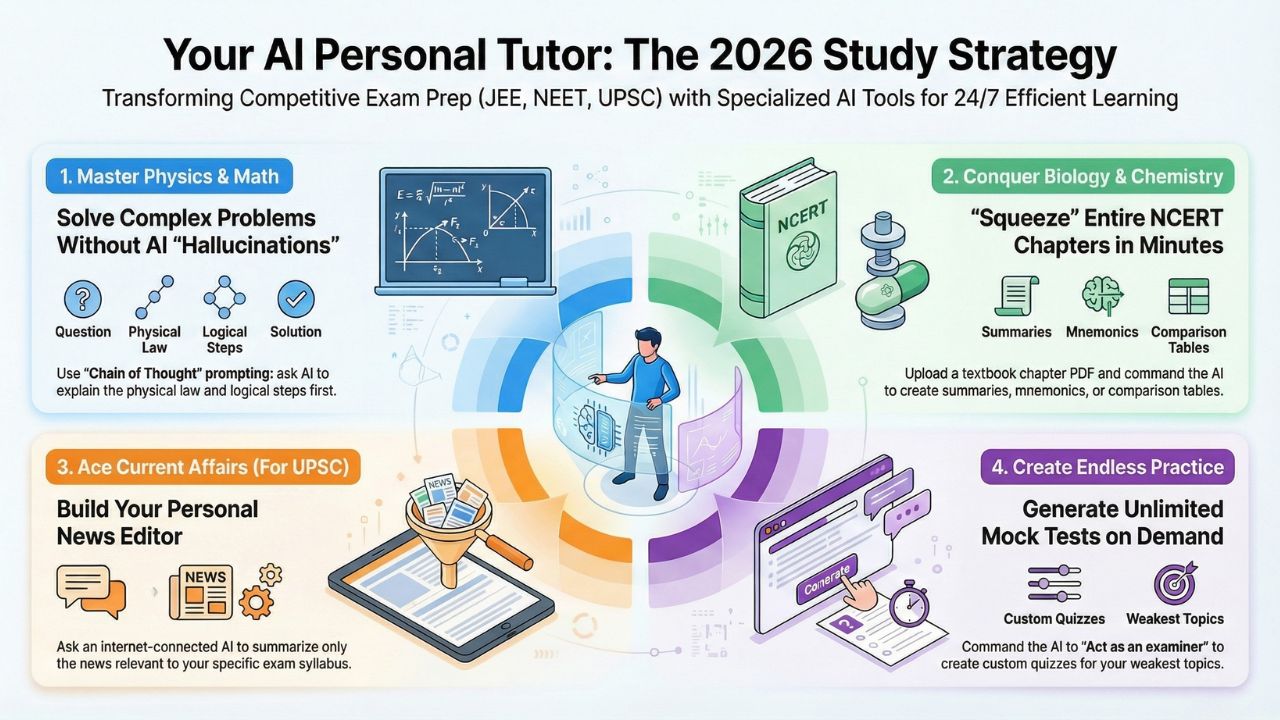
- Context is king: Use models with large memory (like Gemini) to digest entire NCERT chapters, creating instant comparative tables and mnemonics.
- Dynamic testing: Build your own customized mock test generators that adapt to your weakest topics dynamically, saving thousands on coaching materials.
- Current Affairs automation: Use connected AI agents to filter daily news noise, extracting only UPSC-relevant data mapped directly to GS papers.
How to Use AI Agents as Your Personal Tutor for JEE, NEET & UPSC
In 2026, grinding through 14-hour study days is no longer the sole metric determining rank list dominance. The highest percentiles emerging from coaching hubs in Kota, Delhi, and Hyderabad share a common trait: they aren't just working hard; they are operating alongside "Agents."
Imagine having access to a private tutor who instantly recalls every line of HC Verma, can summarize the entire Biology NCERT syllabus in comparative tables, and generates fresh, highly customized mock tests for you at 2:00 AM. That tutor exists today, requires zero hourly fees, and is accessible directly from your smartphone.
Whether you are battling the friction of Rotational Mechanics or drowning in the endless ocean of UPSC current affairs, mastering these tools is non-negotiable. To understand the broader landscape of how artificial intelligence is reshaping the Indian education system, review our comprehensive AI tools and career guide for Indian students.
Explore Indian Student Guide AI Tools & Career Hub
1. Prompting for Physics & Maths: Achieving Zero Hallucinations
The primary anxiety students harbor toward AI is the risk of "hallucinations"—the phenomenon where the model confidently provides a mathematically incorrect answer. This friction occurs when students treat Large Language Models (LLMs) like traditional calculators. LLMs are built on probabilistic language generation, not deterministic arithmetic.
When utilizing AI for JEE advanced physics, do not simply copy-paste a complex numerical question and demand the final digit. To extract the correct derivation and conceptual logic without arithmetic errors, you must enforce a technique known as "Chain of Thought" (CoT) prompting.
The Strategy: Command the AI to solve the problem sequentially, forcing it to articulate the governing physical laws and logical deductions before attempting any arithmetic calculation. For students looking to stretch their budget across these premium models, explore the best free AI tools for studentsavailable right now.
The 2026 Physics Exam Prompt
Execute this sequence in Gemini or ChatGPT to securely resolve Physics doubts:
"Act as a strict, top-tier JEE Advanced Physics professor. I will provide a multi-concept problem on [Insert Topic, e.g., Electromagnetism combined with Kinematics].
1. Identify the fundamental physical principles required (e.g., Lorentz Force, Conservation of Energy).
2. Break the solution down into distinct, logical steps without performing calculations yet.
3. Explain the 'why' behind each formula selection.
4. Finally, execute the calculation. If there is a common conceptual trap or sign-convention error students typically make here, explicitly warn me about it."
This architectural approach transforms a basic text generator into a sophisticated, doubt solving AI bot free of cost that fundamentally teaches the underlying concept rather than merely spoofing an answer.
2. The "NCERT Squeezer": Compressing Biology & Chemistry
For NEET and UPSC aspirants, the NCERT textbook remains the ultimate source of truth. However, passively reading the same dense paragraphs repeatedly yields diminishing returns on retention.
In 2026, frontier AI models boast massive context windows—meaning they possess a vast short-term memory capable of digesting entire books simultaneously. You can now securely upload complete NCERT PDF chapters directly into tools like Gemini Advanced or Claude. This functionality unlocks the ultimate strategy regarding ChatGPT prompts for NEET biology.
How to "Squeeze" the Textbook: Instead of highlighting text passively, compel the AI agent to organize, contrast, and quiz you on the granular details buried within the chapter.
- Step 1: Upload your digital PDF of "Plant Kingdom" or "Biomolecules."
- Step 2: Deploy this extraction prompt: "Analyze this uploaded chapter thoroughly. Extract every single specific example of Algae mentioned in the text. Create an easy-to-remember mnemonic for these examples. Next, generate a comparative markdown table detailing their distinct characteristics (pigments, stored food, cell wall composition) exactly as presented in this document."
You have just condensed hours of manual note-taking into a two-minute automated operation. Furthermore, if you are more comfortable learning in your mother tongue, modern vernacular AI tools available in Hindi and Hinglishcan execute these exact summaries seamlessly in your preferred language.
3. Current Affairs & Mains Evaluator: Your Personal Editor
For UPSC aspirants, navigating the daily influx of editorial news represents a massive time drain. You do not need to consume every article; you must isolate the arguments relevant to the specific General Studies (GS) syllabus.
You can architect a custom "News Agent" using AI for UPSC current affairs 2026. By leveraging internet-connected platforms (such as Perplexity AI or Microsoft Copilot), you can bypass SEO clutter and extract pure signal.
The Strategy: Never ask the generic question, "What is the news today?"
The Prompt: "Scan today's editorials from The Hindu and The Indian Express. Summarize the top three articles strictly relevant to UPSC GS Paper 3 (Economy & Environment). Format the output by highlighting the core problem, bullet-pointing the author's primary arguments, and concluding with a structured 'Way Forward' suitable for a Mains answer."
Evaluating Mains Answers
Writing practice is futile without feedback. You can train an LLM to evaluate your subjective answers. Provide the AI with the official UPSC evaluation criteria (structure, content, presentation), paste your written essay, and prompt: "Evaluate this answer based on standard UPSC Mains rubrics. Assign a score out of 10, highlight missing keywords, and suggest structural improvements." For deeper dives into structuring complex academic queries, review the top AI tools for academic researchused by post-graduates.
4. Building a Custom Mock Test Generator
The best AI app for competitive exams in India is not a standalone application; it is the strategic application of the foundation models you already possess. One of the highest-leverage workflows is creating dynamic mock tests to verify your knowledge.
If diagnostic analysis reveals a weakness in a specific domain—for instance, "Organic Chemistry Named Reactions"—you no longer need to purchase supplemental question banks. You can command the AI to generate a targeted drill.
The Mock Test Generation Prompt
Deploy this framework to simulate intense exam pressure safely:
"Act as a highly critical NTA Examiner for NEET. Generate an immediate 15-question quiz on 'Aldehydes and Ketones'.
- Include 5 standard MCQs.
- Include 5 Assertion-Reasoning questions.
- Include 5 Match-the-column questions.
- Calibrate the difficulty to the upper 10% of past NEET papers.
- CRITICAL INSTRUCTION: Do NOT provide the answer key yet. Wait for me to submit my answers, then evaluate my score with a strict +4/-1 marking scheme and explain my errors."
Conclusion: Orchestration Over Memorization
The core syllabus dictating competitive exams remains static, but the methodology of the competition has irrevocably shifted. By implementing these agentic workflows, you are not taking shortcuts; you are engaging in systems optimization. You are aggressively reclaiming hours previously lost to manual note-taking and routing that energy into active recall, conceptual understanding, and problem-solving execution.
Begin integrating these specific prompts into your daily study cycles immediately. As you transition from clearing exams to entering the professional workforce, understanding how to command these systems will be just as crucial; you can preview this shift by exploring the AI career roadmapoutlining the future of Indian engineering.
Frequently Asked Questions (FAQ)
Yes, but strictly for concept clearing and step-by-step logical breakdown. Do not rely on it blindly for complex calculation-heavy answers without verification, as LLMs can still commit arithmetic errors. Implementing "Chain of Thought" prompting forces the AI to explain its logic, drastically reducing the risk of hallucinations.
There is no single "best" application, but rather a preferred stack. Google Gemini is exceptional for its massive context window (ideal for uploading dense PDFs). Perplexity AI is the definitive tool for real-time citations and current affairs tracking. Both function as a highly capable doubt solving AI bot free of charge for their core features.
Absolutely. You can prompt ChatGPT or Gemini to adopt an examiner persona and generate unlimited, highly specific quizzes on any topic. You can mandate formats tailored exactly to your examination structure, such as MCQs, Assertion-Reasoning, or Match-the-following.
Focus on AI agents equipped with live web-browsing capabilities. Perplexity AI and Microsoft Copilot currently lead this sector, as they can bypass search engine clutter, read today's editorials, and summarize events based specifically on the UPSC General Studies framework.