Why Your Function-Calling Architecture Is About to Become Legacy Code
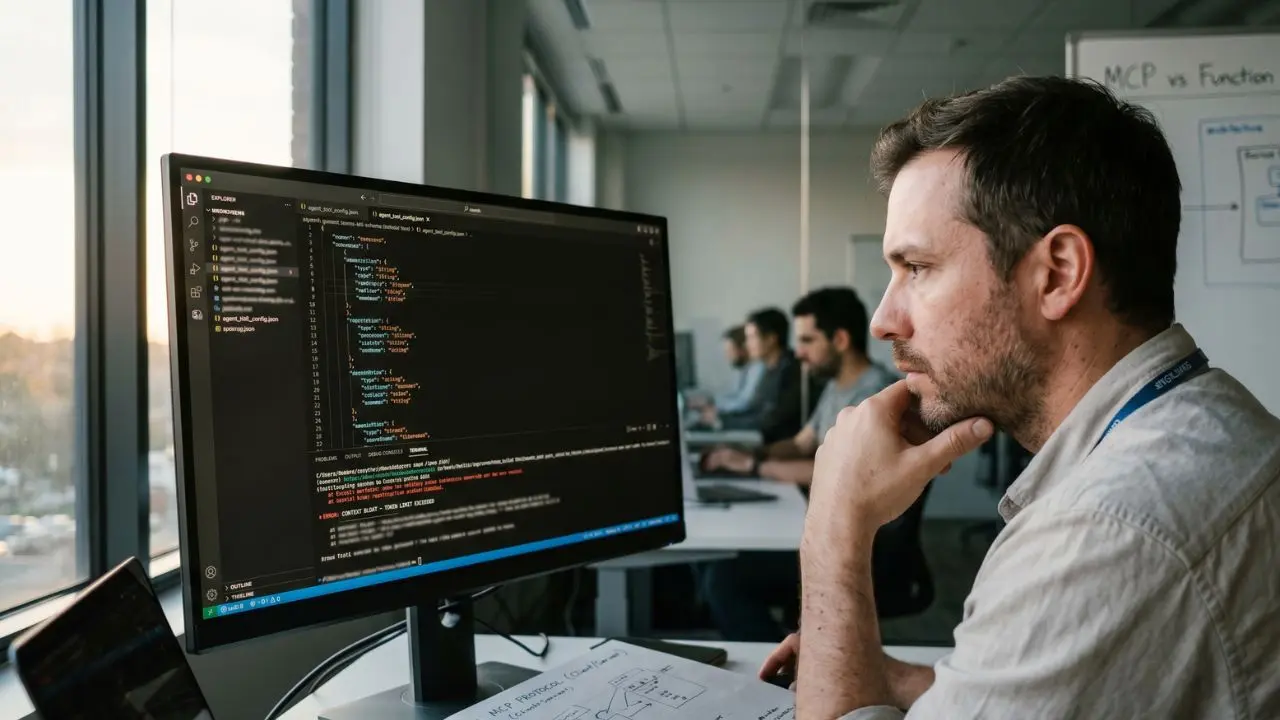
- The 50-Tool Cliff Edge: Function calling reliably degrades and breaks when agents are forced to manage more than 50 inline tools.
- Architectural Paradigm Shift: The fundamental difference lies in moving from static, inline JSON schema definitions to a dynamic mcp client server model.
- Eradicating Context Bloat: MCP stops the wasteful practice of injecting massive tool schemas into every single LLM context window.
- Solving Name Collisions: The protocol naturally resolves the critical 'tool name collision' problem that plagues multi-agent function-calling setups.
MCP vs function calling is not 'similar tech with different names.' One scales to 1,000 tools per agent; the other breaks past 50.
If your engineering team is still hardcoding inline tool definitions into your prompts, you are rapidly approaching a massive operational cliff edge.
Before diving into the architectural autopsy of traditional function calling, ensure you understand the broader enterprise ecosystem shift detailed in our comprehensive MCP server guide 2026 (Model Context Protocol).
The reality is that technical debt in agentic systems compounds exponentially. As we've seen when evaluating how to structure scalable AI product architectures, relying on outdated integration patterns destroys ROI.
We are moving from a world of stateless scripts to stateful, dynamic tool discovery.
The Fundamental Architectural Difference
The core problem with OpenAI-style function calling is how it handles state and discovery. It forces the agent to carry the entire cognitive load of the system.
Every time you prompt the agent, you must pass the JSON schema for every single tool it might need. This is the function calling limitations agents face daily.
The mcp protocol architecture changes this completely. It introduces a persistent client-server relationship where the agent queries the server for available tools dynamically.
By operating this way, the AI client only loads what is strictly necessary for the current context.
The Agent Tool Scaling Problem
At what point does traditional function calling fail? Enterprise data shows a hard ceiling.
Once an agent reaches roughly 50 tools, the inline definitions consume too much of the context window.
This leads to severe "context bloat" and degraded model reasoning. The model becomes confused by massive arrays of JSON properties.
It starts hallucinating parameters, mixing up tool intents, or simply timing out. If your roadmap requires hundreds of enterprise integrations, function calling is a dead end.
The MCP Client-Server Model
Why does MCP use a client-server model instead of inline tool definitions? The answer is decoupling.
By extracting tools into an independent MCP server, your backend engineers can update, deprecate, and secure tools without ever touching the agent's core prompt structure.
Key benefits of this model include:
- Dynamic Discovery: Agents interrogate the server to learn what tools are currently available.
- Namespace Isolation: It directly solves the 'tool name collision' problem that breaks complex function-calling agents.
- State Management: The server maintains session state, freeing the LLM from tracking complex multi-step transaction IDs.
Enterprise Security: Moving Beyond Basic Function Calling
Basic function calling offers zero native security guarantees. It relies entirely on your application's middleware to intercept and validate the LLM's raw output.
What enterprise security guarantees does MCP provide that function calling does not? Strict, protocol-level boundaries.
Because MCP operates over structured transports (like HTTP/SSE), you can implement robust authorization flows before the agent even sees a tool.
If you are handling sensitive data, you must review our dedicated mcp server authentication oauth security guide to ensure you aren't leaking tokens.
Create Pro-Quality AI Videos in Minutes. Try HeyGen
We may earn a commission if you buy through this link. (This does not increase the price for you)
Frequently Asked Questions (FAQ)
Function calling requires injecting static JSON tool schemas directly into the LLM's prompt for every request. MCP uses a persistent client-server model where tools, resources, and prompts are discovered dynamically via a standardized protocol, decoupling the agent from the backend implementation.
Function calling typically starts to break past 50 tools. At this threshold, the massive JSON schemas cause severe context bloat, leading to degraded model reasoning, parameter hallucinations, and increased latency as the model struggles to parse the vast array of options.
A client-server model allows for dynamic tool discovery, strict security boundaries, and independent scaling. It prevents context bloat by allowing the agent to query only the tools it needs, rather than loading every possible tool definition into every single prompt.
You can use both simultaneously during a migration phase. Many enterprise architectures temporarily run custom MCP clients alongside legacy inline function calling. However, maintaining both creates significant technical debt and negates the primary context-saving benefits of full MCP adoption.
No, MCP is often faster in production. While there is minor protocol overhead, MCP's use of persistent HTTP/SSE connections and drastic reduction in context bloat (by not sending massive schemas every time) results in lower overall token processing time and faster agent responses.
Anthropic natively supports MCP across its Claude ecosystem, as they are the original creators of the protocol. Other major model providers currently require lightweight translation shims to map their proprietary tool-calling formats to the standardized MCP specification.
Migration involves three steps: First, extract your inline Python/Node.js functions into an independent MCP server. Second, implement an MCP client in your application layer. Third, replace the static OpenAI tool arrays in your API calls with dynamic context fetched from the MCP server.
Yes, MCP solves the tool name collision problem. Because MCP servers operate as isolated namespaces, you can connect multiple servers offering tools with identical names (e.g., search_database) without confusing the agent, as the protocol manages routing based on server identity.
MCP provides strict, transport-layer security boundaries. Unlike function calling, which relies on application-level logic to validate raw LLM output, MCP supports standardized OAuth 2.1 flows, scoped resource access, and dynamic client registration directly within the protocol architecture.
While OpenAI's Responses API offers advanced capabilities, it remains a proprietary, vendor-specific implementation. MCP is an open-source standard stewarded by the Linux Foundation. The industry consensus is that proprietary APIs will likely converge to support MCP as the universal integration layer.