The MCP Server Stack: Why 78% of Enterprises Switched in 16 Months
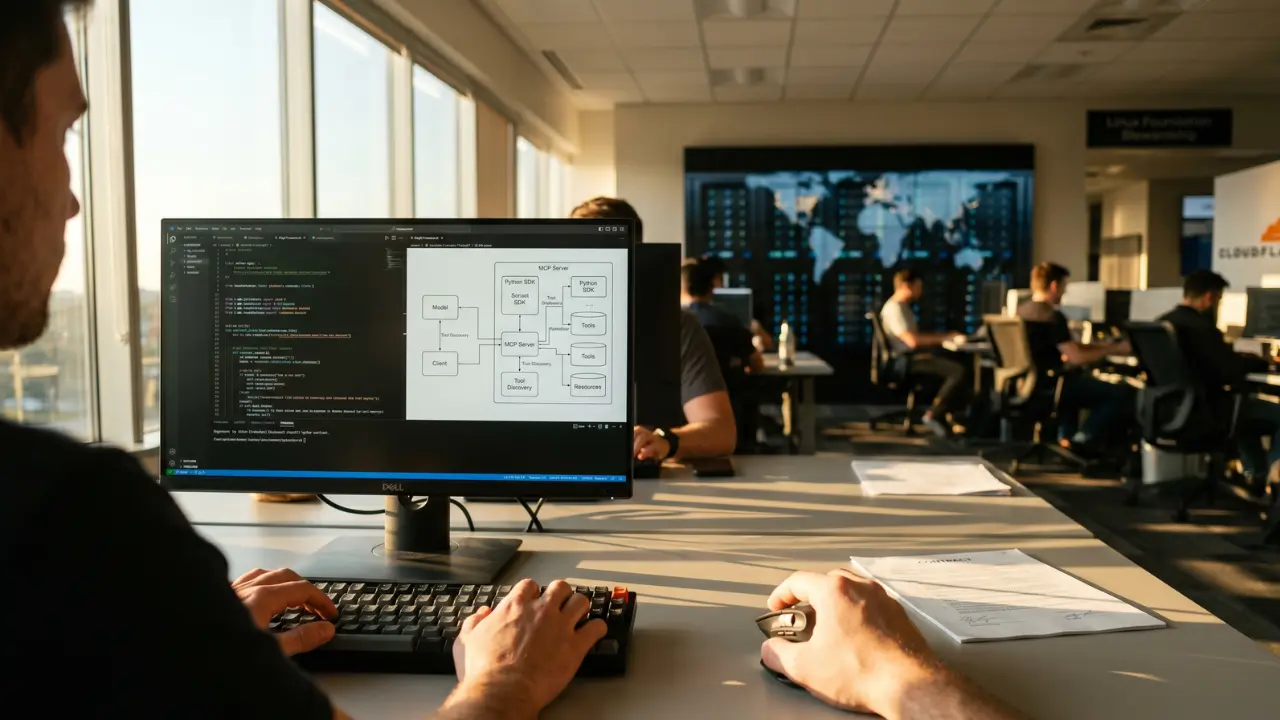
- Standardization: Anthropic officially donated MCP to the Linux Foundation in December 2025.
- Scalability Limits: MCP directly solves the context bloat crisis that breaks legacy agents trying to use over 50 tools.
- Ecosystem Growth: Enterprise adoption exploded, with over 9,400 public MCP servers active by early 2026.
- Evolution: The SEP-1865 spec advances MCP beyond simple data retrieval, enabling agents to stream native UI components.
Enterprise agent architectures are failing as they scale past experimental phases.
Maintaining custom REST wrappers and massive inline tool definitions creates brittle systems. These systems break entirely once an agent attempts to manage more than a few dozen tools.
The Model Context Protocol (MCP) solves this abstraction crisis. It provides a standardized, highly scalable client-server architecture that future-proofs your AI infrastructure.
Executive Summary: The MCP Advantage
To understand why MCP crossed Kubernetes-equivalent adoption in 16 months, leaders must recognize its foundational shifts.
Standardization: Anthropic donated MCP to the Linux Foundation in December 2025.
Scalability: It solves the critical limit where agents break when using more than 50 tools.
Ecosystem Growth: Over 9,400 public MCP servers are deployed publicly as of Q1 2026.
UI Extensibility: The MCP Apps SEP-1865 specification brings native UI rendering to AI agents.
The Open Standard: Anthropic, Linux Foundation, and Agentic AI Foundation
The transition to MCP was accelerated by a crucial governance decision.
Anthropic donated it to the Linux Foundation in December 2025. This move fundamentally changed the protocol from a vendor-specific experiment to an industry-wide open standard.
By operating under the Agentic AI Foundation, official co-stewards have guaranteed that MCP will not be replaced by a vendor-specific protocol.
Enterprises can now build heavily against the MCP specification without fear of vendor lock-in. This governance model is precisely why 78% of enterprise engineering teams adopted MCP within 16 months of release.
The industry required a unified contract between models and data sources. The Agentic AI Foundation provided the trust layer to mandate that switch.
Expert Insight: Compliance Note
When adopting new protocols, enterprise architecture boards demand vendor neutrality. The Linux Foundation backing ensures your MCP investments are insulated against platform shifts in the base LLM layer.
MCP vs. Function Calling: Surviving the 50-Tool Breaking Point
Many engineering leaders mistakenly view MCP as a mere rebrand of existing tool-use paradigms. This is a critical error.
There is a fundamental mcp vs function calling difference enterprise architecture teams must understand. Traditional function calling injects tool definitions directly into the LLM prompt.
As tool counts rise, this causes severe context bloat. This context bloat breaks agents using more than 50 tools, destroying the model's reasoning capabilities and spiking token costs.
MCP uses a client-server model instead of inline tool definitions. The AI client connects to an MCP server, which dynamically exposes tools, resources, and prompts only when contextually relevant.
Can they coexist? Yes, you do not immediately need to migrate your existing function-calling architecture to MCP, and they can coexist during a transition phase.
However, scaling past these limitations and accessing massive mcp code execution mode token savings requires a full cutover.
The 9-Layer Enterprise Reference Architecture in 2026
When engineering teams ask what a complete enterprise MCP reference architecture looks like in 2026, the answer is a rigorous 9-layer enterprise reference map.
Your A2A (Agent-to-Agent) stack is now the wrong abstraction for direct tool execution.
A2A protocols govern how agents negotiate and collaborate. MCP governs how those agents access data and tools.
The reference map dictates strict boundaries. To execute this architecture properly, developers must build robust implementations.
For teams starting this migration, learning how to build a production MCP server in Python tutorial flows is the foundational first step. Teams looking to move quickly should also investigate how to deploy remote mcp server cloudflare solutions.
Authentication and the OAuth Crisis
The most vulnerable layer of this architecture is authentication. Exposing internal databases to an AI model requires zero-trust principles.
Unfortunately, standard implementations often fall short. Enterprise teams must rely on a rigorous mcp server authentication oauth security guide.
Without proper PKCE implementation and token scoping, dynamic client registration can become an attack vector.
Your reference architecture must enforce that no agent accesses an MCP server without granular, user-delegated OAuth 2.1 permissions.
The Evolution: SEP-1865 and MCP Apps
The protocol is rapidly advancing beyond backend data retrieval. The MCP Apps SEP-1865 specification adds capabilities that the original MCP did not have.
Specifically, SEP-1865 allows MCP servers to push UI components directly to the AI client.
Instead of returning raw JSON for the AI to interpret, the MCP server can render custom, interactive interfaces inside the host application.
This fundamentally shifts MCP from an integration pipeline to a comprehensive application delivery platform.
Expert Insight: PMO Warning
Do not let product managers invest heavily in custom frontend dashboards for AI agents. SEP-1865 means your backend tools can now ship their own micro-frontends directly into the user's chat interface.
Production Realities: The Q1 2026 Landscape
The sheer volume of adoption validates the standard. As of Q1 2026, there are thousands of production deployments.
Specifically, public directories track over 9,400 public MCP servers.
However, enterprise teams rarely connect directly to the public registry. Instead, they fork the architecture to build an mcp server registry directory enterprise network.
These private MCP registries ensure compliance teams can audit every tool before an agent invokes it.
If you're balancing the build vs. buy equation, evaluating mcp server cost vs custom integration roi clarifies the business case instantly. The transition is over. MCP is the definitive orchestration layer for enterprise AI.
Create Pro-Quality AI Videos in Minutes. Try HeyGen
We may earn a commission if you buy through this link. (This does not increase the price for you)
Frequently Asked Questions (FAQ)
MCP is an open standard establishing a unified client-server architecture for AI tools. Anthropic donated it to the Linux Foundation in December 2025 to ensure it became a vendor-neutral, long-term standard under the Agentic AI Foundation, rather than a proprietary protocol.
MCP connects AI models to data sources and tools via a structured client-server model. A2A protocols manage dialogue and negotiation between multiple autonomous agents. Use MCP to give a single agent capabilities, and A2A to let multiple agents collaborate on a workflow.
78% of enterprise engineering teams adopted MCP within 16 months because it solved the immediate scaling limits of legacy architectures. It crossed Kubernetes-equivalent adoption rapidly by standardizing tool integration and eliminating the need for custom, brittle API wrappers.
The MCP Apps SEP-1865 specification allows MCP servers to ship their own UI components directly into host AI clients. This evolution goes beyond standard backend tools, bringing interactive front-end rendering directly into the protocol's capabilities.
Anthropic serves as a primary steward following its foundational donation. Under the Agentic AI Foundation, a coalition of leading enterprise technology companies and AI providers co-steward the protocol to guarantee a secure, vendor-neutral ecosystem for all developers.
As of Q1 2026, there are over 9,400 production MCP servers deployed publicly. This massive directory underscores the rapid adoption of the standard, although enterprise teams often rely on private registries for stringent security and compliance management.
MCP is explicitly designed as a permanent, long-term standard. By donating the protocol to the Linux Foundation and operating under the Agentic AI Foundation, the creators ensured it avoids vendor lock-in, making it the definitive open standard for AI orchestration.
Context bloat occurs when injecting too many inline tool definitions into an LLM's prompt window. Traditional methods break agents using more than 50 tools because the model loses reasoning capability and token costs soar. MCP mitigates this via dynamic resolution.
They can comfortably coexist during an initial transitional phase. However, enterprise teams typically migrate fully to MCP to leverage its robust client-server model, unified security boundaries, and its unique ability to bypass the severe scaling limitations of legacy function-calling systems.
The 2026 enterprise MCP reference architecture features a comprehensive 9-layer enterprise reference map. It strictly mandates remote server hosting, rigorous OAuth 2.1 implementation, private enterprise registries for secure discovery, and distinct network boundaries between AI clients and internal resources.