The Open Web is Dying: Why 30% of Ad Budgets Are Moving to AI & CTV
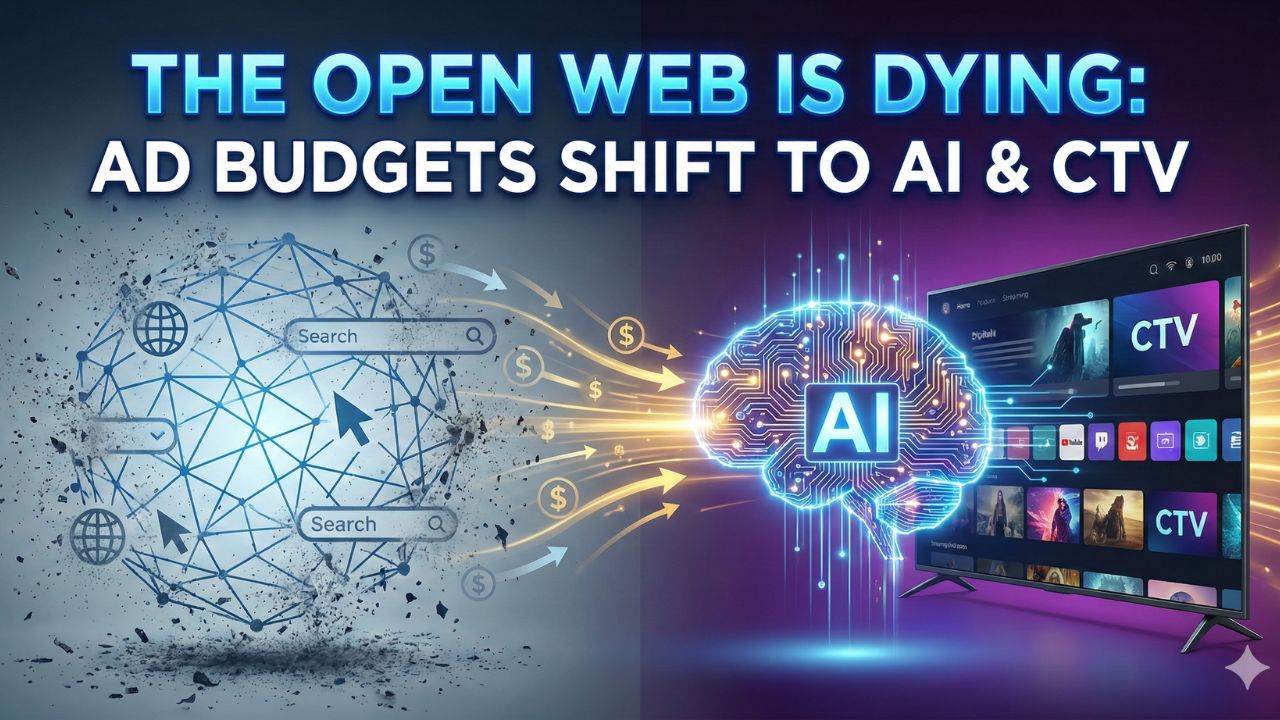
- The Zero-Click Crisis: Why the "traffic firehose" from search engines has officially dried up in late 2025.
- Follow the Money: Ad budgets are fleeing to Connected TV (CTV) and Retail Media Networks (RMNs) where AI cannot block them.
- New Tactics: How to pivot from SEO to GEO (Generative Engine Optimization) and use AI tools like Tripo and Udio to compete.
For 15 years, the digital marketing playbook was stable: create content, rank on search engines, and monetize via display ads. In late 2025, that era officially ended. With the rise of "Zero-Click" AI Search (Gemini, ChatGPT), the "traffic firehose" to publishers is drying up.
This comprehensive guide analyzes the post-web marketing transformation.
We explore why Forrester predicts a 30% cut in open web display budgets by 2026 and map out exactly where that money is going: the high-attention world of Connected TV (CTV) and the high-intent world of Retail Media Networks.
Part 1: The End of an Era (2010–2025)
The "Golden Age" of the Open Web
For over a decade, the internet operated on a tacit agreement: the publisher subsidy.
- Users searched for answers on Google.
- Google sent traffic to websites (Publishers).
- Publishers monetized that traffic with Display Ads (AdSense).
This ecosystem supported millions of businesses. If you could rank for "best running shoes," you owned a valuable piece of digital real estate. But this model relied entirely on one metric: the click.
The "Zero-Click" Crisis of November 2025
The cracks in the foundation started appearing in 2024 with the launch of AI Overviews, but late 2025 marked the collapse.
The Shift: Search engines evolved into "Answer Engines." Gemini 3 and ChatGPT Search now provide direct answers—complex travel itineraries, coding solutions, and product comparisons—without the user ever visiting a website.
The Impact: In November 2025, major publisher networks reported a sharp, structural decline in AdSense revenue. It wasn't just a bad quarter; the traffic simply wasn't there anymore.
The Data: Reports indicate that up to 60% of searches now end without a click.
Strategic Insight: If your 2026 marketing strategy relies on SEO traffic driving display ad revenue or affiliate clicks, you are optimizing for a dying channel.
Part 2: The Great Migration (Where the Money is Going)
Money doesn't disappear; it relocates. As brands slash their "Open Web" display budgets (projected to drop 30% by 2026), they are pouring that capital into two fortified bunkers where AI cannot block them.
1. Connected TV (CTV): The New "Mass Media"
Budgets are fleeing to CTV not just for reach, but for attention. Unlike a banner ad on a sidebar that is ignored or blocked, a 15-second spot on a Smart TV demands focus.
The Projection: CTV ad spend is forecast to hit $48 Billion in 2025. The advantage is that it combines the prestige of television with the targeting precision of digital. You aren't "renting eyeballs" on a blog; you are owning the living room.
2. Retail Media: The "Walled Gardens"
Retail Media Networks (ads on Amazon, Walmart, Marriott, Instacart) are the fastest-growing ad channel in history.
The Logic: Why guess if a user is interested in shoes based on their browsing history (Open Web cookies), when you can advertise directly on the search results page of a shoe store?
The Growth: Retail Media is projected to grow 3x faster than traditional search ads in 2026 because it offers "Closed-Loop Attribution." The platform owns the checkout, so the ROI is undeniable.
Part 3: The Tactical Response (Your New Playbook)
Understanding the shift is step one. Executing on it requires new tools and strategies. We have broken down the tactical responses into specific deep-dive guides for your team.
A. The Creative Shift: 3D Assets for Retail Media
As budgets move to Retail Media (Amazon/Walmart), the "Digital Shelf" becomes the new battleground. Static JPEGs are no longer enough to convert customers.
The Challenge: Creating 3D spins and AR assets for thousands of SKUs is traditionally slow and expensive.
The Solution: New AI tools like Tripo AI and Meshy are automating this process. We tested the top contenders to see which one creates "Shopify-Ready" assets faster.
Read the Full Review: Tripo Prism vs. Meshy-6 – The Battle for E-Commerce 3D Assets →
B. The Legal Shift: Brand-Safe AI Audio
CTV ads require high-quality video and audio. For years, using AI-generated music was a legal minefield for brands due to copyright concerns.
The Update: In November 2025, a historic deal between Udio and Warner Music Group changed the landscape. Marketers can now use generative music tools to create custom, royalty-free soundtracks that are legally indemnified.
Read the Analysis: The Udio & Warner Music Deal – Is AI Music Finally Safe for Brands? →
Part 4: The Future of Search (GEO)
You cannot abandon search entirely, but you must change how you rank. The era of SEO (Search Engine Optimization) is yielding to GEO (Generative Engine Optimization).
The New Rules of GEO
- Old Goal: Rank #1 for a specific keyword to get a click.
- New Goal: Be the cited authority that the AI uses to construct its answer.
- Strategy: Move away from "fluff" content designed to keep users on a page. Focus on "Data Density"—structured facts, unique insights, and primary research that LLMs prefer to cite.
Read the Full Guide: SEO vs. GEO – How to Rank in the Era of AI Search →
Adapt or Vanish
The "Open Web" provided a decade of cheap, easy reach. That subsidy is gone. The marketers who survive 2026 will be the ones who stop chasing declining web traffic and start building assets for the platforms where attention actually lives: AI Interfaces, Connected TV, and Retail Stores.
Frequently Asked Questions (FAQ)
It is affecting both, but informational traffic is hit hardest. Queries that have a simple, factual answer (e.g., "best time to visit Japan" or "how to tie a tie") are now answered directly by AI Overviews, resulting in a 40-60% drop in clicks for those pages. However, high-intent traffic is migrating to Retail Media networks (Amazon/Walmart), bypassing Google entirely.
SEO (Search Engine Optimization): Focuses on ranking a webpage in a list of blue links. It prioritizes keywords, backlinks, and technical site health. GEO (Generative Engine Optimization): Focuses on convincing an AI (like Gemini or ChatGPT) to cite your brand as a source. It prioritizes "Data Density"—unique statistics, expert quotes, and structured facts that LLMs can easily parse and summarize.
No. One of the biggest advantages of CTV over traditional "Linear TV" is programmatic targeting. You can run ads with a modest budget ($5k-$10k) and target specific households based on purchase data (e.g., "Households that buy organic dog food"). This makes it accessible to mid-market challengers, not just Fortune 500s.
Yes. While "Endemic" ads (selling Tide on Amazon) are the biggest chunk, "Non-Endemic" advertising is exploding. For example, an auto insurance company can buy ads on a car parts retailer's site, or a travel agency can advertise on Marriott's media network. You are buying access to their high-intent audience data, even if you don't sell a product on their shelf.
It depends on the tool. Early tools were legally risky. However, the November 2025 deal between Udio and Warner Music Group created a framework for "licensed" generative music. Always check the terms of service: Enterprise plans from providers like Adobe Firefly, Getty, and now Udio/Warner specifically offer indemnification (legal protection) for commercial use. Avoid using "free tier" generators for paid ad campaigns.

Sources and References
This content hub is built on data, forecasts, and industry reports from late 2025. Below are the key sources that informed our analysis of the "Zero-Click" crisis and the shift to CTV/Retail Media.
1. The "Zero-Click" & Publisher Crisis
- AdSense Revenue Decline: Reports from Search Engine Land (Nov 2025) and user discussions on Webmaster World confirm a sharp drop in AdSense revenue for publishers, attributed to AI Overviews displacing traditional search clicks.
- Forrester Prediction: Forrester's Predictions 2026: B2C Marketing report forecasts a 30% reduction in open web display ad spend, citing the migration of audiences to closed ecosystems.
- McKinsey Analysis: "New front door to the internet" (Oct 2025) highlights that 50% of consumers already use AI-powered search, risking 20-50% of traditional search traffic. View Insights.
2. The Shift to CTV & Retail Media
- CTV Growth: eMarketer and The Media Ant project CTV ad spending to reach $48 billion by 2025, driven by programmatic adoption and high attention metrics.
- Retail Media Boom: WARC and Nielsen forecast global retail media investment to hit $174.9 billion in 2025, growing 3x faster than search. The key driver is "Closed-Loop Attribution" (connecting ads directly to sales).
- Non-Endemic Advertising: Reports from LiveIntent and Skai detail the rise of non-endemic brands (e.g., insurance, travel) buying inventory on retail networks like Marriott and Uber.
3. Generative AI & Legal Trends
- Udio & Warner Music Deal: Press releases from Warner Music Group (Nov 2025) confirm a licensing partnership with Udio, establishing a precedent for copyright-safe AI music generation.
- Generative Engine Optimization (GEO): Insights on GEO vs. SEO are synthesized from Search Engine Land, Backlinko, and First Page Sage, which define GEO as optimizing for "citation share" in LLM answers.
- Tripo AI Growth: Search trend data from Exploding Topics (Nov 2025) identifies Tripo AI as a breakout tool with +8400% growth, validating its relevance for 3D asset creation.